Paul Owens
During every school holiday bar the Christmas break, I run one-v-one football competitions close to my home in East Yorkshire. As the name suggests, the hugely popular ‘Hull and East Riding Goalie Wars’ tournaments are aimed primarily at budding keepers and are a fabulous way of bringing members of the region’s goalkeepers’ union together, which is something I am extremely proud of. Notwithstanding, the competitions are open to anyone who buys into our slogan: ‘Save theirs; Score yours; Have fun!’ A number of past winners have actually been outfielders, who decided to pull on the gloves to see what it felt like to spend a couple of hours between the sticks, and we have even had a couple of participants enjoy the experience so much that they’ve been permanently converted to the goalkeeping faith following our events. Job done!
Before top-flight clubs were permitted to name substitute goalkeepers on their benches at the start of the Premier League era, it was the responsibility of game outfielders to take over in goal following an injury to their team’s last line of defence, or their custodian receiving his marching orders. Below is a tribute to the nineteen brave individuals who took on the role of emergency stopper during their time at Everton Football Club. I am not sure any of them were up for doing it on a full-time basis, mind!
In October 1985, skipper Kevin Ratcliffe took over from Neville Southall after the Everton keeper was sent off at Stamford Bridge in a 1-2 defeat to Chelsea. Having already received a yellow card in the first half, for complaining about a penalty being awarded against him for pulling down Scotsman David Speedie, Southall came rushing out of his penalty area in the 63rd minute, and deliberately handled the ball to deny forward Kerry Dixon a goalscoring opportunity. The Welshman’s actions left referee Vic Callow with no option other than to send him off. Incensed by the decision, Southall threw down his shirt in disgust before making his way down the tunnel, though he received little sympathy from manager Howard Kendall, who told the Liverpool Echo: ‘The referee was 100 per cent right. Neville made two bad decisions and he knows he has let us down. But he has done a lot for us in the past and I am sure he will do a lot for us in the future.’ Captain Ratcliffe would later joke, ‘Neville was the best in the world, but of the three Wales internationals who played in goal at Stamford Bridge that day (Eddie Niedzwiecki was in goal for Chelsea), only one of us kept a clean sheet. Me!’

Almost a decade apart from each other, the colossal Mike Lyons made a couple of brief appearances between the Everton posts. In April 1973, after an injury to the luckless David Lawson, Lyons was subbed on and took over in goal for the last thirty minutes of the Blues’ 1-4 defeat at West Bromwich Albion. Beaten twice by Baggies forward David Shaw, the first just seconds after pulling on Lawson’s shirt, Lyons – primarily employed as a centre-half during his Everton career but often operating as an emergency forward – fared better at home to Manchester United towards the end of the 1981/82 campaign – though the following caveat does need to be inserted here: at Goodison Park, the Everton skipper took over from the injured Southall in the 90th minute, having earlier scored Everton’s second equaliser in an entertaining 3-3 draw with Ron Atkinson’s Red Devils. It would turn out to be the boyhood Blue’s final appearance for Everton at the Grand Old Lady as just over two months later, Lyons, who made 473 first-team appearances for the club over twelve seasons, was transferred to Sheffield Wednesday.

For the majority of the swinging sixties, Everton was home to two of the country’s most gifted goalkeepers: Gordon West, a 1962 signing from Blackpool for a then-record fee for a goalkeeper, who would go on to win an FA Cup, two league titles and three England caps during his time on Merseyside; and Andy Rankin, the club’s outstanding youth-team product, who was widely regarded as the finest back-up goalkeeper in England throughout that period. Utility player Alexander ‘Sandy’ Brown had the dubious honour of deputising for both of them – firstly switching positions with Rankin in Everton’s 1-1 draw with Stoke City in December 1964, when a nasty shoulder injury to the Everton goalkeeper meant he could no longer continue in goal (Rankin was employed on the wing for the majority of the second half that day as there were no substitutes back then), and then taking over from West for the final few minutes of a league game at St James’ Park in October 1967 after Everton’s temperamental gloves-man had received his marching orders that day.


In Dr David France and Becky Tallentire’s book, Gwladys Street’s Holy Trinity, West recounted the incident that saw Brown end up between the posts for the second time in his Everton career: ‘In those days it wasn’t uncommon for the nastier forwards to bad-mouth or spit at the keeper. So I learned to retaliate by throwing the ball out with a clenched fist and if they didn’t get out of my way then it was their own fault. Well, this day a fella called Burton [sic] happened to get on to the end of my fist and, shortly after he hit the deck, the referee directed me towards the showers. Sandy Brown, who would play anywhere for Everton, pulled on my green shirt and the first time that he touched the ball was to pick it out of the net from the penalty kick. I sulked most of the way home on the coach, until Sandy tried to console me by informing me that I’d ruined the game for him. I simply glared at him: “I don’t know what you are going on about. It was 0-0 when I came off!” I had expected Bally [Alan Ball] to have a go at me, not an unsung hero like Alexander Dewar Brown.’

Prior to the 1965/66 season, teams were not permitted to make any substitutions during a game, never mind bring on a goalkeeper. This resulted in many outfielders taking over in goal for short periods in matches, while the injured keepers got patched up before returning to the field of play. In April 1962, just seven games into his Everton career, Gordon West dislocated a finger punching away a cross in a 1-1 draw at Blackburn Rovers. With West off the field for five minutes midway through the second half, while the Blackburn club doctor put the big keeper’s finger back in place, wing-half Brian Harris took over in goal for the Blues. The home team’s doctor may well have regretted working so swiftly as Westy returned to his penalty area as good as new, pulling off a save late on from Northern Ireland international Lawther which earned his side a share of the spoils and was described by the Liverpool Echo’s Horace Yates as a stop which ‘bordered on the miraculous’. In the same report, Yates went on to question whether Everton’s stand-in stopper would have been capable of making such a save had his spell in goal been extended beyond the five minutes: ‘Had West not resumed, I believe Everton would have been beaten, for one diving save across goal demanded reach as well as anticipation. West had both. Whether deputy Brian Harris would, we can only guess.’


Fun-loving Harris, a league title winner in 1963 and an FA Cup winner three years later, never seemed to take life too seriously – with a heart-warming image from the FA Cup Final 3-2 victory over Sheffield Wednesday in 1966 being of the Bebington-born youth-team product trying on for size the helmet of the policeman who had lost his headpiece when rugby tackling pitch invader Eddie Cavanagh, the Evertonian who had run on to the pitch in celebration of the Blues’ equaliser that day.


Cyril Lello is another outfielder who had the briefest of spells guarding the Everton goal. When Irishman Jimmy O’Neill required treatment for cramp in the second half of the fourth-round victory over Nottingham Forest in 1953, the former Shrewsbury Town man stepped in…for a period of two minutes! A hugely important figure in Everton’s return to the top division in 1954, Lello departed the club after ten years – with former teammate and future Goodison manager Harry Catterick taking him to Rochdale for a fee of £750 in 1956. Lello loved his time on Merseyside, telling the Liverpool Echo in 1970: ‘I could not have picked a better team. The atmosphere among the players was terrific. I could sum it up as “one for all and all for one”.’


Having turned out on 497 occasions for the club, over a 24-year period, when goalkeepers received next to no protection from referees, it is somewhat surprising that legendary keeper Ted Sagar, affectionately known as ‘The Boss’, had to relinquish goalkeeping duties on only two occasions during his stellar Everton career. The first of those came on Boxing Day in 1935, in a 4-3 victory over Sheffield Wednesday, when winger Albert Geldard, the recipient of four England caps, took over in goal for the opening twelve minutes of the second half after Sagar suffered a nasty knee injury. Following spells both on the sidelines and then on the wing that day, Sagar returned to his usual position on fifty-seven minutes, pulling off a match-saving stop from Ellis Rimmer late on.
Despite being beaten in the first minute of his brief stint in goal, Geldard would later describe his guarding of the Everton goal as ‘the fulfilment of a lifelong ambition’. Moreover, in his biography, Life and Times of a Professional Footballer, the following wonderful conversation between Geldard and teammate Tommy White is detailed. The conversation took place just seconds after Everton’s stand-in stopper made a full-stretch save (and momentarily lost sight of the ball) in the game against Wednesday: ‘Where is it, Tommy?’ he asked. ‘Tha’s aw reight, it’s over bloody top,’ he replied. Albert could’ve hugged him.’

If Geldard was happy with his performance in goal that day, then it is fair to say that Sagar was pleased with his own showing on the left wing two years later, in a game against Leicester City, a game in which he had dislocated his shoulder in a collision with Joe Mercer and handed over goalkeeping duties to Robert ‘Bunny’ Bell towards the end of the first half. Having returned from the local hospital fifteen minutes into the second period, Sagar, still wearing his black goalkeeper shorts entered the field smoking a cigarette. He almost scored when his shot hit the side netting after the Leicester City keeper had saved magnificently from Douglas Trentham. Sagar recalled, ‘Sandy McLaren, the Leicester goalkeeper, said to me, “If you had scored, I would have reported you to the Goalkeepers’ Union!” I believe I acquitted myself quite well.’ As indeed had Bell, who kept a clean sheet in Everton’s 3-0 win over the Foxes that day.
Incredibly, two Christmases earlier, Bell had scored nine goals (and missed a penalty) for former club Tranmere Rovers in their 13-4 victory over Oldham Athletic. The prolific marksman signed for Everton four months later and was mainly used as cover for Dixie Dean during his time at Goodison. Little did he know back then that he would have ended up deputising for Ted Sagar too.

Before the emergence of Sagar as an Everton giant, Billy Coggins had done a marvellous job between the Everton posts and been a key figure in the club’s promotion back to the First Division in 1931. Indeed, his performances had been so impressive during that period that there was talk of him gaining international honours. However, that summer, in a cruel twist of fate, the Bristolian was laid low by appendicitis. He endured a difficult time of convalescence – unable to walk unaided for a long period of the close season and at one point, according to Liverpool full-back James Jackson, fearing for his life. Coggins’ demise opened the door for Sagar, who grabbed the opportunity with both hands – and though the former Bristol City keeper remained an Everton player for a further four years he made only three more appearances for the club. In the second of those, he had to be replaced by right-back Warney Cresswell just before half-time, after his leg gave way on him in a 2-3 loss to Sheffield Wednesday in 1933. Over a ten-year period, Cresswell, nicknamed the ‘prince of full backs’ and ‘the iceberg’ – the latter because of his cool demeanour in pressure situations, gave Everton excellent service, winning two First Division titles, a Second Division title and the FA Cup during his time on Merseyside. He also won seven England caps and was once the most expensive player in world football – following his £5,500 move from South Shields to Sunderland in 1922.

In the 1920s, tough-tackling left-back Jack O’Donnell deputised for a trio of Everton goalkeepers, with all three of his appearances between the posts for the Blues taking place in the Midlands. In September 1925, the Gateshead-born signing from Darlington took over from Alfie Harland, at West Bromwich Albion, and then Jack Kendall, at Birmingham City, after both keepers suffered nasty injuries. Three years later, in Everton’s title-winning season, O’Donnell, an ever-present that term, completed his hat-trick, when former England international Ted Taylor sustained a finger injury, which resulted in Taylor having to leave the pitch for a couple of minutes.
Despite him being an Everton regular, controversy surrounded O’Donnell throughout his time on Merseyside – and in August 1930 a board minute recorded that he ‘was suffering from a disease owing to his own misconduct’, possibly a sexually transmitted disease, which resulted in him being suspended for fourteen days. That summer, he was sold to Blackpool. After further disciplinary problems, his contract was terminated and he headed back to the northeast to sign for Hartlepool United.

Like O’Donnell, both Richard ‘Dickie’ Downs and David Raitt deputised for Ireland international Alfie Harland, whose four years on Merseyside were blighted by illness (appendicitis) and injuries. In his debut season, on Valentine’s Day 1923, Harland was knocked unconscious after taking a blow to the head when making a courageous diving save at Chelsea. Veteran full-back Downs, once capped by England during his time at Barnsley, took over in goal – but conceded two goals in the last ten minutes as Everton, down to nine men following injuries to both Harland and inside-left Billy Williams, lost 1-3 in the capital.

Towards the end of the following season, Harland was again knocked out, this time at St James’ Park, where, according to the Newcastle Daily Journal and North Star, the goalkeeper had put in an ‘outstanding’ display. Although he had to be taken from the field of play following the clash, with full-back Raitt, a 1922 signing from Dundee, taking over in goal in another 1-3 defeat, Harland returned between the posts in the second half. Having lost his place to Warney Cresswell, Scotsman Raitt moved to Blackburn Rovers at the end of the 1927/28 title-winning campaign. In total, he made 131 appearances for Everton.
The Everton keeper who had to be replaced by emergency stoppers on the most occasions is the outstanding Tom Fern, a key member of the 1914/15 title-winning side, who made 231 appearances for the club over a ten-year period. In five of those matches, he needed to receive treatment following his courageous actions, with outfielders Tom Fleetwood, Jack Page and Jock Maconacchie all replacing him between the Everton posts.

Fleetwood, who started out his Everton career as an inside forward, became a defensive stalwart and a massively influential player for the club in the interwar years – taking up the role of captain at the start of the 1919/20 campaign, when peace had been restored. On two occasions during the following season, he temporarily took over from Fern – in a 2-2 draw with Oldham Athletic at Goodison Park and in a 0-2 defeat at Sheffield United.


In the first season following the Great War, reserve right-back Jack Page had taken on the goalkeeping duties at Valley Parade after Fern came off with a knee injury with just seven minutes of the game with Bradford City remaining. Page’s appearance in the entertaining 3-3 draw was a rare run-out for the Liverpudlian, who made just ten competitive appearances for the club during his war-interrupted career.
In addition to replacing Fern between the posts in games played at both Burnley, in 1914, and Middlesbrough the following year, Scotsman Jock Maconacchie also took over from Billy Scott when Everton’s phenomenal Ireland international was badly injured in the catastrophic 0-3 FA Cup semi-final loss to Barnsley in 1910. With blood gushing from two of his fingers, Scott had to leave the pitch to have his hand bound up. According to the Birmingham Mail, Maconnachie, a left-back by trade, who would go on to win the 1915 league championship with the Blues, pulled off a great save to deny forward George Lillycrop. Desperate to play, Scott then returned to the field before having to come off again minutes from the end of the game, due to the wounds having reopened.

Half a decade earlier, both Jack Crelley and Walter Abbott had also deputised for Billy Scott, with Crelley conceding a late winner at Bramall Lane after Scott had been forced off with a thigh injury at half time. More interestingly, at home to Manchester City on Christmas Eve 1904, Crelley started the game in goal as another legendary glovesman, Leigh Richmond Roose – signed by the club after Scott injured his shoulder at Sheffield Wednesday the previous month in a 5-5 draw which saw Abbott replace the Irishman in goal for the last twenty minutes as Everton let a two-goal lead slip – had failed to arrive due to thick fog. Luckily for Everton, who started the game with ten men, the fit-again Scott was tracked down and entered the field around ten minutes into the game, keeping a clean sheet in a goalless draw.
It is fair to say that Walter Abbott and Jack Crelley fared far better as outfielders. Prior to taking over from Scott in the game at Hillsborough, Abbott, a £250 signing from Small Heath in 1899 and the recipient of an England cap in 1902, had netted just before the break to put the Blues 5-1 up. Renowned for his long-distance shooting, the left-half played a significant role in Everton’s FA Cup victory in 1906 – scoring against Liverpool in the semi-final with a goal that changed the flow of the game and set up a clash with Newcastle United at the Crystal Palace that April. During his eight years with Everton, full-back Crelley made over 127 appearances for the club, including one alongside Abbott in the aforementioned FA Cup Final win over Newcastle United.
Following the tragic passing of goalkeeper John ‘Jack’ Angus from typhoid fever in the summer of 1891, just months after Everton’s first title triumph, Richard ‘Dick’ Williams was signed on professional forms to compete with Scotsman David Jardine for the first-team goalkeeping spot. Williams holds the distinction of being the first Everton goalkeeper to save a penalty, having kept out Hughie Wilson’s effort in the Christmas Day fixture against Sunderland at Anfield in 1891. Two years later, in the 8-1 thrashing of Darwen, he became the first keeper to save a penalty at Goodison Park. He is the only custodian in the club’s history to save penalties at both stadia. Before the introduction of the penalty spot in 1902, the penalty kick could be taken from any point along a line 12 yards from goal and goalkeepers could charge up to six yards out of their goal (it was not until 1905 that keepers were required to remain on their goal line for penalty kicks).
In the last of his seventy appearances for the club, away at Sheffield United in a 2-4 defeat on Boxing Day 1894, Williams was unable to continue after sustaining an ankle injury in the 25th minute. Goalkeeping duties that day were subsequently shared between Bob Kelso and Alf Milward, with both men conceding two goals. Although Milward failed to excel between the posts for Everton, in his usual position, on the left wing, he formed an incredible partnership with inside-forward Edgar Chadwick and was a key figure in Everton bringing the 1891 league championship to Anfield. The game at Bramall Lane wasn’t Bob Kelso’s first rodeo between the uprights. Two seasons earlier, the rugged Scot, known for his no-nonsense approach to defending, had taken over from Jardine – Everton’s main keeper during the 1890/91 title-winning campaign – for the final three minutes of the Blues’ heavy loss to Aston Villa in September 1892.
In the eyes of many, you have to be absolutely crazy to be a goalkeeper – the risk of injury, the ridicule when things go wrong, the fact that you are separated from your teammates and out of the game for so long have fed into this idea that those playing in goal are a breed apart and all just that little bit bonkers. With that in mind, it feels appropriate to finish this piece with a paragraph on half-back Hope Robertson, who played a full game in goal for Everton against Newton Heath in October 1892, having deputised for David Jardine at Bolton Wanderers twelve months earlier – following yet another injury to Everton’s regular goalkeeper of that period.


It was his actions following another game against Bolton that are worthy of note here, mind. After a 4-1 defeat at Pike’s Lane, the first-team squad was instructed to attend a meeting called by the club’s directors. As Robertson had not played in the game, he took umbrage at being summoned to a dressing down and chose not to attend the meeting. Having received a letter from the secretary demanding an explanation, Robertson ‘liberated’ a crossbar from the stadium by way of protest and told the club, ‘If the directors want it back, they must send a man to remove it.’
Bonkers – the lot of them!
………………………………………………….
References
Corbett, J., The Everton Encyclopedia, deCourbetin, (2012)
France, D. and Tallentire, B., Gwladys Street’s Holy Trinity: Kendall, Harvey and Ball, Skript Publishing, (2001)
Johnson, S., Everton: The Official Complete Record 1878-2016, deCourbetin, (2016)
Ponting, I., Everton Player by Player, Hamlyn, (1992)
Sawyer, R., The Hope Robertson Chronicles, Amazon, (2022)
Wilson, B., You’ve Got to be Crazy: On Goalkeepers and Goalkeeping, Weidenfeld & Nicolson; First Edition, (1989)
Liverpool Courier
Liverpool Daily Post
Liverpool Echo
Liverpool Evening Express
Liverpool Mercury
Liverpool Post
……………………………………………
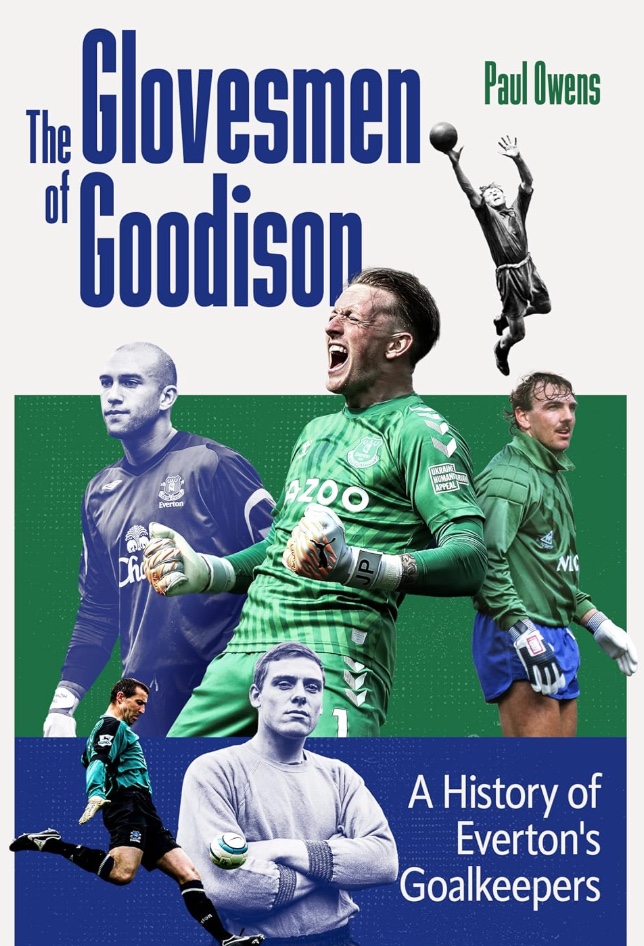
Paul Owens is the author of The Glovesmen of Goodison, on sale in all good bookshops and online (click image).
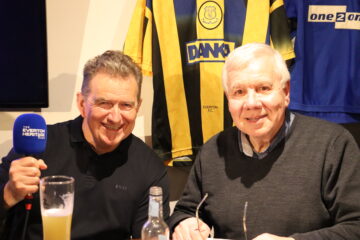
See Pauls’s appearance with goalkeeper coach Alan Kelly on our Everton Heritage Show;
………………………………………………………………………….