
Marking the centenary of the motorcycle accident which drove Dixie Dean to even greater heights
.
Jamie Yates
.
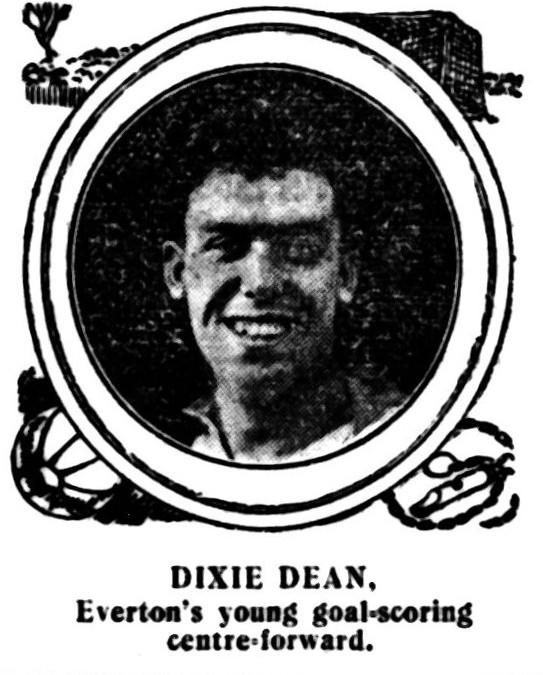
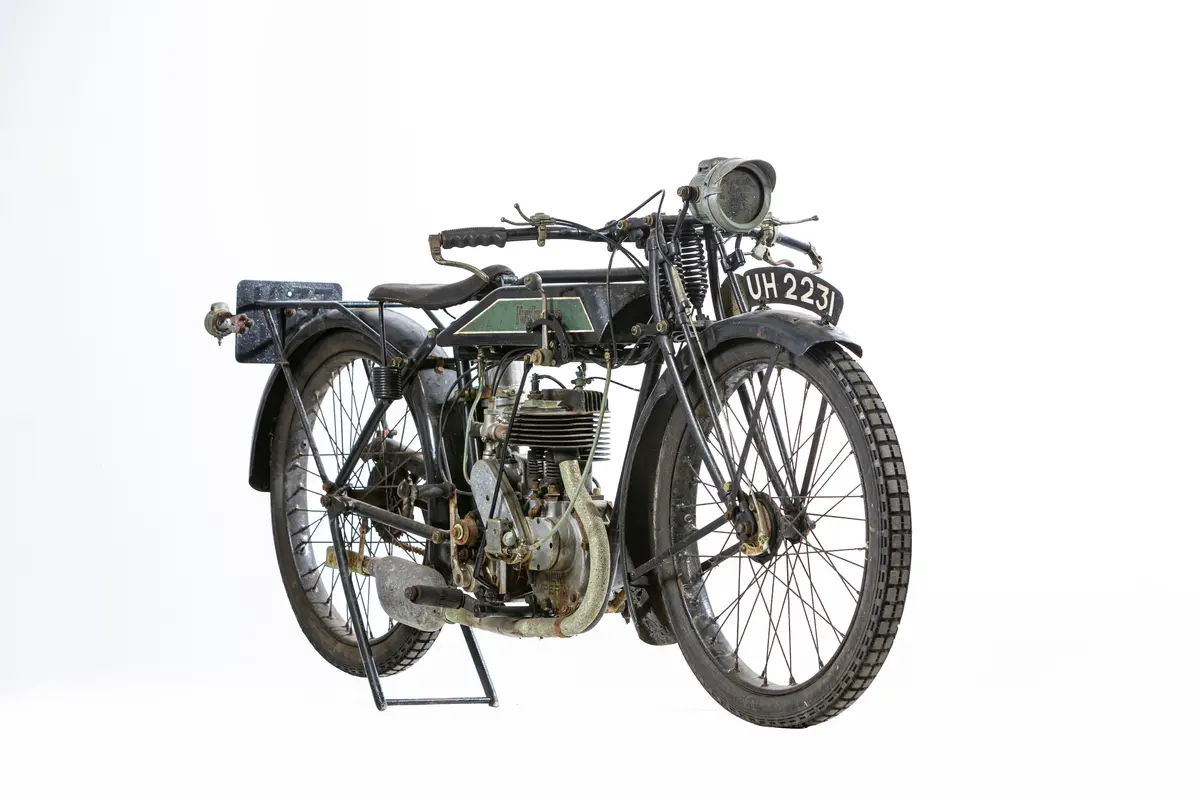
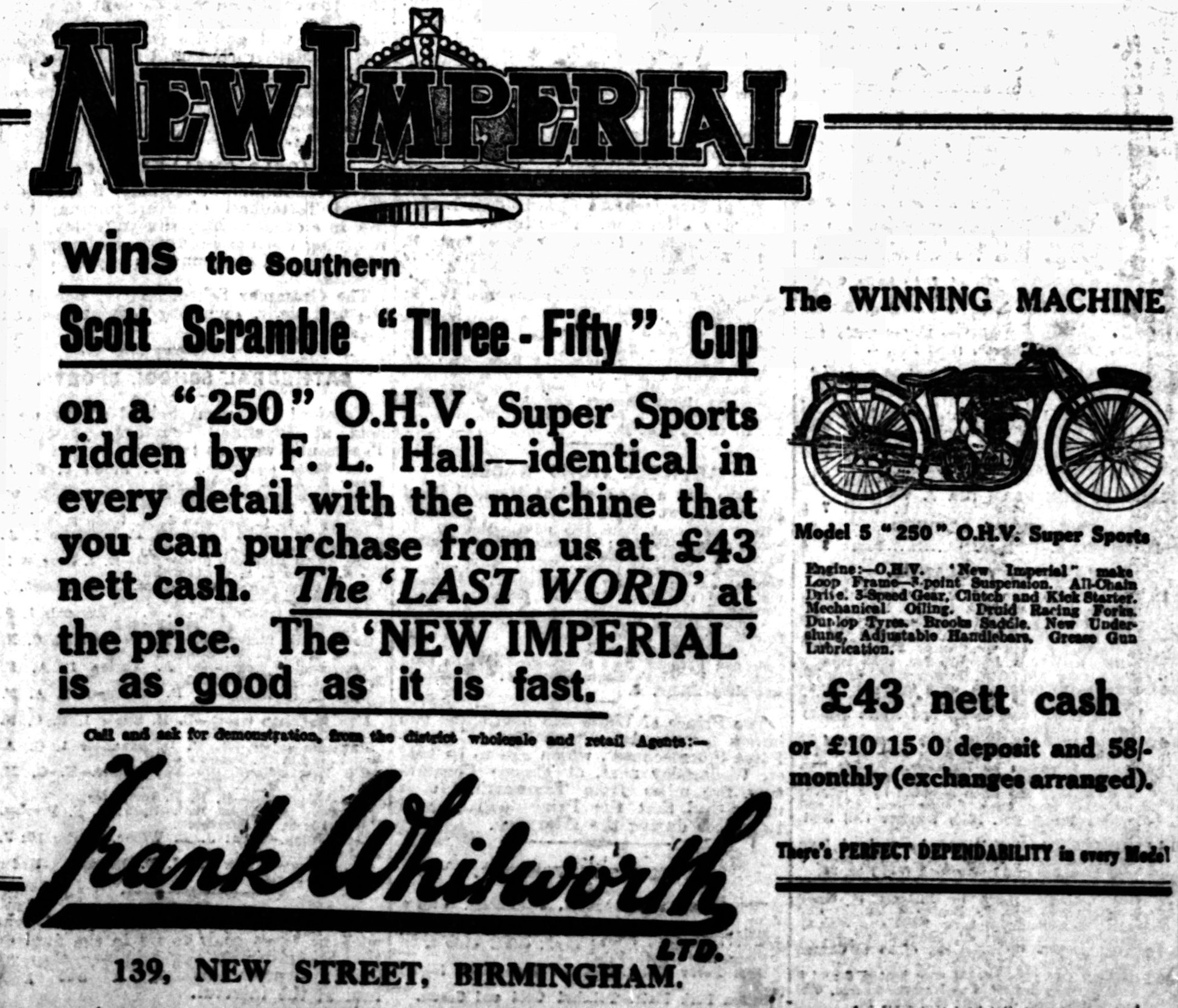
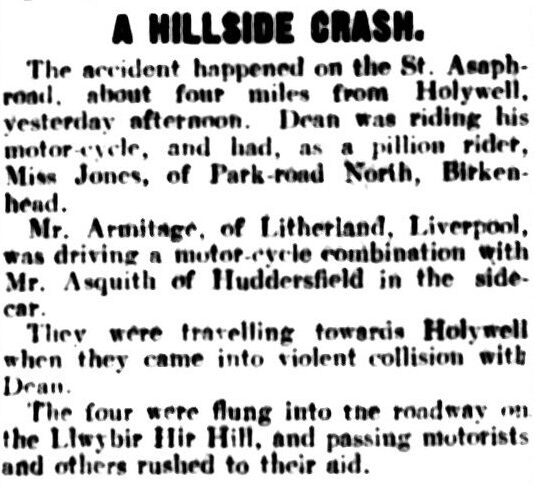
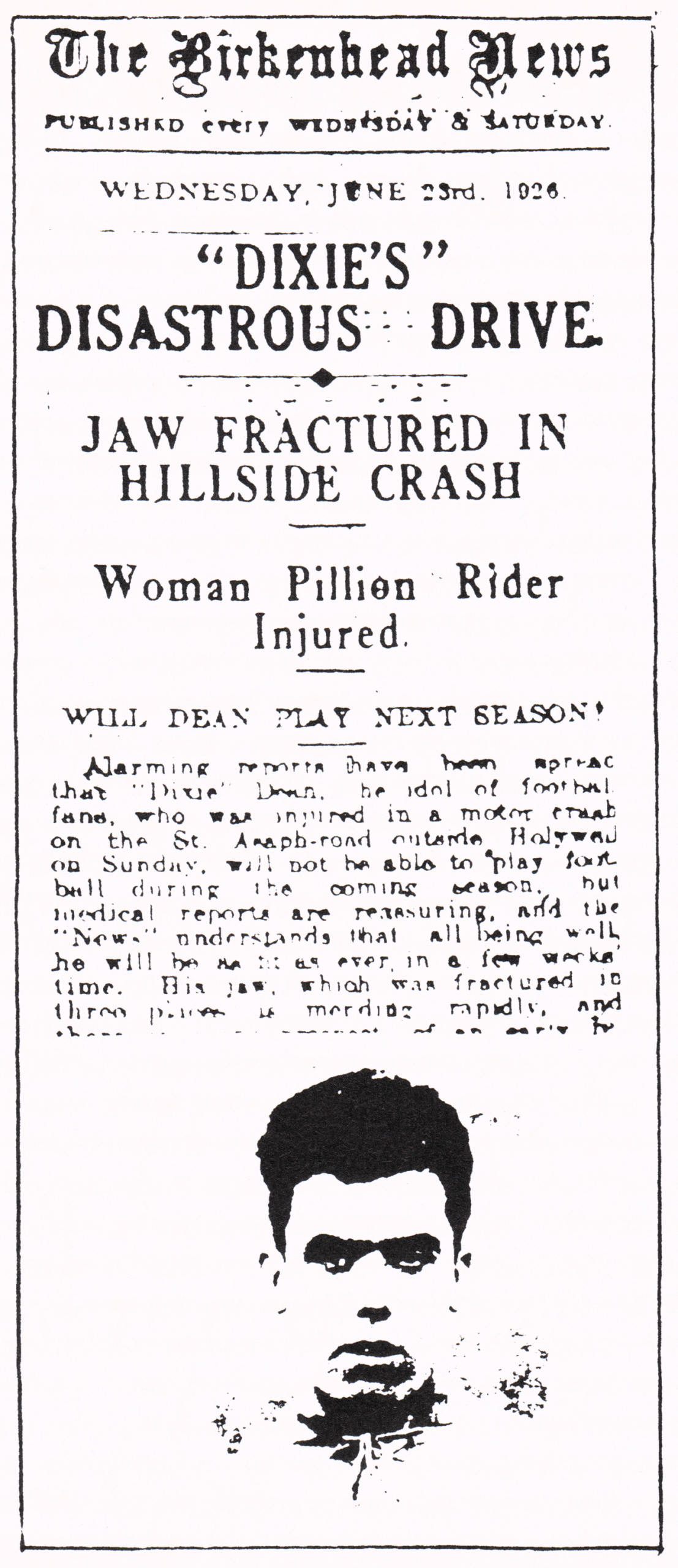
Sunday, 20 June 1926, a sunny summer’s day like any other. Two young people from Birkenhead with the world at their feet – nineteen-year-old professional footballer Bill Dean, and his friend, twenty-one-year-old draper’s assistant Evelyn Jones, tennis partners who played in Birkenhead Park close by to their respective childhood homes, set off for a jaunt on Dean’s recently purchased New Imperial motorcycle. By around four o’clock that afternoon they found themselves across the border in Flintshire, North Wales, travelling west along the scenic St. Asaph Road (now the A5026), passing the village of Lloc, four miles from Holywell to the east.
According to a report in the Flintshire County Herald published on 25 June:
‘About the same time a motor combination driven by Arthur Armitage, of Litherland, Liverpool, with Sam Asquith, of Perseverance Street, Huddersfield, in the sidecar, was on the same road. They were following a small Austin car, and apparently pulled out to pass it, just as Dean was doing so. The two machines crashed into each other, and all the riders were severely injured and thrown out.’
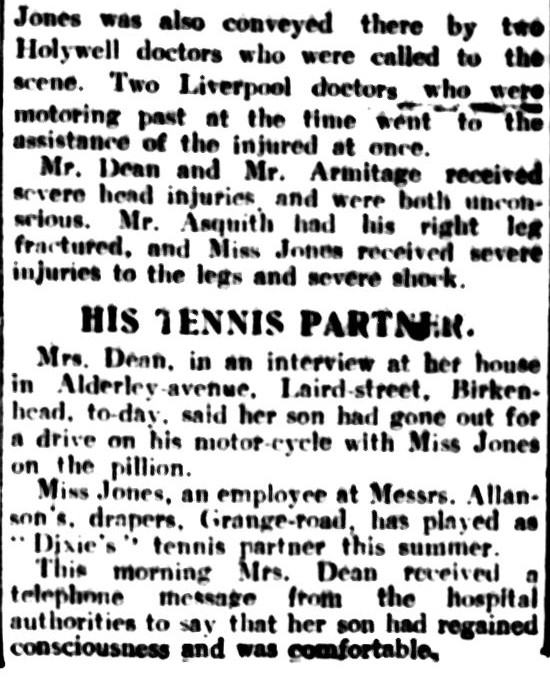
The injuries to all four people were indeed significant. Dean was knocked unconscious, suffered a fracture to the base of his skull and broke his jaw in two places. The Liverpool Echo report of 21 June stated that ‘one of his shoes was torn to shreds in the accident, and it is miraculous that his foot escaped injury.’
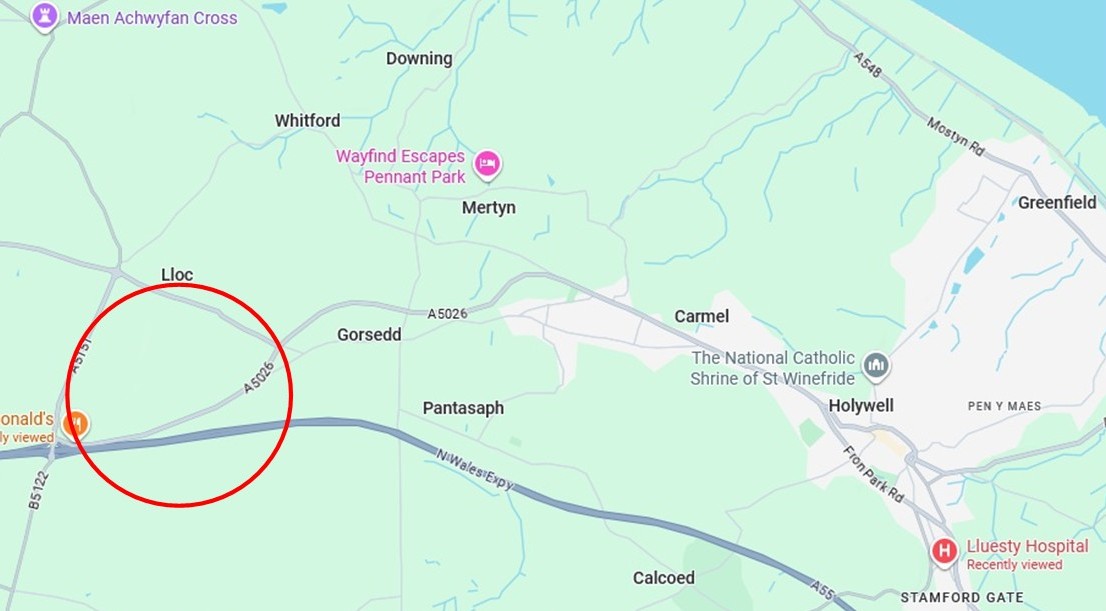
accident occurred on Llwybr-Hir Hill, near Lloc, with the site of the former Lluesty Infirmary also marked.
In John Keith’s book Dixie Dean: The Inside Story Of A Football Icon (Robson Books, 2001), the legendary Everton striker’s own memory of the accident is transcribed from taped interviews recorded in 1977:
‘The season had finished, it was the summer of 1926 and I bought a New Imperial motorbike, one of the latest models. I was taking a young lady to have a run out and went into Wales. We were just going through Holywell when a combination coming towards us kept cutting in and out of traffic. Then it hit us head on. It was just as well I came off the way I did. If I’d come off on the left I’d have gone down a mountain side. I finished up in hospital with a fractured skull and pretty well patched up. Then they moved me from Wales to Liverpool and put me in the Sir Robert Davis Nursing Home in Eaton Road, West Derby. My head was parcelled up in a splint and bandages and God knows what. They’d put a metal plate in my head which later had to be removed. They also strengthened my jaw, which was left with a hole in it caused by the crash.’
Evelyn Jones and Sam Asquith each suffered a broken leg. Arthur Armitage was the most seriously hurt, sustaining a fractured skull, significant facial injuries and severe concussion. It is almost certain that none of the injured were wearing crash helmets or any other form of protective clothing. Dean and Armitage were both lying unconscious at the roadside when an Inspector Whitehead arrived on the scene. Whitehead found two doctors – both of whom, mercifully, had happened to be passing in their own vehicles – already tending to the injured quartet.
Mr. Pinder, landlord of the nearby Travellers’ Rest inn, was summoned to bring his lorry to the crash site, and Inspector Whitehead, along with a Sergeant Gallagher and Constable Evans, accompanied the injured men on the back of the wagon to Lluesty Infirmary in Holywell. Two more doctors, named Jones and Roberts, had arrived from the infirmary and conveyed Evelyn Jones there in their car.
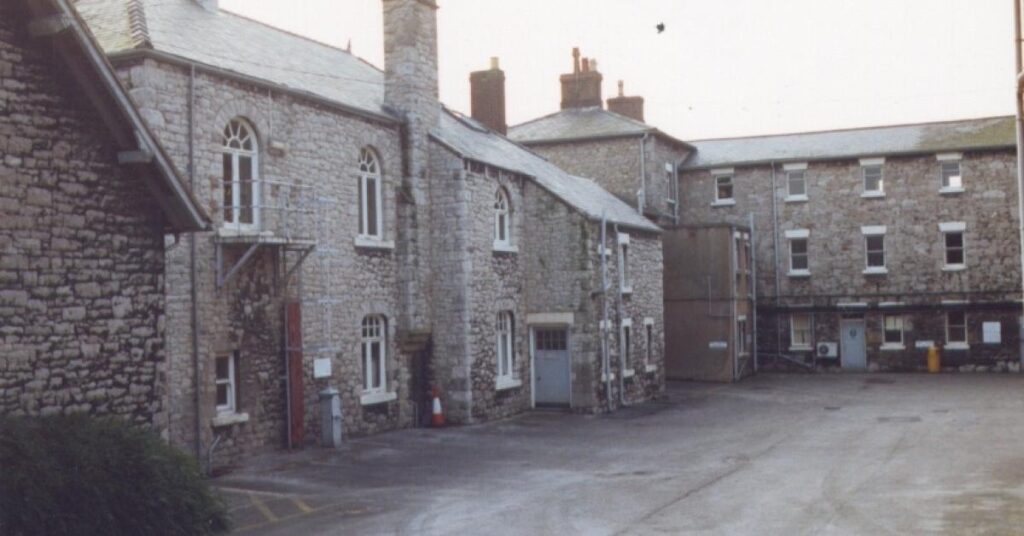
On arrival at the hospital, all broken limbs were set. Evelyn Jones was first to recover from a state of shock while Dean and Armitage remained unconscious throughout the night.
The news had already broken back on Merseyside, with an understandable sense of concern brewing amongst the Evertonian community at the announcement on BBC news that their star striker Dixie Dean was in a critical condition in hospital.
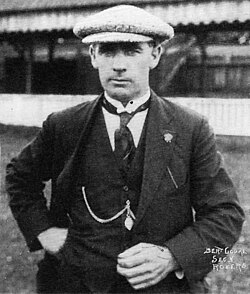
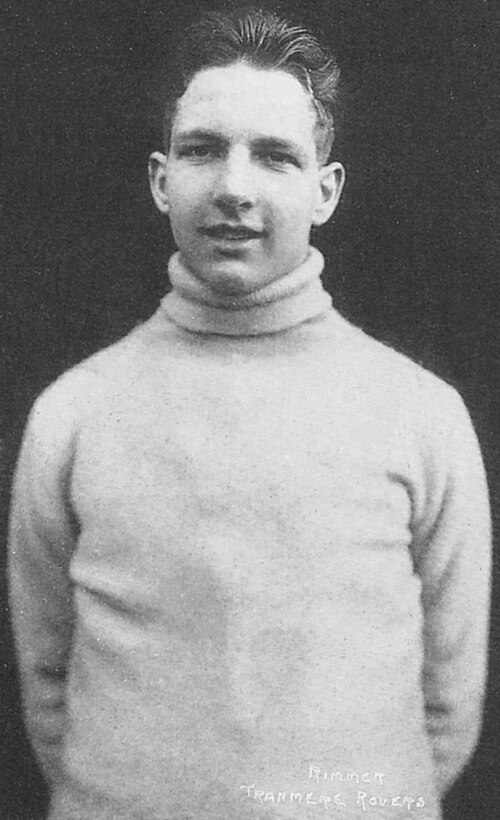
Tranmere Rovers secretary Bert Cooke arrived at the hospital at eleven o’clock on the evening of the accident, accompanied by Ellis Rimmer, one of Dean’s former teammates at Rovers – the pair of them travelling over from Birkenhead by motorcycle! Finding Dean unconscious, both men spent the night at his bedside.
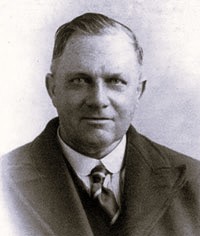
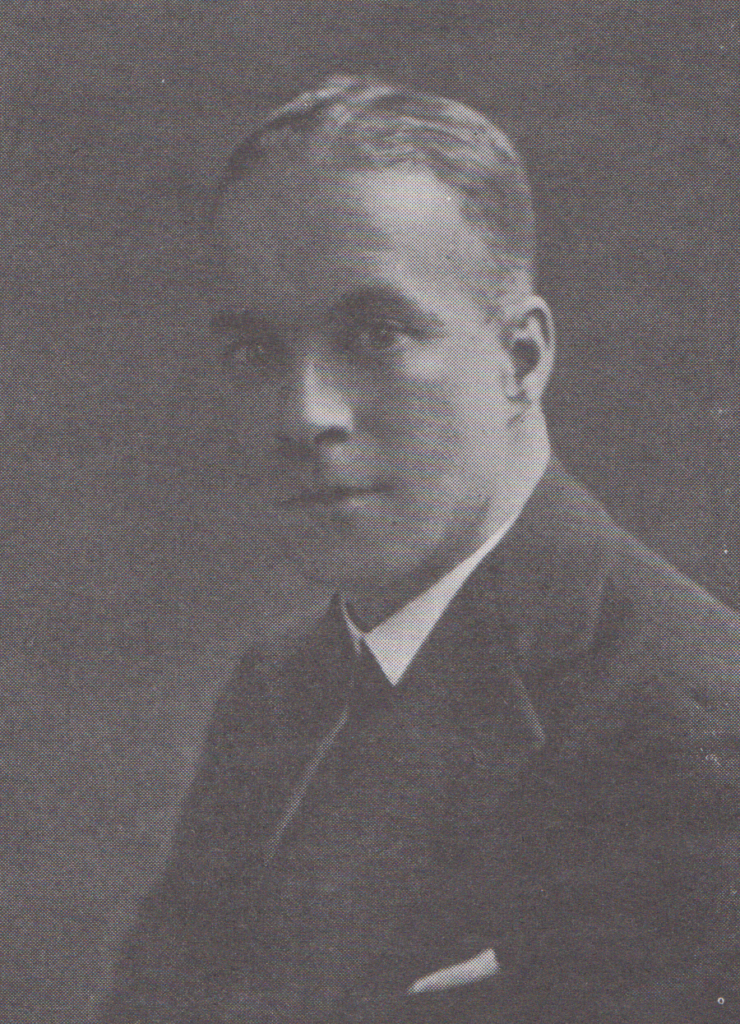
The following morning, Monday, 21 June, Everton Football Club’s secretary Tom McIntosh and physician Dr. Cecil Baxter, son of long-serving director Dr. James Clement ‘J.C.’ Baxter, arrived at the hospital. Shortly thereafter, Dean regained consciousness and, according to the Flintshire County Herald report ‘after enquiring where he was and whether he was in the Isle of Man, recognised his friends and enquired whether Miss Jones was hurt.’ Satisfied that Evelyn Jones was in a stable condition, Dean apparently settled back down to sleep and was reported to be in a much better state later that afternoon.
The Daily Express of 22 June reported the worrying words for Evertonians everywhere:
‘EVERTON’S CENTRE MAY NOT BE ABLE TO PLAY NEXT SEASON
“Dixie” Dean, Everton’s twenty-year-old star centre forward, who was considered to be the most promising young footballer in England, met with a serious motor accident near Holywell, North Wales. He had not regained consciousness last night, and it is said that even if he recovers he will not be able to play for Everton at all next season. This will be a serious blow to the club, who for some years had been searching for a really capable centre, and had to compete with a score of other league clubs when they signed Dean from Tranmere Rovers in March 1925.
The fee paid for this eighteen-year-old boy ‘s signature was about £2,500, and Everton were warned against launching him into first-class football too soon. The needs of Everton and the promise of Dean were so great, however, that he was given a trial within a week of joining the club. He was not a success till early last season, when he suddenly jumped into the splendid form which had brought him into such prominence while with Tranmere. Dean maintained excellent form all the season, scoring twenty-nine league goals for Everton, including two separate “hat tricks” against Newcastle United, while he also scored the only Cup-tie goal obtained by the Goodison Park club.’
Daily Express, 22 June 1926
Dean, who was of course not yet twenty years of age, had in fact scored thirty-two league goals in thirty-eight appearances during 1925/26, his first full season as an Everton player, including two further hat tricks in consecutive matches at Burnley and at home to Leeds United in October 1925. However, frustratingly inconsistent form saw Everton finish in a disappointing eleventh place in the First Division. The club’s Annual General Meeting for 1926 took place just a fortnight before Dean’s accident, with the indomitable Mr. Will Cuff in the chairman’s seat. The first team squad was reported to be in ‘good shape’ and work on the new Bullens Road stand, designed by Archibald Leitch, was stated to be progressing well.
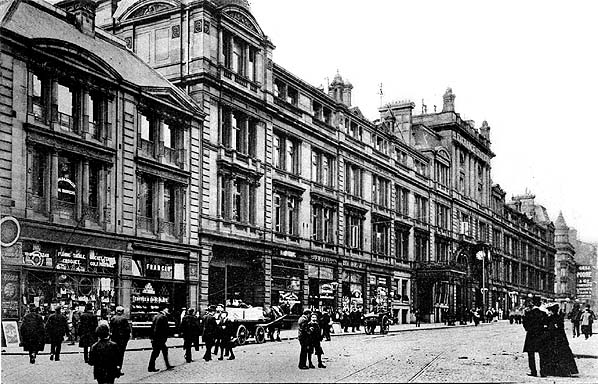
The next meeting of the Everton board of directors had been scheduled for the evening of 26 June at the Golf Hotel at Grange-le-Sands, presumably following a leisurely eighteen holes in the afternoon. In the event, the directors gathered for an emergency meeting at Exchange Station Hotel in Liverpool on the evening of 22 June. Needless to say, the condition of the club’s prized asset Dean, was top of the agenda:
‘Dean – Secretary reported that this player had been severely injured through a motor cycling accident and was lying in hospital at Holywell. Dr. Baxter and himself gave reports on his condition, and it was decided that the Doctor be empowered to get the services of a specialist to examine him. It was decided that all players be notified that the Directors recommended that in future players be requested to refrain from riding motorcycles during the period of their engagement, and that in future agreements, a clause be inserted to restrain them from doing so.’
Meanwhile, back at Lluesty Infirmary, Arthur Armitage was unconscious for almost twenty-four hours, and, despite showing marginal improvement once he woke up, remained in a critical condition. The Flintshire County Herald report carried further information on his and Asquith’s background, revealing that Asquith was, in fact, Armitage’s uncle:
‘(Armitage) is a widower, with two children, who live with his aunt, Mrs. Garbutt, at 66, Lawler Street, Litherland, and a nephew to Asquith, the other injured man, who was staying for a few days with Mrs. Garbutt. Asquith displayed great pluck all the time. He refused assistance until the other injured had been attended to and was quite cheery all through.’
The report also praised the local constabulary for the way in which they had dealt with the accident:
‘It should be noted that the police arrived on the scene about 5.20 and had to improvise an ambulance, stretchers, etc., as there are none in the town, but succeeded so well that the patients were in bed in the Infirmary by 5.55. very quick work in the circumstances.’
A few months later, the same publication reported that Tranmere Rovers Football Club had made a donation of three guineas to the local council Housing Committee ‘as an appreciation of the care taken of “Dixie” Dean at the Infirmary. The Committee had decided to give the inmates a treat with the money.’
A report in the Huddersfield Daily Examiner of 23 June quoted Everton medical officer Dr. Cecil Baxter, who spoke as reassuringly as possible on the prognosis for his club’s centre forward:
‘Although it is too early yet to make a definite statement, it is hoped he will be able to play football again. Perhaps he will be able to play towards the end of the coming season. Both jaws are fractured, but the question of the skull, which is of the greatest concern, cannot be decided until an X-ray examination has been made.’
Dr. Baxter returned to Holywell on the morning of 25 June, accompanied by Dr. Heaney, a specialist, and the decision was taken that Dean would remain at the infirmary for a further three weeks, before being moved to Liverpool for X-rays. The Everton directors were updated as follows at a meeting on 1 July:
‘W. R. Dean – Reports on this player’s condition were read from Dr. Heaney and Col. Osborne and Dr. C. Baxter, and Secretary reported that his condition was much improved. It was decided that the question of his removal from Holywell to the Eaton Rd. Nursing Home, W. Derby and also the taking of an X-ray photo be left in hands of our Doctor.’
At this point Armitage and Asquith were both reported to be making ‘good progress’ while Evelyn Jones had already returned home to her parents’ house in Birkenhead with her broken right leg in plaster.
On 8 July 1926, Dean was removed from Holywell Hospital to the Robert Davies Nursing Home in West Derby to continue his recuperation. He travelled back in Birkenhead in a private ambulance paid for by Everton, before boarding the ferry to Liverpool.
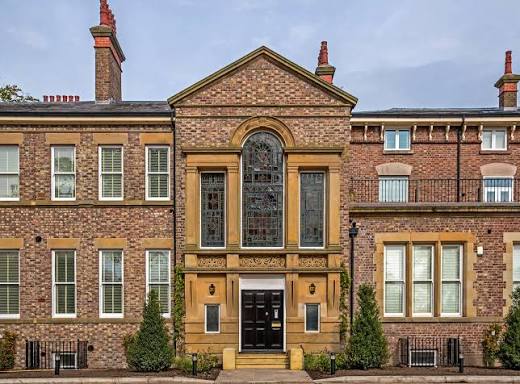
In an interview on the Mersey ferry, Dean, dressed smartly in a pale suit, was in good spirits stating confidently that he ‘would play all right, and soon, I hope.’ He praised the staff at the infirmary but added ‘all the same, there’s no place like home, and it pleased me to see old Birkenhead again.’ Dean also revealed that he had self-prescribed an unlikely form of treatment during his time at the infirmary, telling the reporter that he had ‘been playing a mouth organ to get my jaw bones in trim.’ Alas, this unconventional exercise routine was soon called to a halt by the nursing room staff ‘in the interests of the other patients.’ Dean also revealed that he enjoyed passing time by playing card games like Patience.
Once back in Liverpool, Dean attended an appointment at the office of the pioneering radiologist Dr. Charles Thurstan Holland at 43 Rodney Street, where his bones were closely examined.
Everton secretary Tom McIntosh delighted the club’s supporters on 10 July, when he informed the press that X-rays had confirmed Dean’s broken bones were healing well and he would be fit to play in time for the start of the 1927/28 season. At the meeting of directors held on 15 July, Dean was reported to be ‘progressing very favourably’ in his recovery, and a radiogram report prepared by a Dr. Mathers was read.
Dean continued to make a rapid recovery and, at a meeting of club directors held on 24 August, Dr. Baxter reported that – following an examination by Dr. Heaney – the Everton striker would be ready to commence training in two months’ time, just four months after the accident. He added that Dean was to undergo ‘violet ray’ treatment twice weekly. A finance report presented at the meeting of 7 September, stated that the club had paid £9 9s 0d to the Holywell Union, £5 5s 0d to R. McDougall and Co., Ltd., for ambulance services, £6 6s 0d in doctor’s fees and a further £16 13s 0d to the Robert Davies Nursing Home.
Four days later, Everton opened their 1926/27 campaign with a 1-2 defeat at Tottenham Hotspur. A further four more defeats followed in successive games, with Everton after five matches somewhat alarmingly having conceded seventeen goals and scored only five. The newly opened Bullens Road stand echoed to a sea of Evertonian groans.
A major statement was recorded in the minutes of the meeting held on 14 September when ‘the Chairman and Secretary reported that Dr. Heaney had again examined Dean who was progressing very favourably. He suggested he be re X-rayed and afterwards commence training.’ This put Dean’s recovery well ahead of the schedule discussed just three weeks previously.
The following afternoon, Wednesday 15 September, Everton picked up their first point of the season, courtesy of a 0-0 draw with West Bromwich Albion at Goodison Park. When Saturday came the hapless Toffees contrived to throw away a 3-0 half-time lead over Leicester, who stormed back to win 4-3, thanks to two goals in the last six minutes. Much needed positive news arrived three days later, at a board meeting held on 21 September, where ‘Dean was reported to have commenced training and the Doctor stated he had stood it very well.’
After losing narrowly at Birmingham City, Everton, sitting rock bottom of the First Division, welcomed mid-table Liverpool to Goodison Park on the afternoon of Saturday 25 September. They ground out their first victory of the season at the ninth attempt thanks to a second-half goal from Jack O’Donnell. Liverpool Echo journalist Ernest ‘Bee’ Edwards reported as follows:
‘DEAN’S HAPPY VERDICT: I saw Dixie Dean on the stand, and was delighted to hear that in his training he has been heading a ball. This is a wonderful turn-up surprise and pleasure for, of course, the head was the doubtful quality in Dean’s case. Everyone will be thoroughly delighted to realise that he is recovering to the full extent of his mental and physical ability. It is great news.’
Draws followed in consecutive games home and away against Bury and Blackburn Rovers.
At the meeting on 5 October, the Everton directors heard the news they had been praying for when Tom McIntosh reported that ‘Dr. Heaney had stated that Dean might now play.’
At a follow-up meeting two days later Dean was selected to play for Everton reserves in a match at Armitage and Asquith’s hometown club, Huddersfield, on 9 October. Everton lost the match 3-0, but, according to the Athletic News of 11 October 1926, Dean ‘headed the ball twice – once against the crossbar – without evident injury. He shot well, but had not much support from his colleagues.’
That same day Everton managed a third First Division draw in a row, 0-0 at home to Huddersfield Town’s first team, the reigning champions of England. Dean was initially pencilled in to make his comeback in the home fixture against Newcastle on 16 October. Mercifully for the Magpies, against whom Dean had scored hattricks home and away the previous season, he failed a late fitness test and Everton were beaten 3-1.
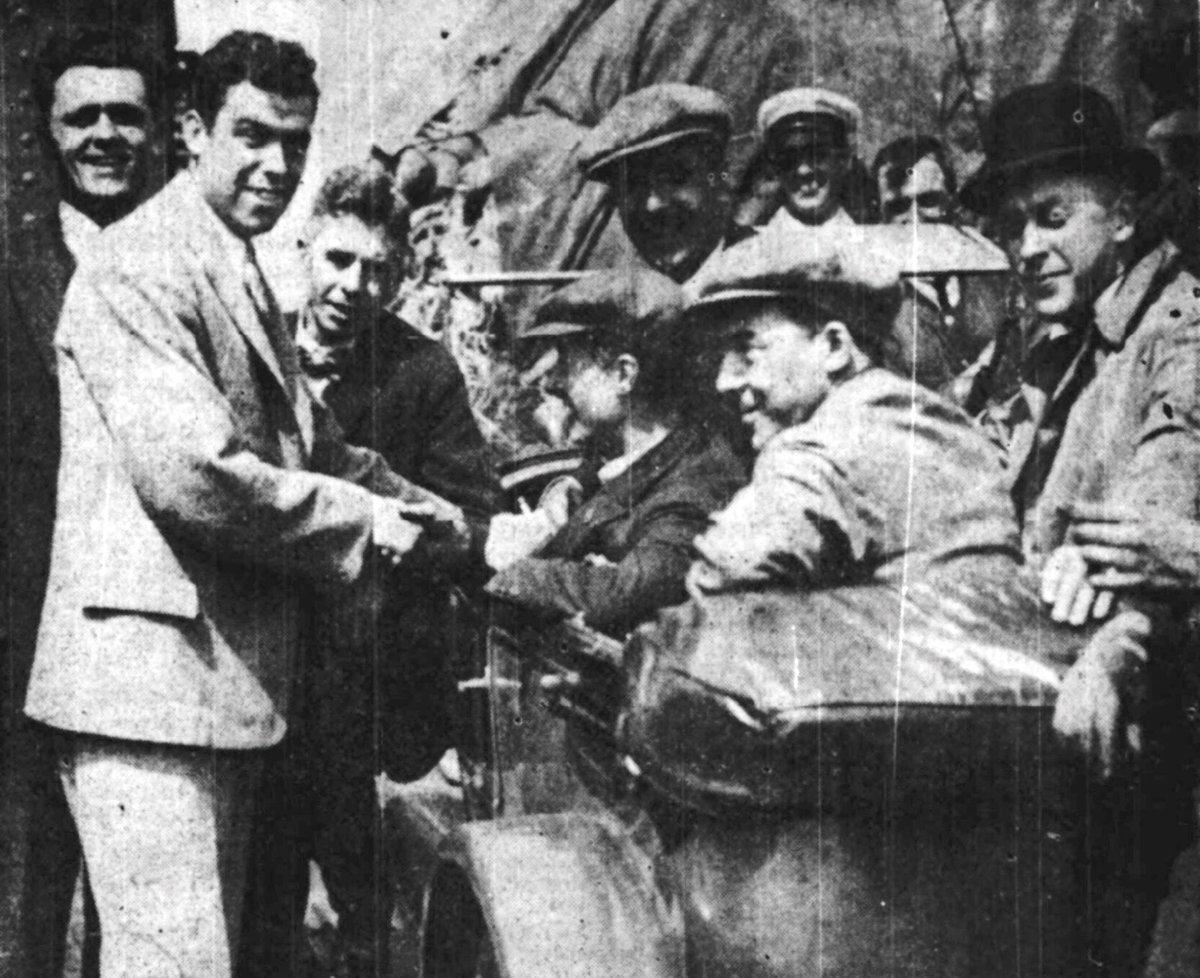
Dean had by now made his Goodison Park return on 13 October in another second-string fixture – this time against Birmingham City Reserves before a crowd of over 30,000 supporters anxious to see their hero back in action – and he scored twice, the first goal a trademark header. What relief Dean, his family, teammates, the supporters and everyone else associated with Everton Football Club must have felt when he showed no adverse reaction whatsoever having nodded the ball home. Everton won the match 3-2.
And so, on Saturday 23 October 1926, Dixie Dean returned to Football League action in an Everton jersey. He scored Everton’s equaliser on the half hour mark and inspired his struggling team to a 3-1 win at Elland Road versus Leeds. Dean proceeded to score a goal a game for the next four matches; a 3-1 home win over Arsenal, a 3-3 draw at Sheffield United, and another home win, 3-2 over Derby County, before opening the scoring in a 2-1 defeat at Manchester United. At the conclusion of that victory over Derby County, Everton had climbed from the bottom of the table to seventeenth place, their highest position of a wretched season.
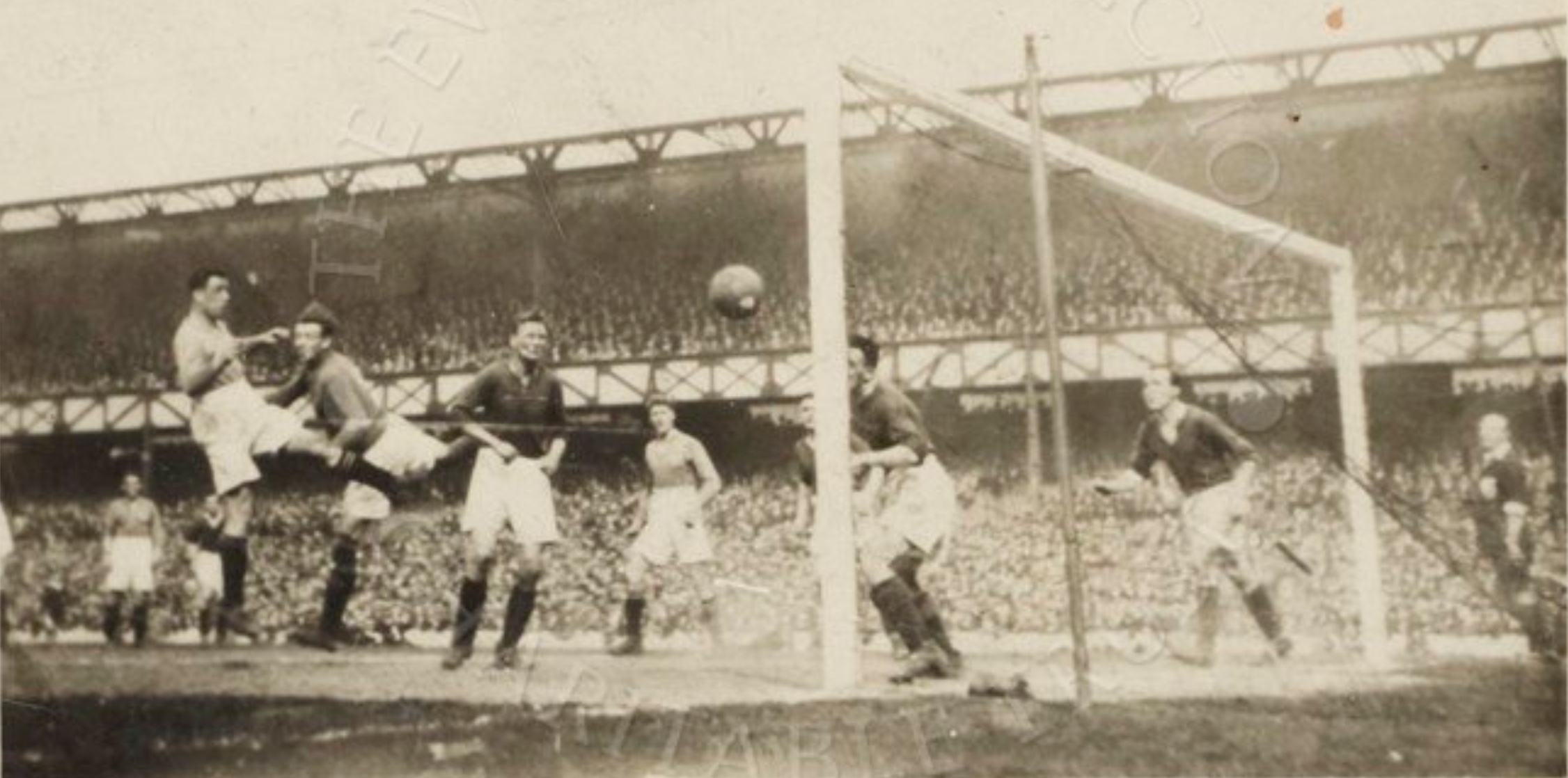
Poor form would continue to blight Everton, who remained mired in the bottom four. The returning Dean’s total of twenty-one goals from twenty-seven appearances – including four in the first forty-eight minutes in a 5-4 thriller at Goodison Park versus Sunderland – went a long way to keeping them clear of the two dreaded relegation places come the end of the campaign.
Four months later, Dixie Dean embarked on his record-busting sixty-goal crusade in 1927/28, and Everton were crowned League Champions for the third time.
The stuff of fairytales indeed.
LEST WE FORGET
But what became of Arthur Armitage, Sam Asquith and Evelyn Jones? News of the accident and Dean’s recovery was reported far and wide, but it occurred to me that the story of the other people involved in one of the most famous motorcycle collisions in British history had never been told, so I set out to find out more about them.
ARTHUR ARMITAGE
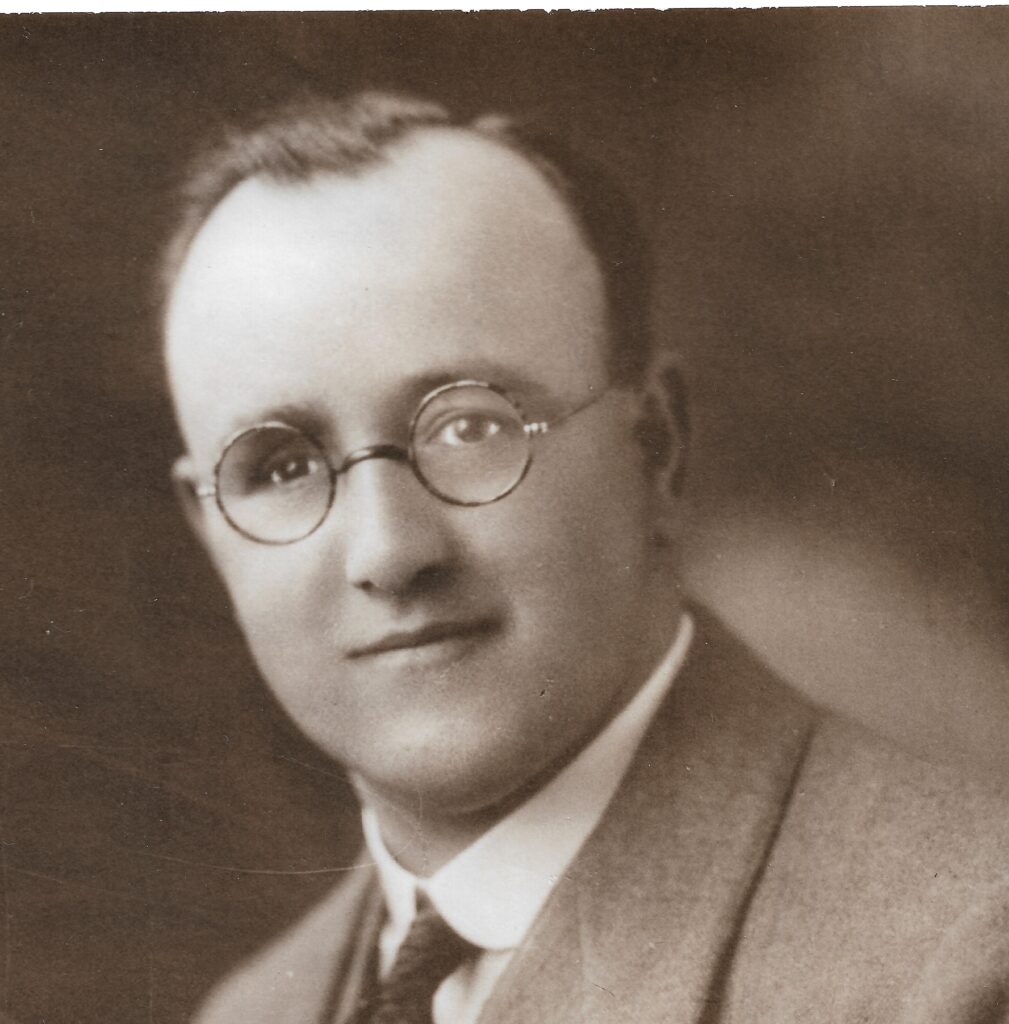
The following biographical detail and accompanying images were kindly sent to me earlier this year by Jan Armitage, granddaughter of Arthur Armitage and great grandniece of Sam Asquith:
Arthur Lionel Armitage was born on 30 September 1891 in Salford, Greater Manchester, the second son of Alfred and Clara Armitage (nee Asquith). His parents were married in September 1889 at Huddersfield Register Office, both younger children born to large families of millworkers, and raised by their stepmothers after the deaths of their mothers. They had one child soon after their 1889 marriage, George Irvin, born in January 1890, who sadly died in July of that same year. By September 1891, when Arthur Lionel was born, the little family had collapsed; his father was nowhere to be found and Arthur was taken away from his mother by her older sisters, or that’s the family story.
In the 1901 census, Arthur was living in Huddersfield with two of his mother’s sisters, Charlotte and Frances, plus Charlotte’s husband Charlie. Charlie and Frances were both weavers at one of the local mills. A birth certificate obtained in September 1904 tells us that he probably went to work then, aged thirteen.

By the time of the 1911 census, Arthur was a young man of nineteen and still living with Charlotte and Charlie. Charlie had taken a big step and become a self-employed milk dealer and sweetshop manager, while Charlotte helped in the shop. They had no children of their own, and Arthur had no contact with the throngs of Armitage relatives (a half-brother, three half-sisters, two stepbrothers and a stepsister) but he did have contact with a younger cousin, born in 1905, who also gave me information on Sam Asquith. This is how I know that when Arthur left school, he was apprenticed as an engineer to the David Brown company in Huddersfield.
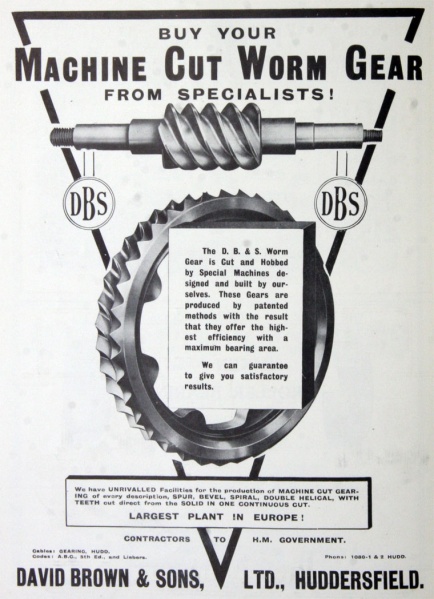
Arthur left Huddersfield in 1914/15, and worked in Peterborough, where he met and married Eva May Webb, the middle daughter of a railway clerk, in January 1916. Conscription was brought in in March 1916, but as an engineer he was doing essential war work – I think on the railways – so he was never conscripted.
Arthur and Eva had two children, Kenneth George in 1917, and Jack Stanley in 1922, but Arthur lost his job around 1921 and became a greengrocer. He tried his luck in Baldock in Hertfordshire and Sam Asquith (motorbike Sam) bought a horse for him and sent it off by rail from Huddersfield.
‘However, it ran away, kicked the cart to bits, and that was the end of that,’ said my informant!
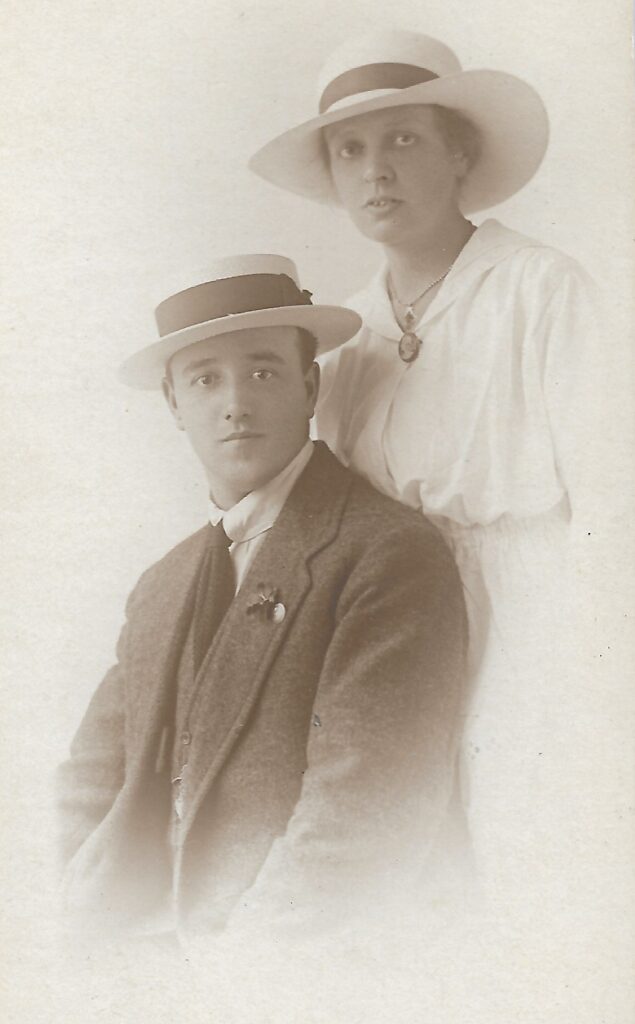
By 1925, Arthur and Eva were living in Litherland and running a fish and chip shop, trying to make ends meet. But there were hard times ahead; Eva died of stomach cancer in May 1925, and once again Arthur’s maternal aunts came to the rescue. This time it was Eliza, aged sixty, who moved in straight away, and lived with Arthur and his family until her own death in late 1939. She had married late, and had no children, and I think she liked Arthur’s young children, Ken and Jack.
I can’t imagine what Arthur went through: his life hadn’t been particularly stable and now he’d lost his wife, who’d come from a very grounded working-class family; shepherds, railway clerks, and running a village shop and post office in Northampton.
I don’t know when Arthur bought the motorbike and sidecar, but the collision with Dixie Dean and his girlfriend happened in June 1926, just over a year after his wife had died. He had definitely hit it off with his uncle Sam, who was himself a two-times widower, unable to work because of knee trouble.
After the accident, the Liverpool Echo of Monday, 21 June reported that ‘Asquith, who had his right leg fractured, is reported to be making very satisfactory progress… Mrs. (Eliza) Garbutt, of 66 Lawler Street, Litherland, was one of the relatives to visit the injured at the infirmary this morning.’
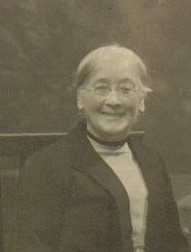
In an interview after returning from the ward, she said she was an aunt of the man Armitage, and a sister to Asquith. Armitage, she told me, is a widower and has two children who live with her.
On seeing Mrs. Garbutt by his bedside this morning, he smiled bravely and told her that his knee was “bound to come all right again now.”
Dixie, fortunately, recovered completely from this awful accident, as we know. For Arthur, the consequences lasted for the rest of his life, as he’d lost an eye. I think the severity of his injuries is why there are no newspaper quotes from him. He needed a long convalescence, and that’s when he met his second wife, Jessie Byrne, whom he married in Liverpool on New Year’s Day in 1927. They had no children together, and maintained contact with his first wife’s family, as one of the boys would visit their maternal grandparents in Northamptonshire every year.
Arthur had a glass eye after the accident and later lost his sight in his other eye after suffering from diabetes, but he was able to carry on engineering work in Liverpool factories during World War II.
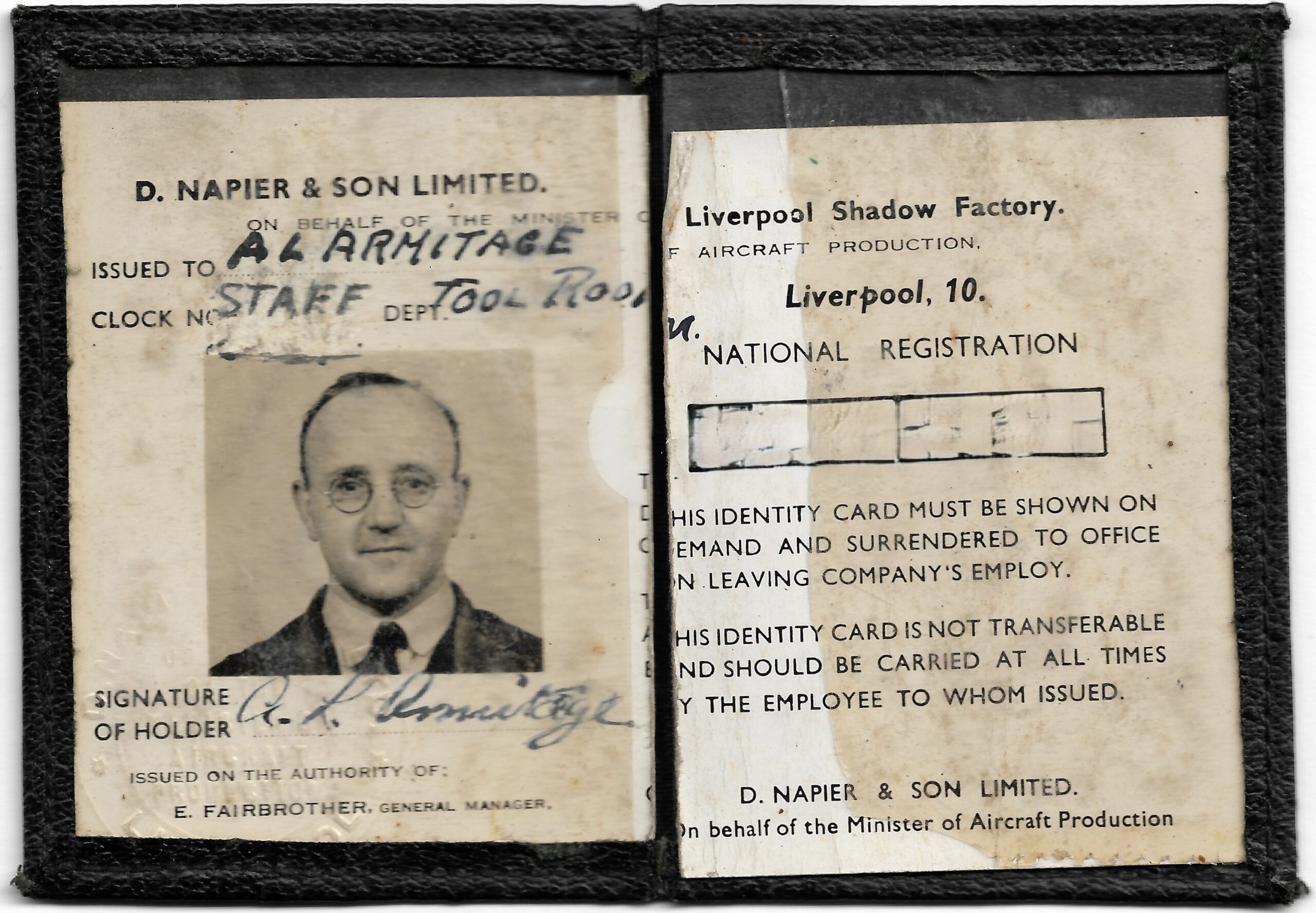
East Lancs Road on the outskirts of Liverpool where Arthur worked during WWII
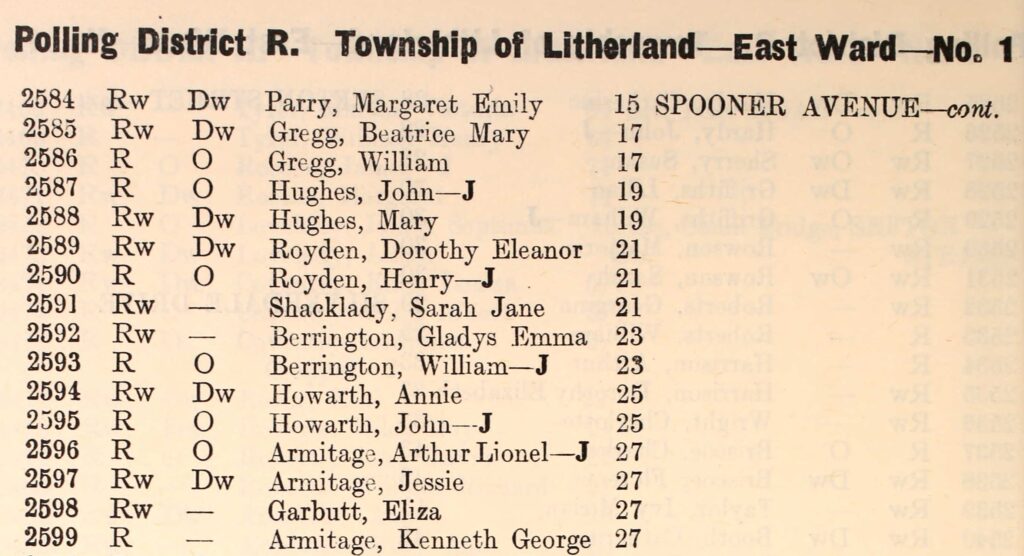
His elder son, Ken, died in 1941, in his early twenties, but his younger son Jack came through healthy and well, and married, having three children in the 1950s. Arthur and Jessie lived with them for the last ten to fifteen years of their lives, in Cheshire. Arthur died aged eighty-two at Victoria Infirmary, in Wallasey on 25 July 1974, and Jessie passed away in 1982, aged eighty-nine.
Arthur was very lucky that he had no scarring on his face from the accident. I do remember him taking out his glass eye when we were very little.
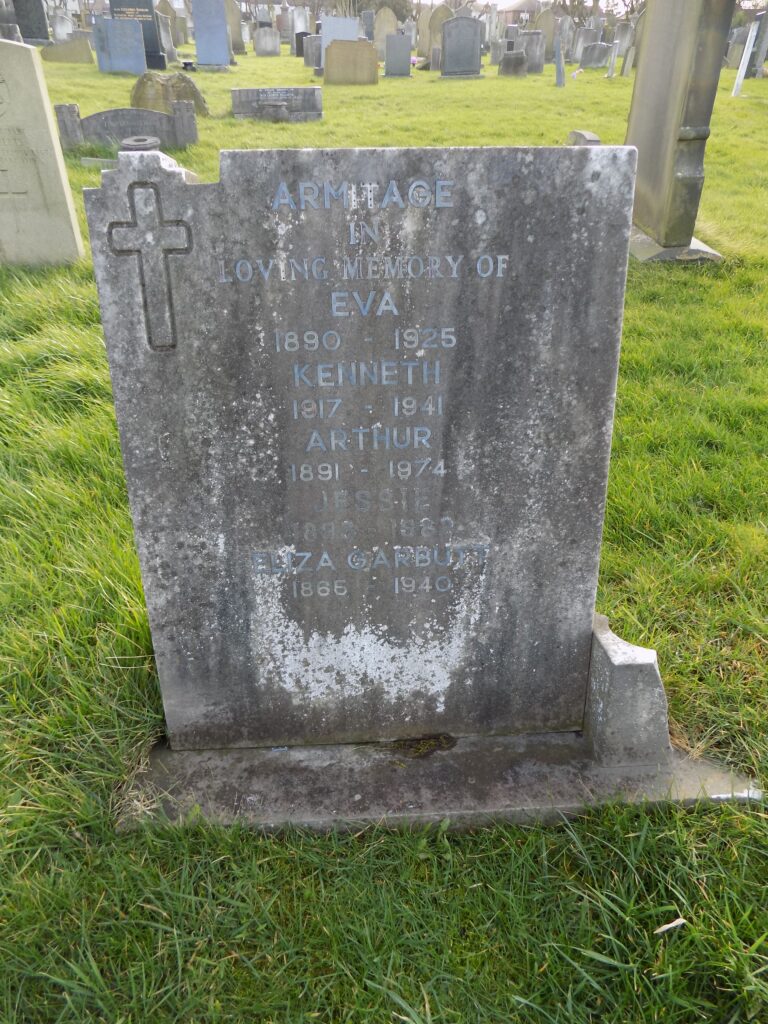
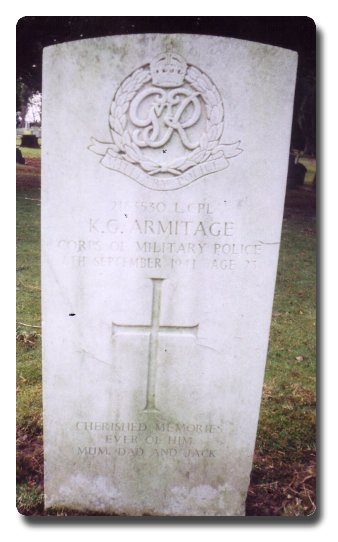
Lance Corporal Kenneth George Armitage,
Corps of Military Police
(Kenneth died tragically in a motorcycle accident while on a training exercise in Ilkley, West Yorkshire. He was buried at Ilkley Cemetery)
SAM ASQUITH
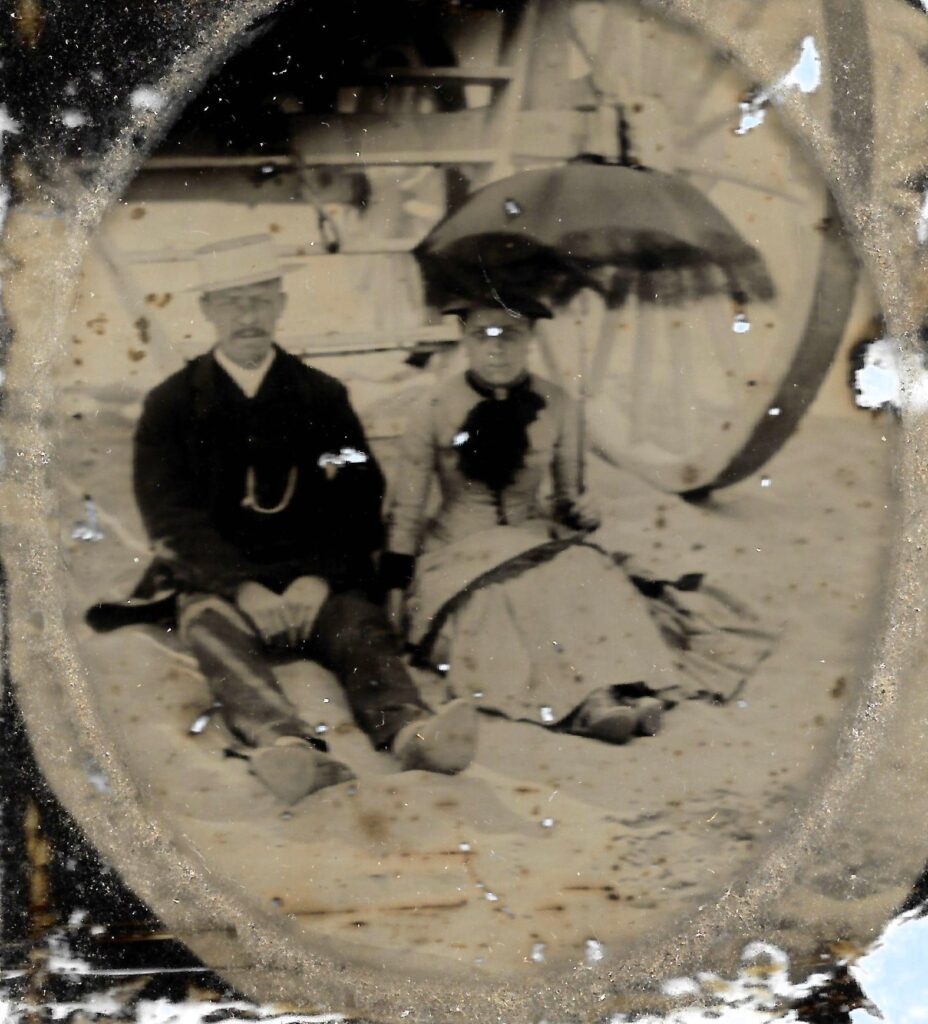

Sam (not Samuel) Asquith was born on 9 August 1858 in Almondbury, West Yorkshire, a village two miles south-east of Huddersfield. He was the son of George Asquith, a mill worker, and his wife Martha Whiteley, and one of ten children, two of whom died in infancy. He left school at the age of twelve and signed his own name when he was married in January 1880 in Huddersfield, to Jane Bayliff, at Lockwood Parish Church in Huddersfield. He was working as a beamer, setting up the looms with the correct yarn. It was a skilled job.
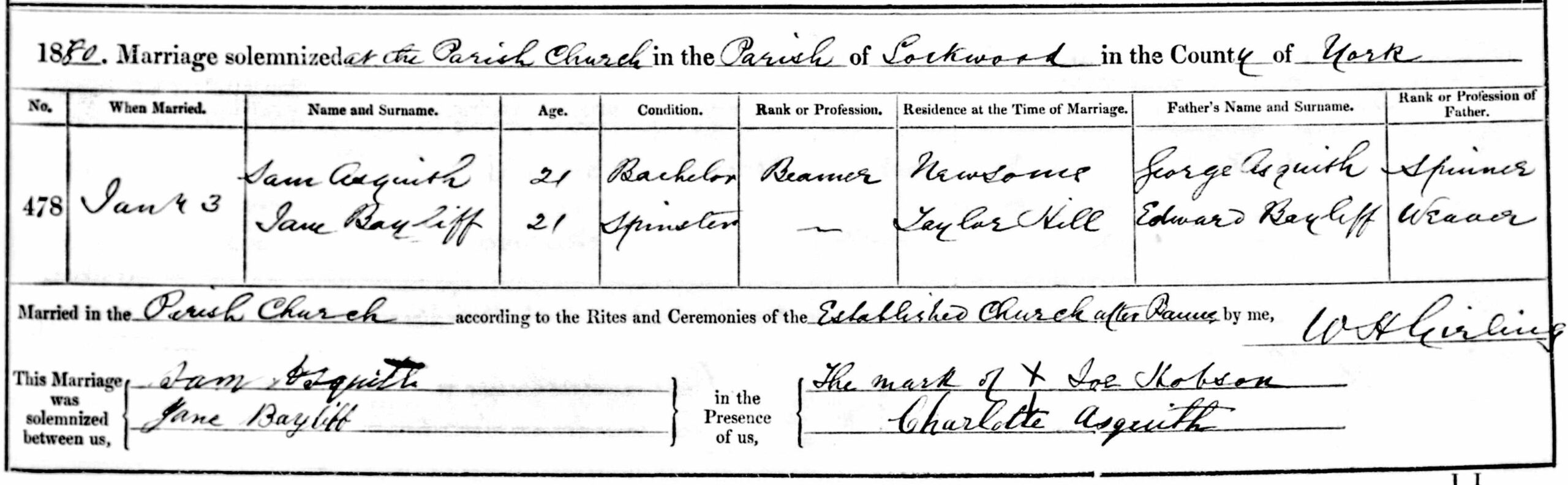
Sam and Jane had three children: George in 1882, Louisa in 1884, and Rose in 1890, all in Huddersfield, with Sam always employed in the mills as a beamer. By 1901, George was working as a teamster (working with horses), and Louisa was working as a wool-winder in one of the mills. Ten-year-old Rose was still at school.
However, in 1904 Jane died, at the age of forty-seven. This was the start of a turbulent few years. Sam’s daughter Louisa married in 1906, as did Sam himself, to an unmarried woman by the name of Ada Crowther, aged thirty-four.
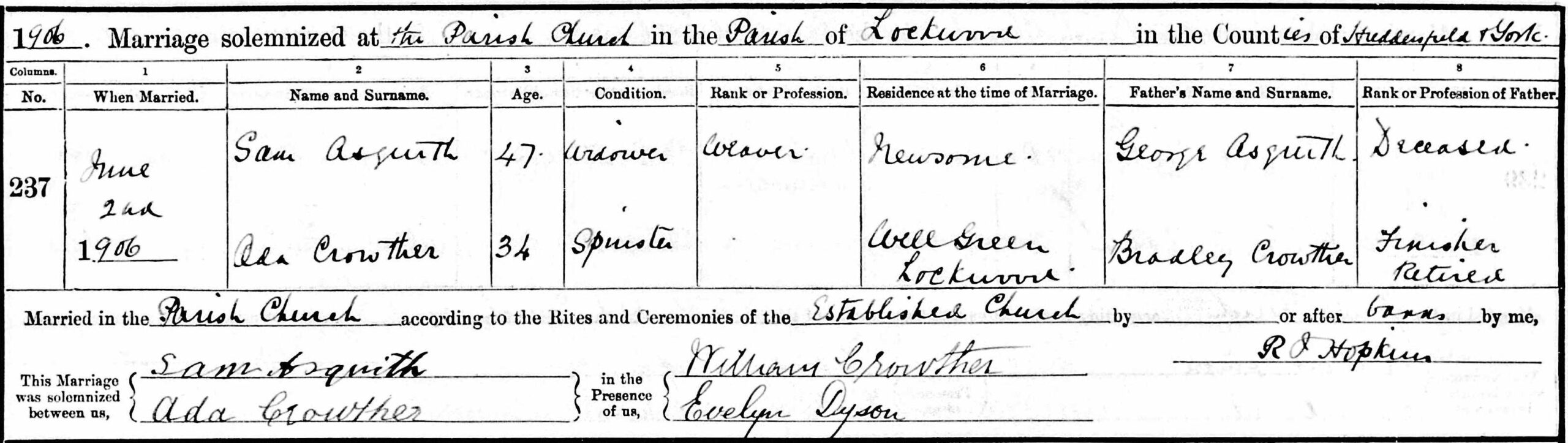
In 1909, Sam’s daughter Louisa died, aged only twenty-nine. By the time of the next census in 1911, his younger daughter Rose had moved out and was living with a family of cousins. Sam and his second wife Ada lived with Sam’s son, twenty-nine-year-old George. In December 1915, Ada Asquith died, aged about fifty-four. Sam’s son George finally married in 1916, in Huddersfield, to a woman named Annie Steele. George lived a long life. He died in 1954, but I don’t think he had any children. George’s wife Annie died three years after him and left their money to her spinster sister.
Rose’s history was as sad as her sister Louisa’s. Rose married in 1917, at the age of twenty-four, to Irvine Hoyle, who had been witness to George’s marriage witness the year before. Alas, by 1920, she was dead – there was a family story that she drowned herself.
Sam, however, seems to have refused to let life drag him down. I spoke with a nephew of his, back in the 1970s, who said that Sam played the concertina. The story that he fought in the Zulu wars, given the documentation of his life here in the UK, must be a fiction he told a little boy (my informant was born in 1905). I was also told that he was a ladies’ man, that he was married three times. He was certainly only married twice, but maybe he also had a lady friend after his second wife died. There does seem to be a bit of mystery about him. ‘His history was always kept from me,’ his nephew said.
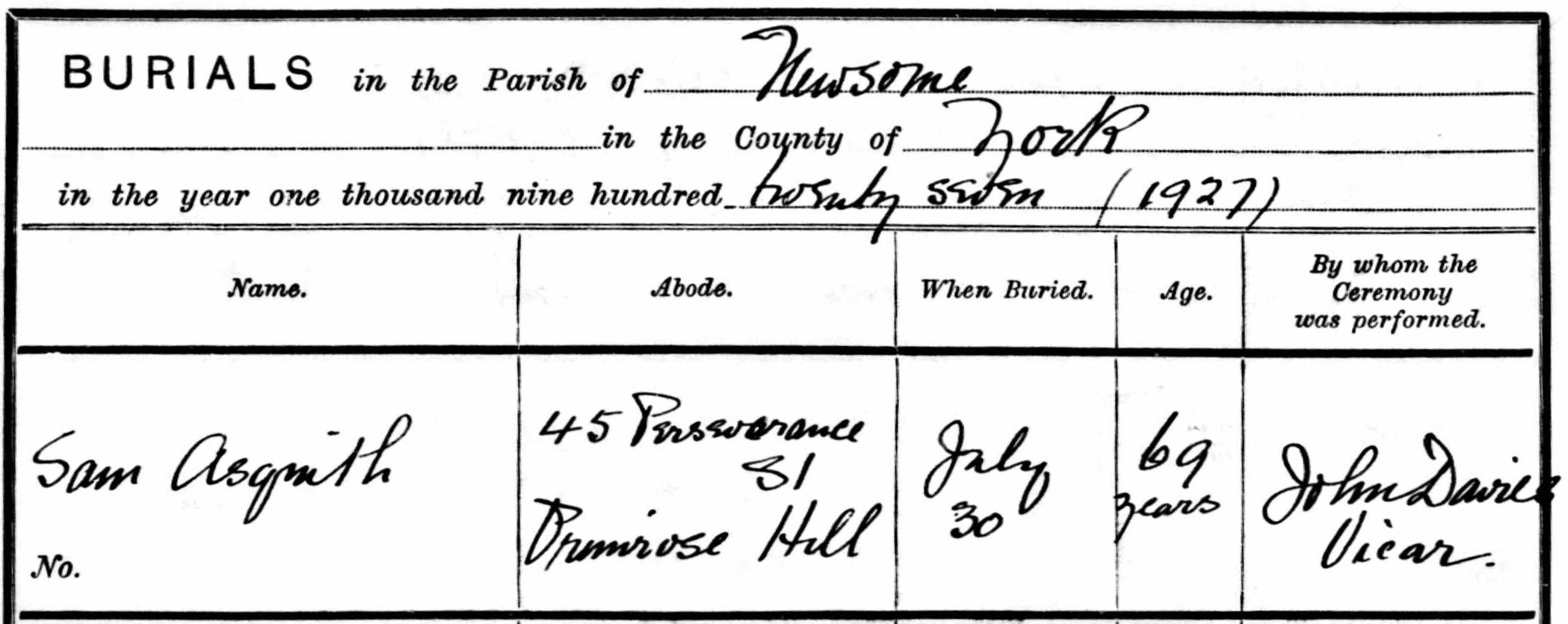
In 1926, there was the accident, of course. Sam had been unable to work for the preceding year, with knee trouble and his son George and George’s wife Annie took him in to live with them. Sam died in July 1927, just a few days short of his sixty-ninth birthday, and possibly from complications as a result of the accident. He was buried at his local parish church in Newsome, Huddersfield on 30 July.
EVELYN JONES
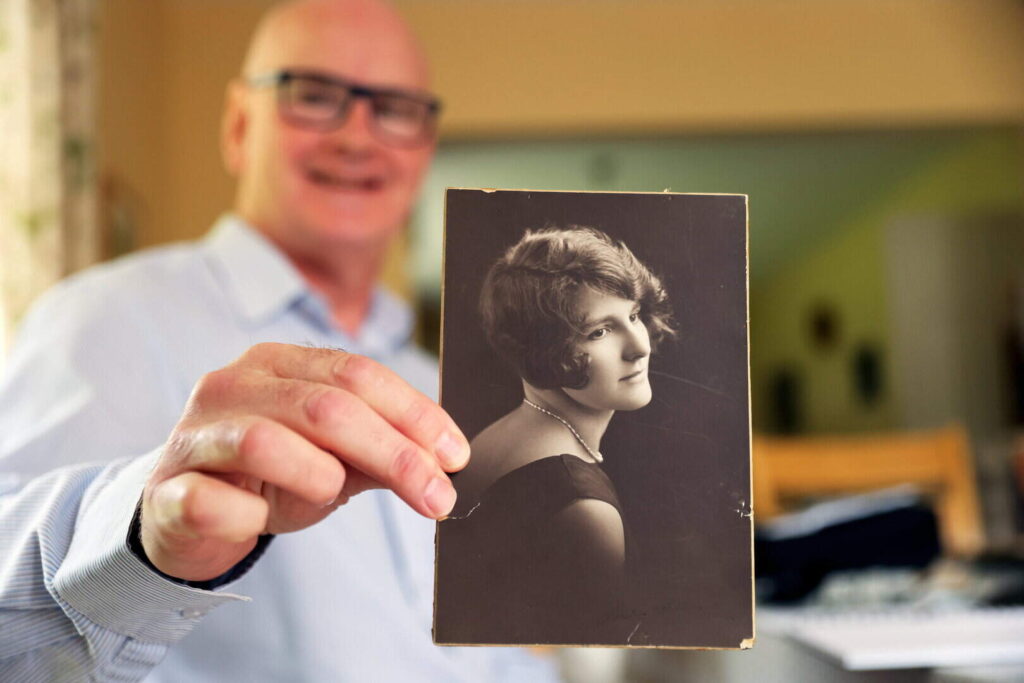
I have been fortunate to trace Evelyn Jones in the statutory records and compiled the following information and images with the help of her grandchildren Brian, Susan and Ian:
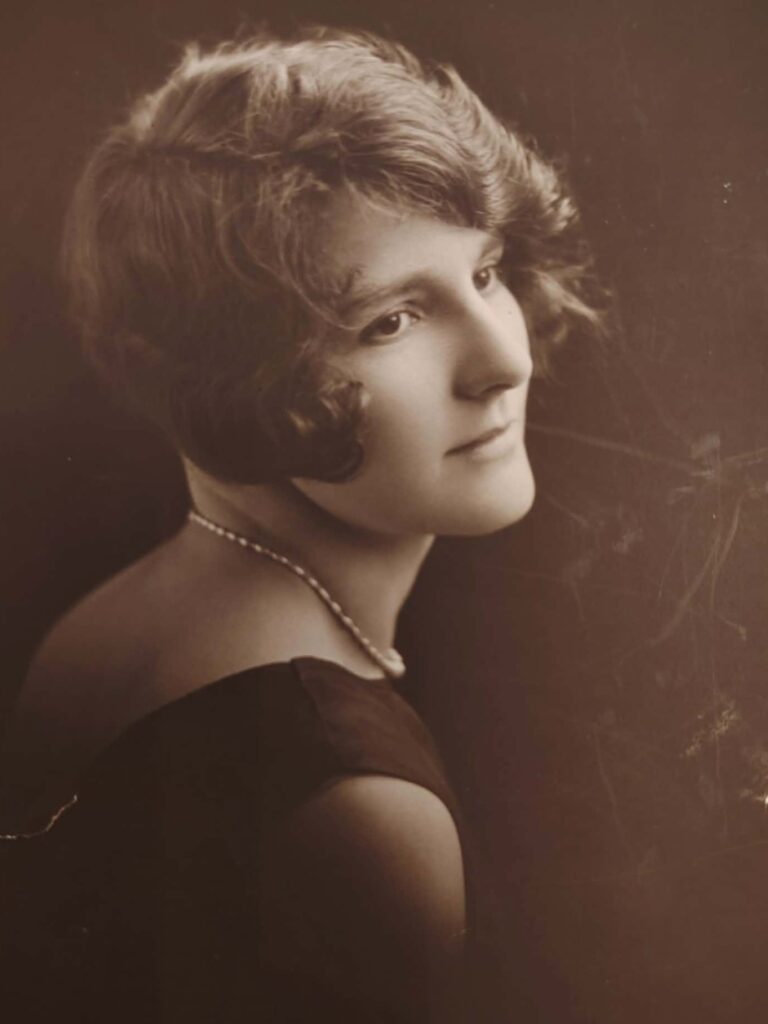
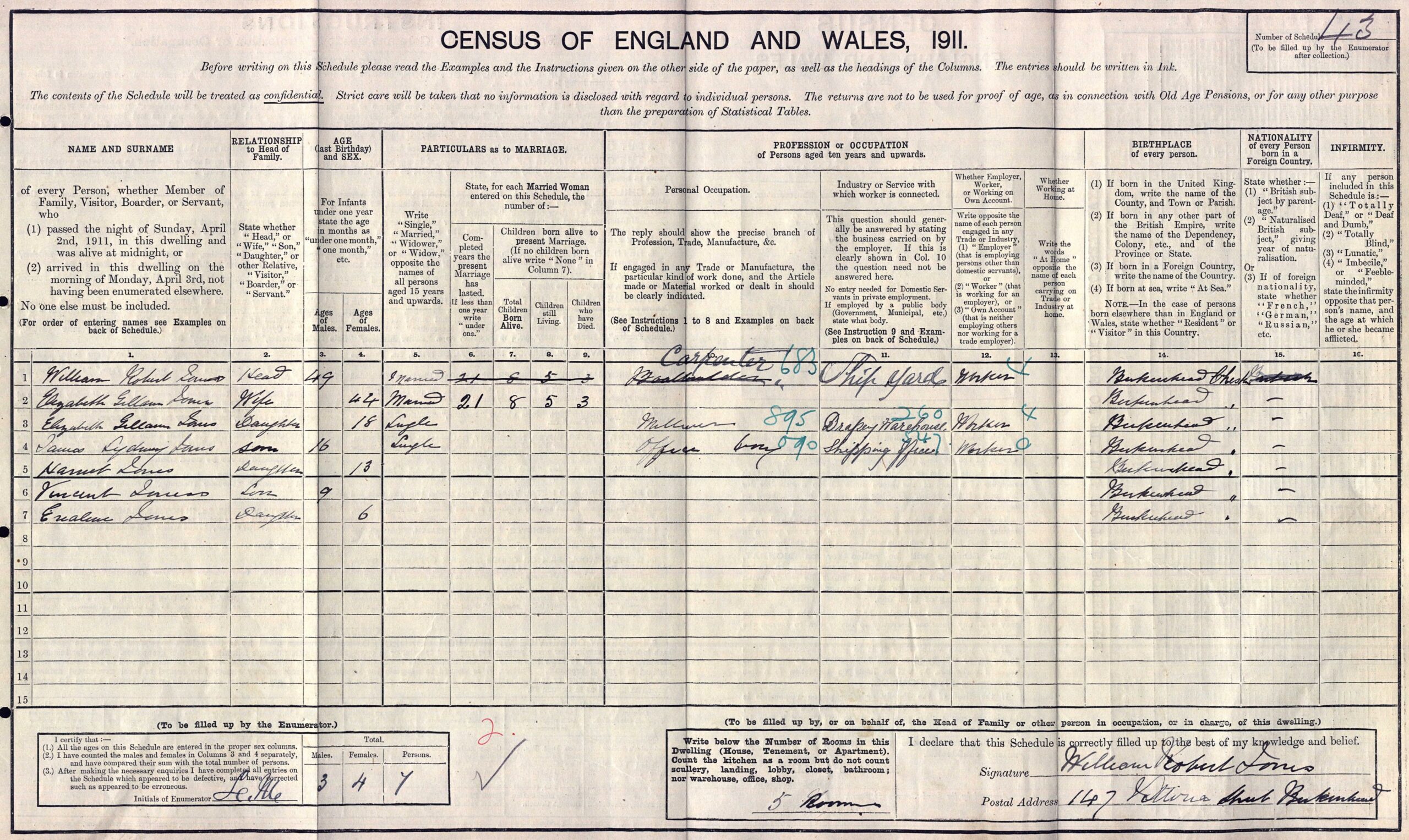
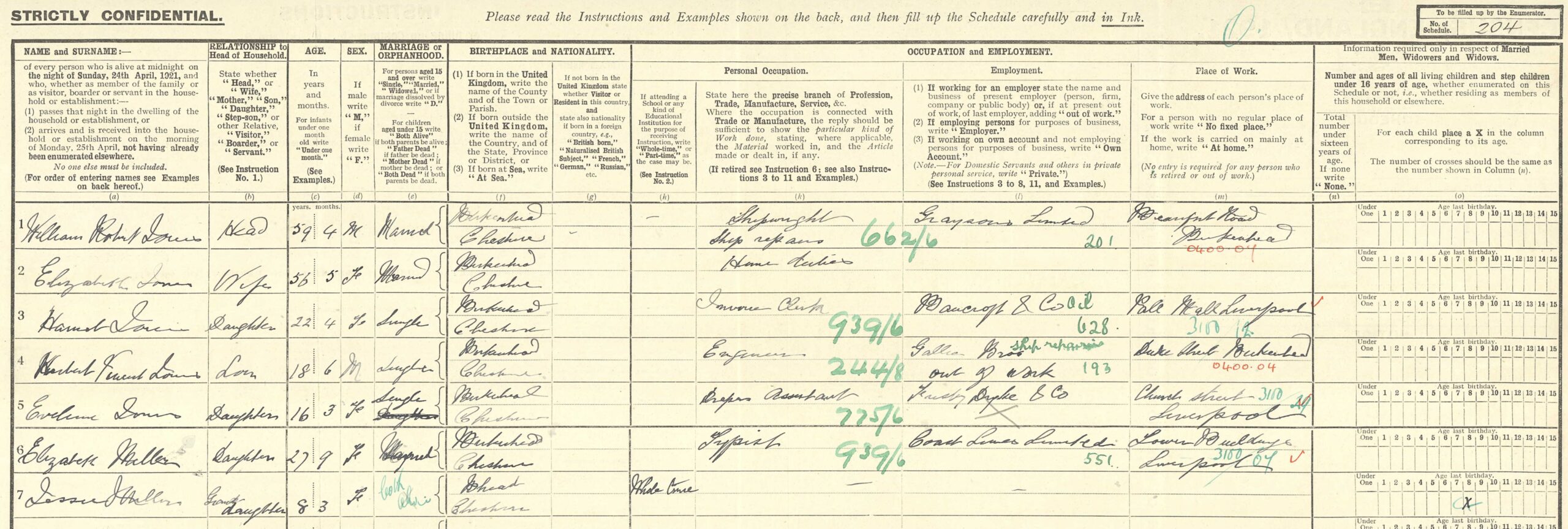
Evelyn (spelt Evaline or Eveline in various statutory and census records) Gillan Jones was born in Birkenhead on 7 February 1905, the daughter of Birkenhead-born couple, William Robert Jones, a shipwright, and Elizabeth ‘Cissy’ Gillan (sometimes spelt Gillam), who married in Birkenhead on 23 October 1889.
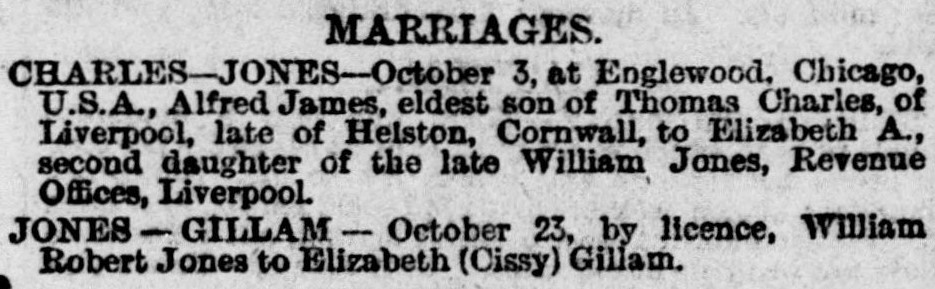
Liverpool Echo, 24 October 1889
Evelyn was the youngest of eight children born to William and Elizabeth, five of whom survived infancy, alongside her sisters Elizabeth and Harriet and brothers James Sydney and Herbert Vincent.

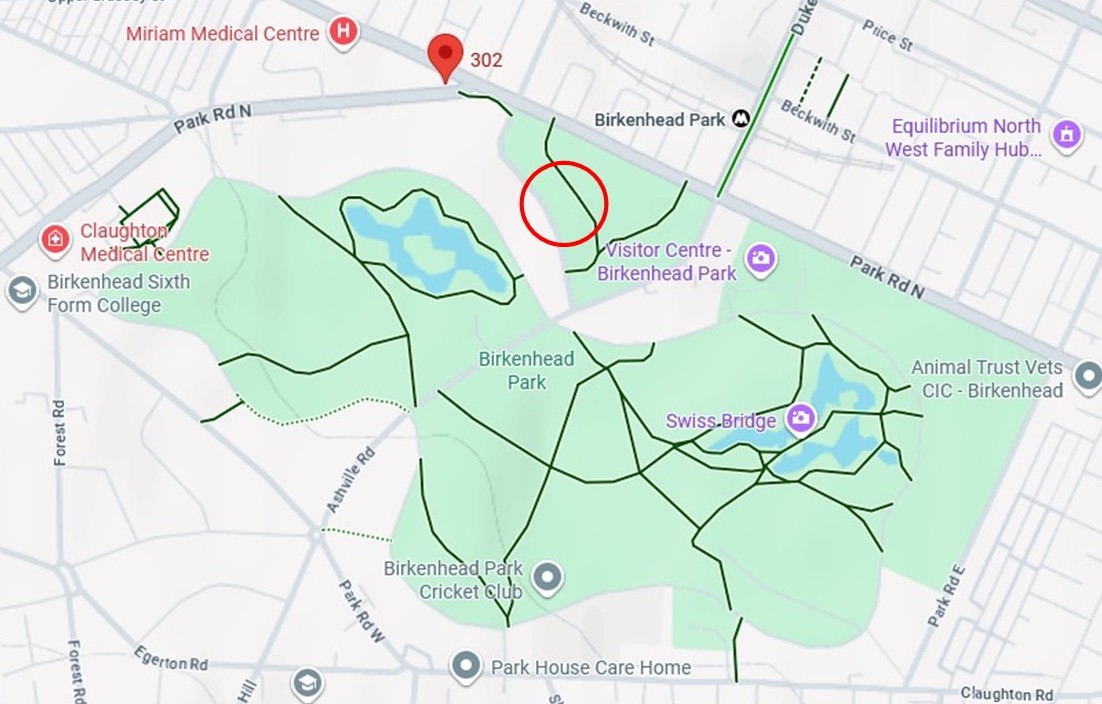
The Jones family lived at 147 Vittoria Street in Birkenhead as of the 1911 census. By 1921 they had moved to 302 Park Road North, at the northernmost tip of Birkenhead Park and just a short walk from the park’s tennis courts. At this time sixteen-year-old Evelyn was working as a draper’s assistant at the famous department store Frisby, Dyke and Company, on Lord Street in Liverpool. The store was destroyed in the May Blitz of 1941.
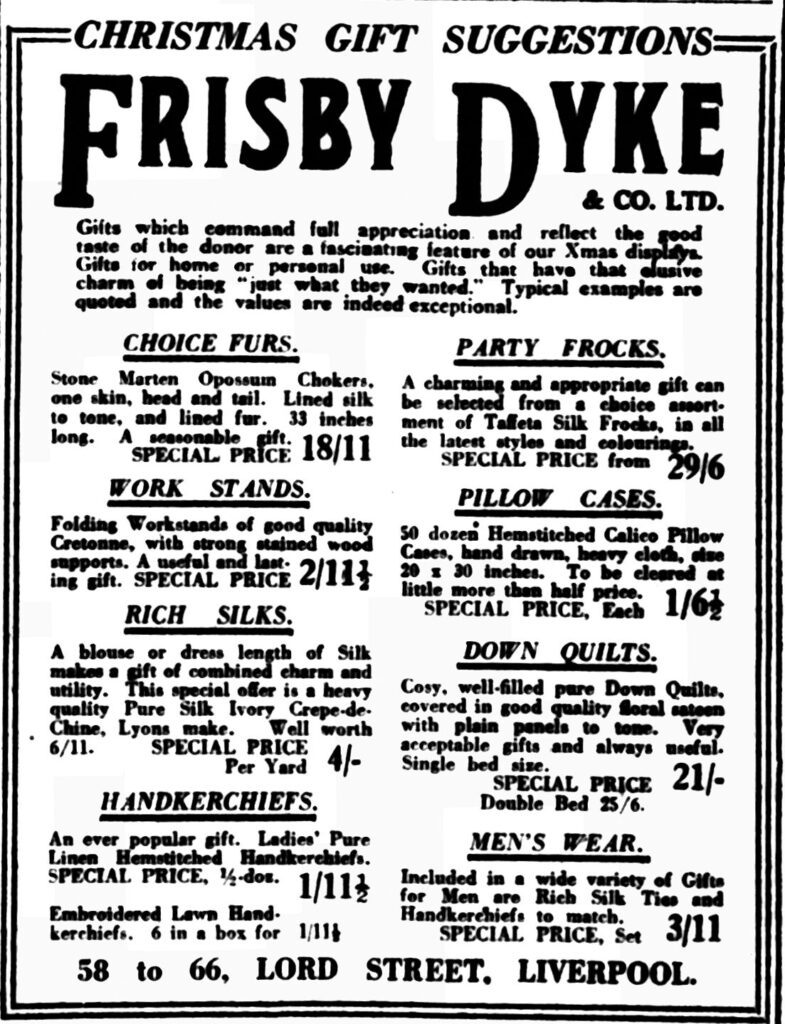
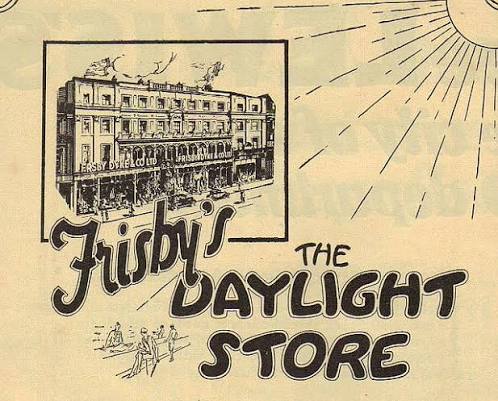
Frisby, Dyke and Co. Ltd,
58-66 Lord Street, Liverpool
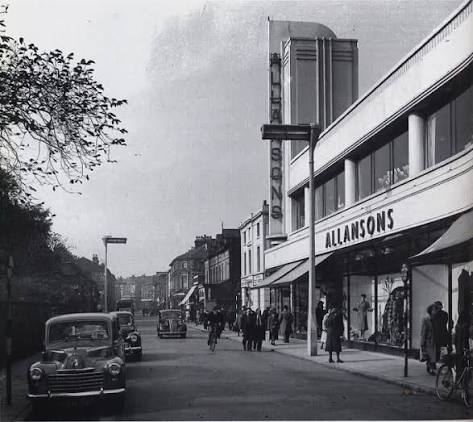
Grange Road, Birkenhead
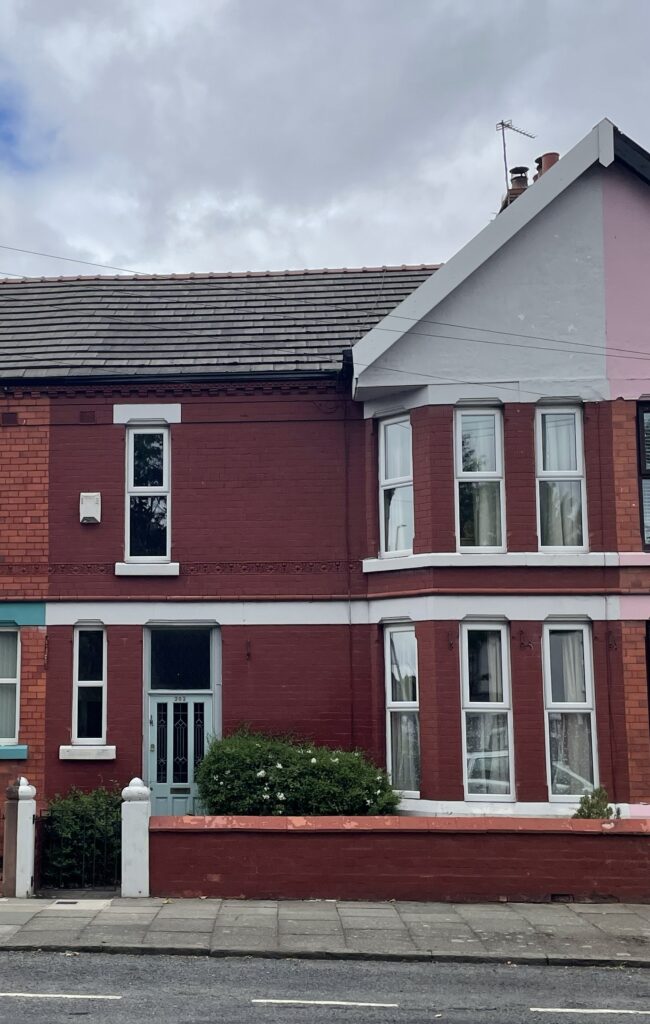
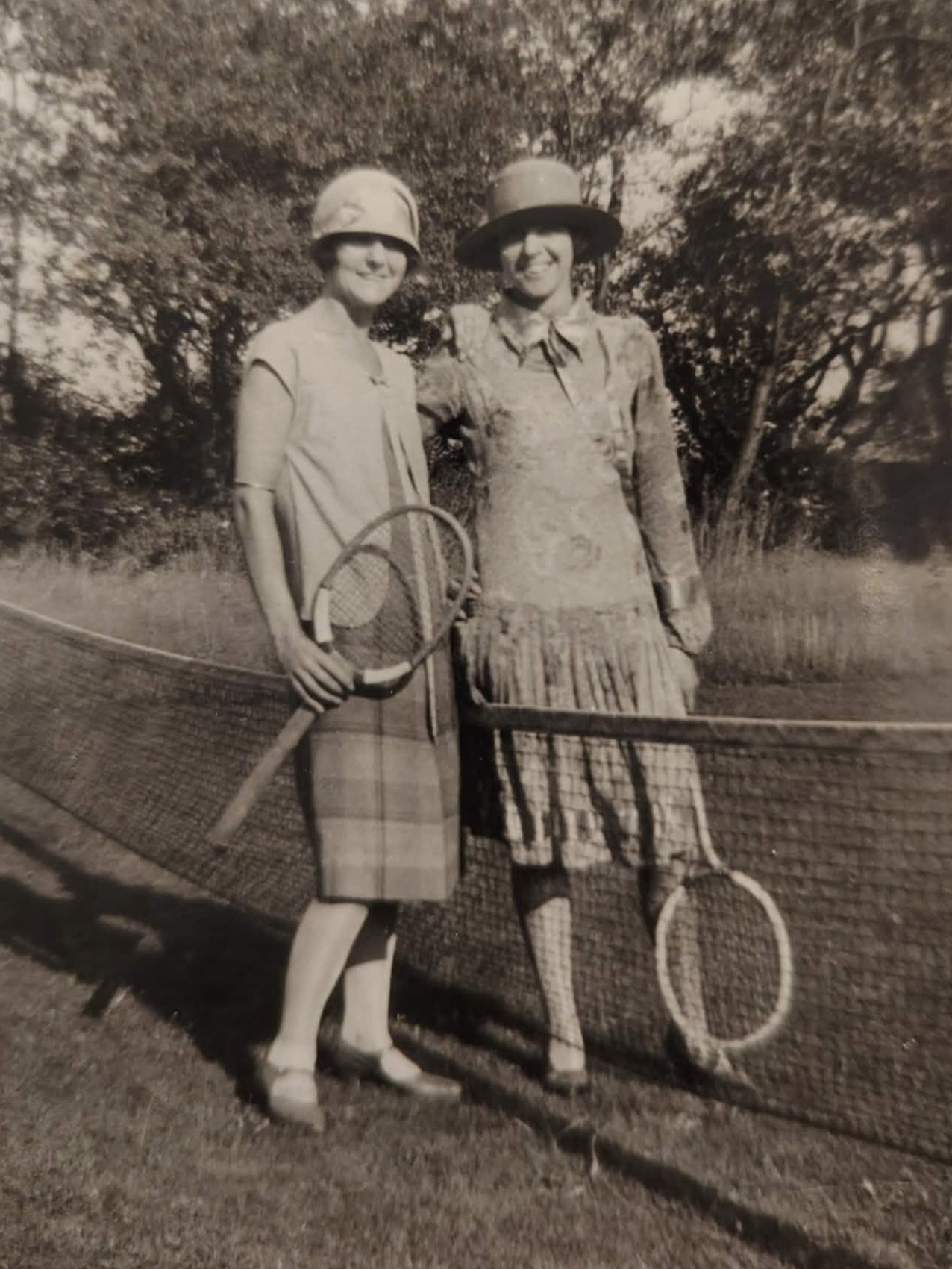
Newspaper reports from the days after the accident corroborate the Park Road North address and add that, by 1926, Evelyn was employed by Messrs. Allanson’s, drapers, of Grange Road, Birkenhead. Evelyn’s parents were still living at 302 Park Road North at the taking of the 1939 England and Wales Register at the outbreak of World War Two. A family photograph confirms that Evelyn played tennis.
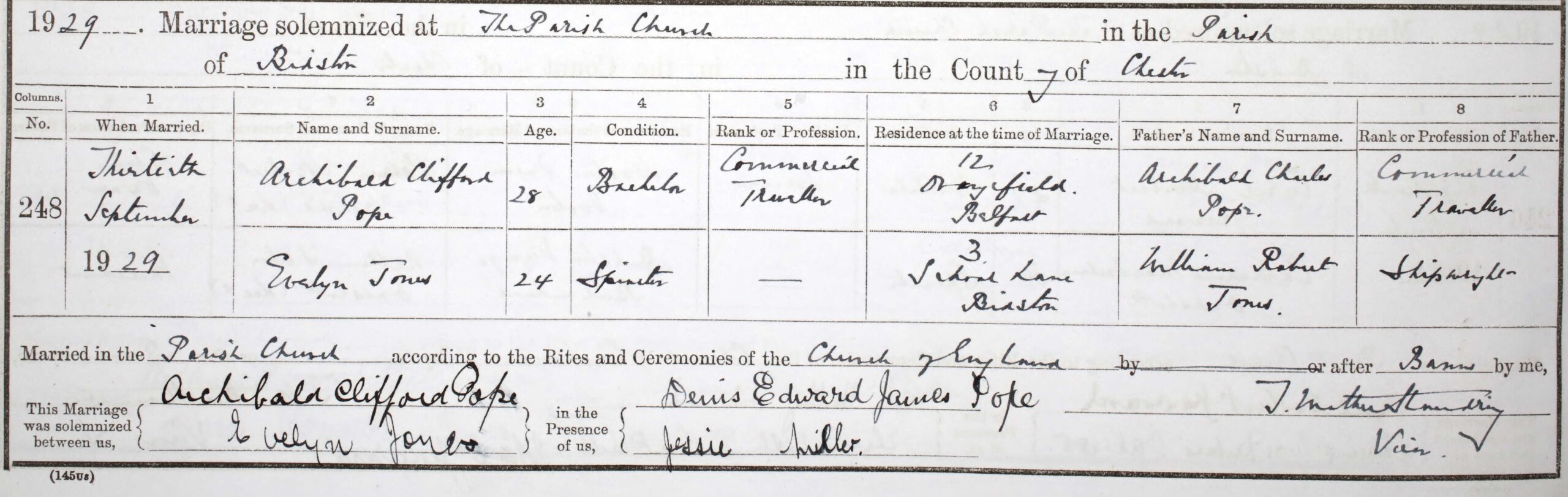
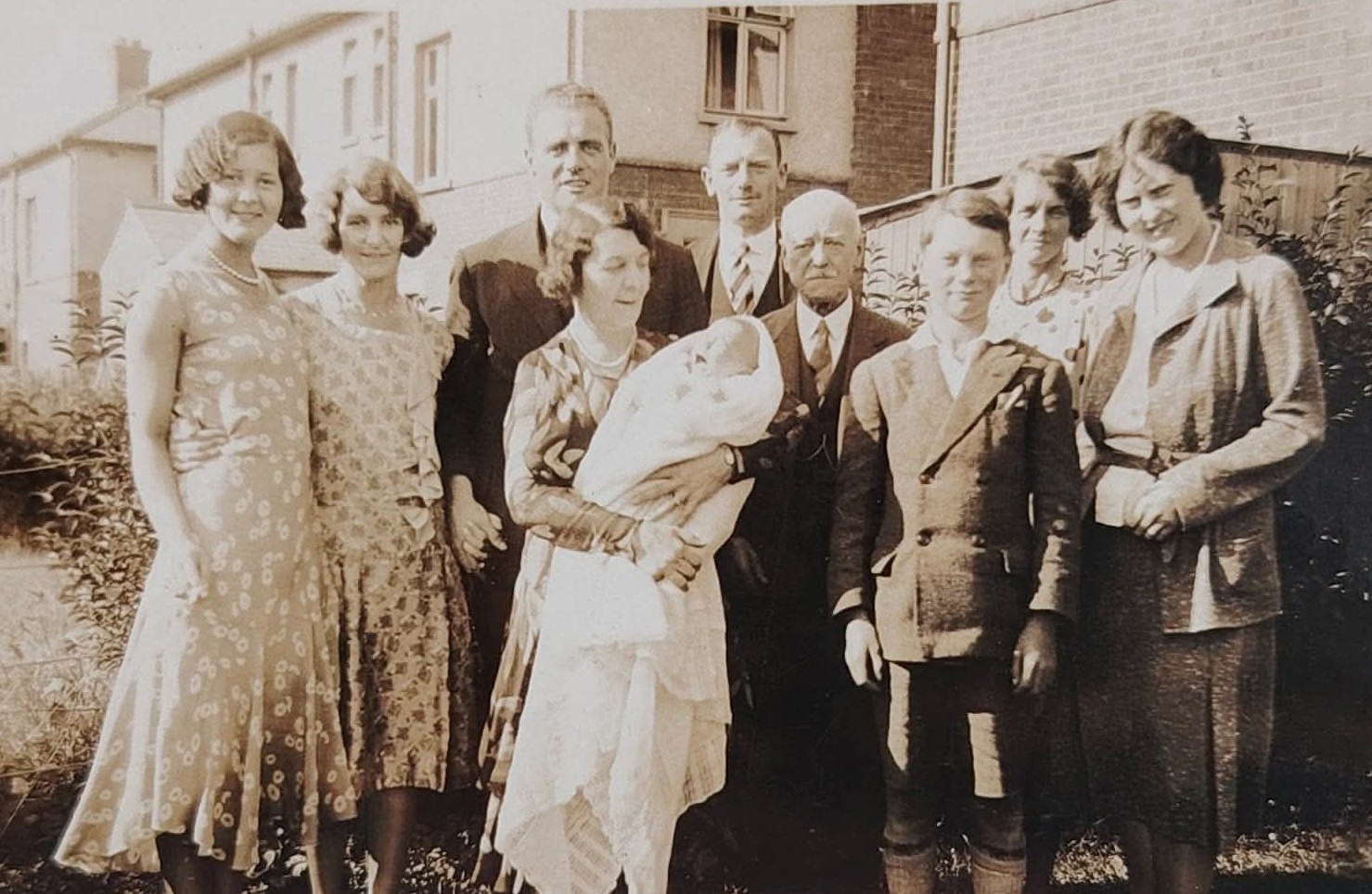
Evelyn married (Archibald) Clifford Pope, a Bristol-born commercial traveller, living in Belfast, at Bidston Parish Church on 30 September 1929. She was living at 3 School Lane in Bidston at the time and signed her name on the marriage register with the ‘Evelyn’ spelling. Her niece Jessie Miller, who lived with her mother, Elizabeth, grandparents, aunts and uncle at the house on Park Road North at the taking of the 1921 census, was one of the witnesses. Clifford and Evelyn settled in the Knock area of Belfast and there, on 12 June 1931, Evelyn gave birth to a son, Derek Brian Pope, their only child.
Dixie Dean – Life After Everton
In 1939, a thirty-two-year-old William Ralph Dean, having left Everton in 1937 for a brief stint at Notts County, crossed the Irish Sea to sign for Sligo Rovers, 130 miles west of Belfast. There he scored eleven goals in eleven games, including five in a 7-1 demolition of Waterford – which remains an individual club goal scoring record to this day. He also helped the club to the FAI Cup final, where they lost in a replay to Shelbourne.
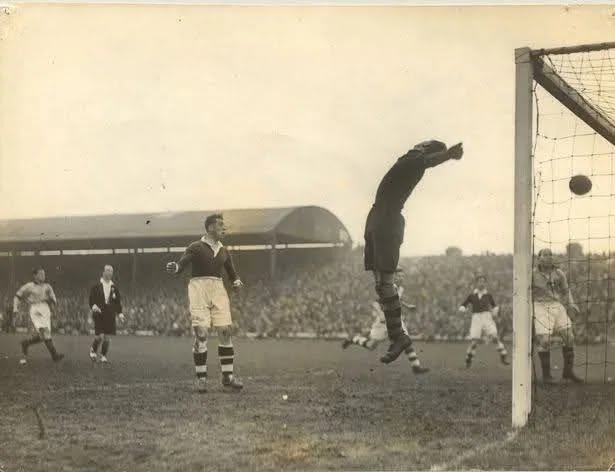
Dean headed the opening goal in the final, in the process becoming the first man to score a goal in the FA Cup final in both England and Ireland. The match ended in a 1-1 draw, and Sligo lost the replay by one goal to nil. In another barely believably twist, Dean’s runners-up medal went missing after the final. When Dixie returned to Ireland thirty-nine years later as a guest of Sligo Rovers, to attend the 1978 final between his former club and Shamrock Rovers, an anonymous package was delivered to his hotel room which contained the stolen medal (another version of the story claims that the medal was mailed to the Dean at the Dublin Packet public house in Chester which he ran for several years after the Second World War).
There is one final quirk of fate in the story of Evelyn Jones and her association with William Ralph Dean. In notching 383 goals in 433 league and cup matches for Everton, Dean scored an English club record of thirty-seven hattricks, another record which still stands today. On 24 June 1961, Evelyn Jones’ only child, Derek, was married at First Derry Presbyterian Church. The name of his bride was Anne Mitchell Hatrick. Of course, the couple had three children!
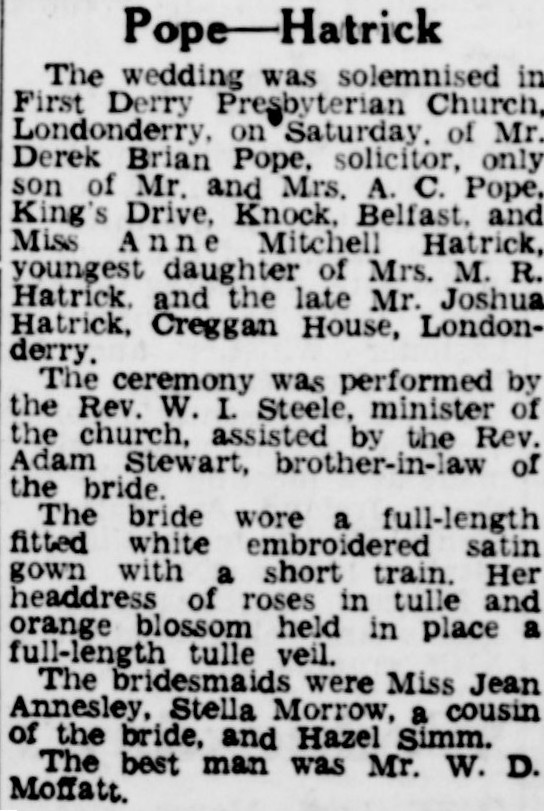
Northern Whig, 26 June 1961
Evelyn Pope died aged eighty-five on her father’s William’s birthday, Valentine’s Day, in 1990. Her funeral took place at St. Columba’s Parish Church in Knock three days later. Clifford, Evelyn’s husband of over sixty years, passed away aged ninety on 1 February 1992.
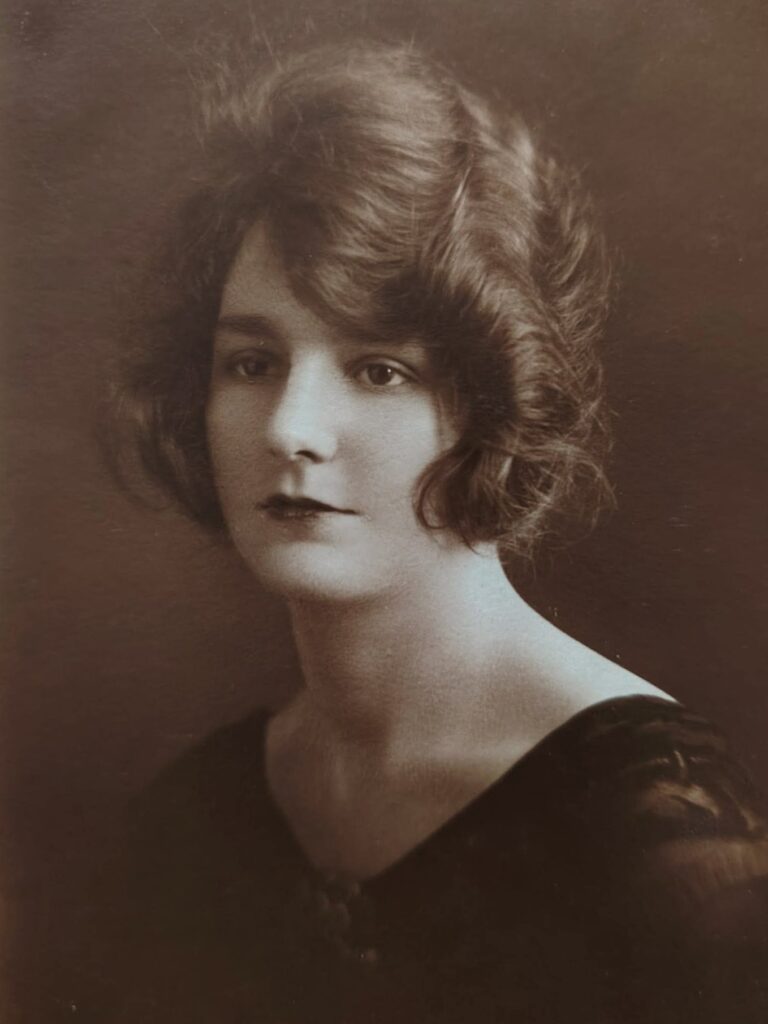
Evelyn never told her grandchildren of her adventures with Dixie Dean in the 1920s. It was not until I traced and contacted them in June 2026, one hundred years after the event, that they learned of her involvement in the motorcycle accident.
DIXIE’S SIXTY
I can’t help but wonder what might have happened if Dixie Dean had never been involved in that accident in 1926. What if he hadn’t almost lost his life, or, at best, the physical ability to compete at the top level of football with his beloved Everton? Would he have achieved such great things? Could he perhaps have done even better without the injuries and untimely stalling of his soaring career trajectory? How did the accident impact him psychologically?
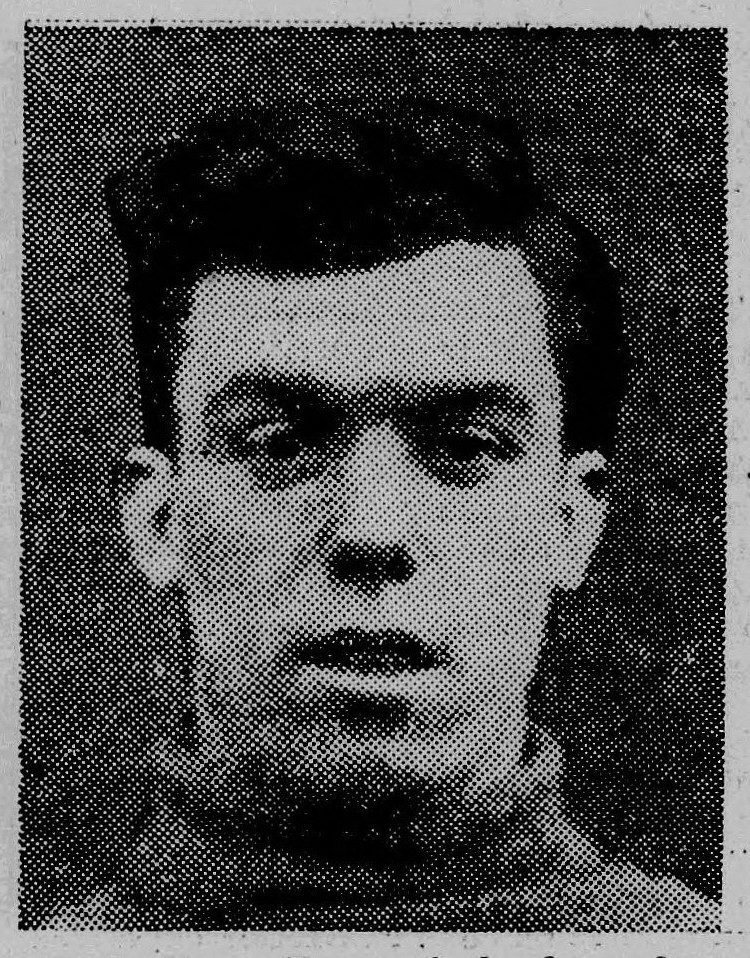
Not yet out of his teens, William Ralph Dean was the hottest young goalscorer in English football in June 1926. It isn’t difficult to imagine that almost losing it all before it really began may well have spurred him on to even greater accomplishment. I’m not suggesting for one moment that it was a good thing that the accident happened, but it must certainly be considered a watershed moment in Dean’s life.
Eight weeks before the crash, on 1 May 1926, Everton had travelled to Bolton Wanderers on the final day of the 1925/26 season. They won the match 2-0. Dean scored his thirty-second league goal of the season after fifty-six minutes and thirty-seven-year-old Sam Chedgzoy, in his three-hundredth and final appearance for Everton, signed off in style with a clinching goal four minutes from time.
What might have turned out to have been Dean’s final appearance for Everton Football Club was only his forty-seventh for the club in league and cup, during which he had already scored thirty-five goals. Had he never played again what would become of Everton? Could they have afforded to replace Dean? They must have considered the available options, if only as a back-up plan if the worst case scenario transpired and Dean never returned. Relegation would surely have been a certainty for Everton had Dean not been fast-tracked back into the forward line as hastily as he was, and then what? Certainly no 1927/28 League Championship and no record sixty-goal haul for Dean. And then there is the unanswered question of what long-term impact rushing back to fitness may have had on Dean’s health and wellbeing for the rest of his life.
The passage of time and the telling of tall tales on the Goodison Park terraces over the years has seen so many myths and legends about Dixie Dean spawned, or truth embellished. Fact is often more awe-inspiring than any fantasy when Dean’s story is told in full. Examples are his stubborn refusal as team captain to give the Nazi salute during Everton’s summer tour of Germany in May 1932; or (my personal favourite) the time he passed his friend, Liverpool’s brilliant Irish international goalkeeper Elisha Scott while walking on the street in Liverpool (or was it Dublin… or Belfast?!). Dean innocently nodded a greeting to his great rival, and Scott dived instinctively, through the plate glass window of a jeweller’s shop in a desperate effort to save Dean’s imaginary header! The motorcycle accident was no different and various, jumbled or embellished versions of the story have been circulated over time.
Dean himself spoke often about the accident in interviews later in life, often telling contrasting stories. In ‘The Lost Interview: Uncut’ (Ken Rogers, 2005, which includes the transcripts of Liverpool Echo journalist Michael Charters’ lengthy 1971 conversations with Dean), Dixie shared the following recollection of what occurred:
‘A chap driving a car cut in and then dropped back and then suddenly cut in again coming towards me. I had the choice of either going into the car or going down the mountain, so I went right through the windscreen of the car. But before the crash I was able to turn round and push the girl off the bike. She only damaged her ankle, fortunately, but I fractured my skull, broke a cheekbone and fractured my jaw in two places.’
In the same conversation Dean shared the quite possibly apocryphal story of his being found by visiting Everton secretary Tom McIntosh high up an apple tree in the grounds of the Robert Davies Nursing Home, throwing fruit down to the nurses below. Once back on his feet, restless and keen to help, Dean did apparently serve as a porter at the infirmary in Wales before being moved to the nursing home, but might also have sprinkled this particular tale with a little stardust when claiming that one of his jobs was to convey corpses to the mortuary. He was only at the infirmary for eighteen days, and presumably not fit to be wheeling dead bodies around for much of that time.
When discussing his reserve team comeback game at Huddersfield in October 1926, Dean remembered Everton trainer Harry Cooke’s concern about his attempting to head the ball. He claimed that winger Ted Critchley flung over a cross after fifteen minutes, which he met with a firm header into the back of the net, setting his side on the way to a 2-0 victory. Just a few problems with this particular version of events; namely, Dixie didn’t score that day, Everton lost the match 0-3. Oh, and Ted Critchley didn’t sign for Everton from Stockport County until December 1926, two months after the match at Huddersfield!
Dean continued:
‘In those days you got £1 bonus for winning a reserve game, and I was a goal up towards £1 so I stayed on. We won 2-0 and I’ve never felt anything wrong as a result of the accident ever since. As a matter of fact, I think the skull fracture knitted twice as hard, so they tell me, and it considerably helped me with the old heading trick.’
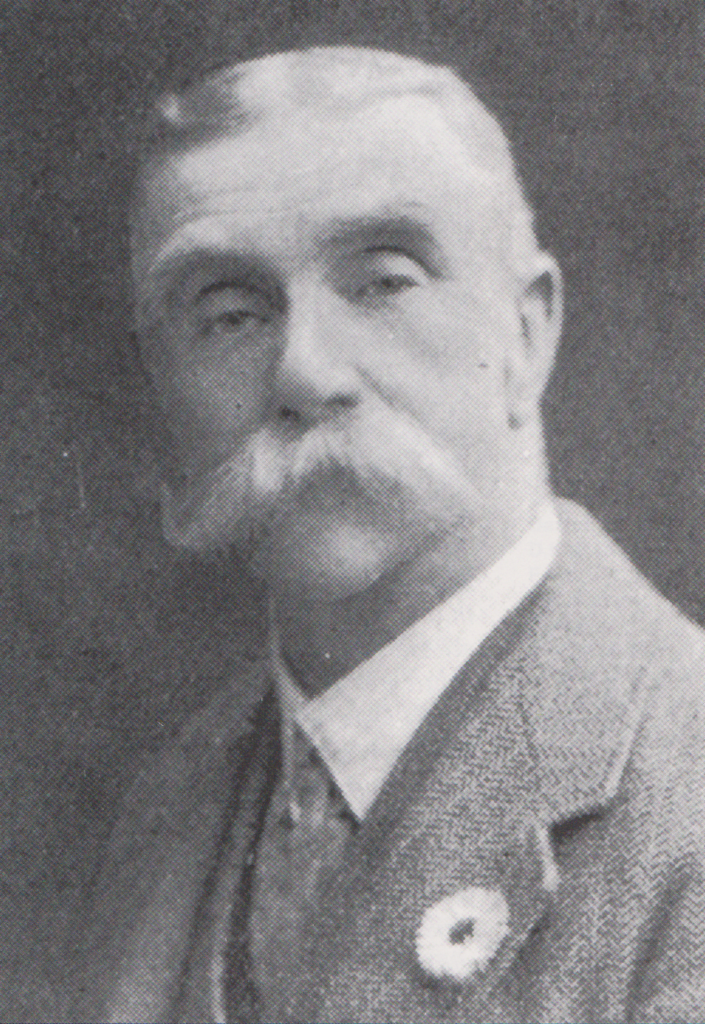
Whether or not the manner in which the fracture healed reinforced Dean’s skull in any way – and remember the crack was to the base of his skull, not his forehead – according to former Everton director Thomas Keates, Dean’s heading ability was always more a case of craft and guile than sheer power. In his 1929 golden jubilee history of Everton Football Club, Keates wrote:
‘Heading the ball in the open field is carried to excess. Ordinary players butt the ball with the crown of their heads, and it usually goes over the bar. Dean artistically glides it downwards with the side of his head. In this respect he excels every other famous centre forward. His head-play is the primary contributor to his success.’
However, Keates himself was responsible for some questionable reporting in the same publication:
‘In June, 1926, in the close period, Liverpolitans were shocked by Dean’s motor-cycle accident in North Wales. His skull and jaw-bones were fractured, and the doctors were afraid he could not live for many hours. His survival astonished them. Progressing favourably he was removed to a West Derby Nursing Home. For months he wore silver plates in his head, the Club meanwhile taking care that he had the best medical care and treatment. When recovery was assured the medical pronouncement was, “This man will never be able to play football again.”’
There is no evidence that Dean ever had any metal plates inserted directly into his head. The fracture was to the base of his skull, so no plates would have been required elsewhere. The broken bones in his jaw were held together temporarily with metalwork while the broken bones reset. There is also no indication that any public pronouncement was made stating that Dean would never play football again, although early reports did mention that doctors had initially feared for his life. Notably, only three days after the accident, club physician Dr. Cecil Baxter was quoted in the press as saying hopes were that Dean may return to play for the team before the end of the 1926/27 season.
Like Dean, both Thomas Keates in his 1929 book and John Roberts in his 1978 centenary publication on the History of Everton FC, erroneously claim that Dean scored a goal in his reserve team comeback at Huddersfield. Roberts mistakenly places the date of the accident ten days early on 10 June 1926, and states that Evelyn Jones only suffered minor injuries when, of course, she fractured her right leg. Roberts does, however, clarify the ‘metal plate’ confusion at least to an extent:
‘Metal plates were inserted to help the jaw-bones mend – but these were removed when the bones were set (the story about the magical plate that enabled Dean to head the ball with such power is a myth).’
Keates does, however, articulate the sense of magic and wonder at Dean’s return quite beautifully:
‘The romance of Dean’s recovery, and the amazing increase in his skill, are psychological, physiological, and supernatural occurrences, and are striking witnesses in favour of the aphorism that “fact is stranger than fiction.” His future and its achievements will be watched with absorbing interest by the football world – may the fates be kind – may he be another of Everton’s long-service men – a devoted attache of the Club in which he rose to fame – and the Club which is proud of him.’
In Keates’ obituary – he sadly died in October 1928, a few months before the publication of his book – the Liverpool Echo closed by stating that Keates: ‘had a fine flow of language, and a happy aptitude for gossip-cum-news’. At its heart football is a game for romantics, for terrace storytellers with tales of heroes, villians, what-ifs and maybes. It always has been. A character like William Ralph Dean comes along and the myths and legends just write themselves. As Keates rightly said, the truth was almost always much stranger and more fantastical than any fiction where Dixie was concerned.
Nick Walsh’s 1977 biography of Dean meanwhile repeated the claim that Dr. Baxter and others were convinced that Dean would never play football again. Walsh also told the ‘apple tree’ tale in almost children’s storybook terms:
‘One day (Dean’s) doctor discovered him climbing an apple tree in the hospital garden helping to pick fruit for the kitchen staff. Sir Robert Davis, the famous bone specialist, who noticed Dean was moving from branch to branch with great agility, remarked, “If you are fit enough to do that, you can get back to Everton as soon as you like!” Delightfully, Dean scampered down and, after thanking Sir Robert, rushed off to make ready to return to his beloved Everton and football.’
Dean was of course moved from the hospital to the Robert Davies Nursing Home on Eaton Road in West Derby to continue his rehabilitation and for ease of access to X-ray facilities in Liverpool, technology not available at the more primitive Lluesty Infirmary. In an interview mentioned earlier in this article, Dean mistakenly referred to the facility as the ‘Sir Robert Davis Nursing Home.’ However, the image of the great Everton striker ‘scampering’ down a tree and gleefully back to Goodison Park having been spotted leaping like a monkey from branch to branch by a ‘famous bone specialist’ is somewhat fanciful.
One Sir Robert Davis, inventor of cutting-edge underwater breathing apparatus for Royal Navy submariners and the man who introduced a form of ‘iron lung’ to the United Kingdom in the 1930s, died in March 1965 aged ninety-four. I cannot find a bone specialist or orthopaedic surgeon of the same name anywhere in history.
Walsh also claimed that, after his discharge from the nursing home, one of the first things Dean did was to ‘find a motorcycle and ride it to re-establish his confidence.’ This would presumably have concerned the Everton board of directors enormously, as they drafted new contract terms for their players in response to Dean’s brush with death, precluding them from riding motorcycles during their term of engagement with the club – a paragraph Peter Beagrie must have failed to have noticed in his Everton contract around sixty years later!
The final, curious, claim in Walsh’s biography concerns Dean’s reserve team return. Apparently, when Dean rose to head the ball for the first time in the match, the crowd let out a cry in unison of ‘His head! His head!’ Once play resumed the supporters began to chant of ‘He’s alright. He’s alright.’
Fact or fiction, these are all scintillating stories which serve to preserve the folklore, aura and mystery surrounding Dixie Dean and ensure that his story will continue to be told for centuries to come.
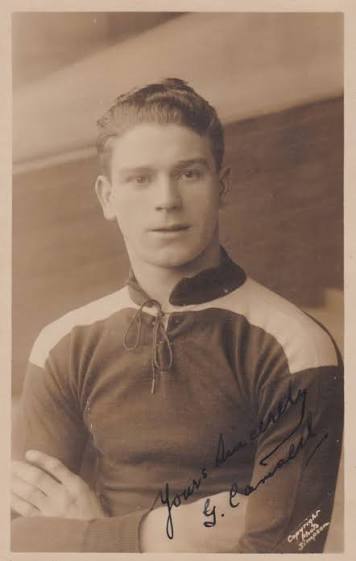
At this point it seems right to spare a thought for George Camsell. Fate can also be a fickle mistress, and such a truism must have played on the mind of the Middlesbrough striker at the end of the 1927/28 season. Only twelve months previously Camsell had set a seemingly insurmountable fifty-nine goal Football League goalscoring record, propelling his team to promotion to the topflight, while Dean worked hard on his rehabilitation, and Everton floundered. Everton’s second fixture – and first away game of 1927/28 – was scheduled to take place at Ayresome Park, home of Camsell’s Middlesbrough.
A buoyant ‘Boro led 3-2 at half-time thanks to a George Camsell hattrick. The former coalminer added a fourth goal in the second half to crown a 4-2 victory for the newly promoted Teesiders. Dean scored Everton’s second goal that day and the goalscoring exploits of the twenty-four-year-old Camsell must have made an impression on him. A latecomer to the professional game, Camsell’s Football League record at the end of that August afternoon stood at an incredible eighty-seven goals in sixty-five matches for Middlesbrough and Durham City.
Did Dean fear being left behind, viewed as old news, while the likes of Camsell, who proceeded to score goals at a phenomenal rate for the rest of his career, dominated what were once his headlines? Maybe he was worried that the Everton directors had been scouting other strikers – the likes of George Camsell perhaps – to replace him should he fail to regain his form and fitness. For the record, there is no mention in the Everton meeting minutes of any big-name centre forward – Camsell included – being considered as a replacement signing during Dean’s convalescence.
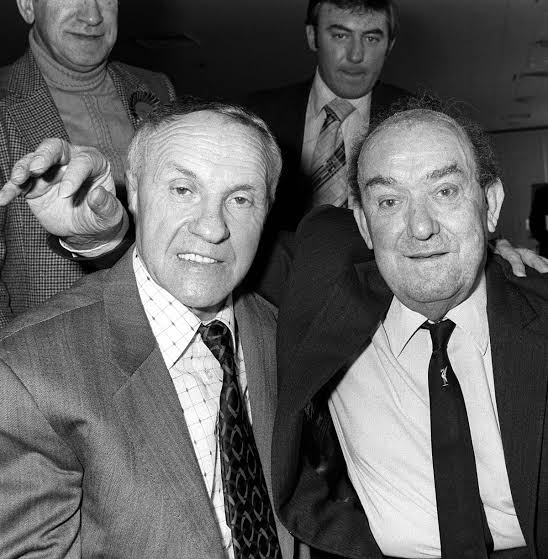
1 March 1980 (Liverpool Echo)
It is not difficult to arrive at the conclusion that all these factors combined to propel Dean – a strong-willed, fiercely competitive character – to the greatness he achieved. This left Camsell damned with the faint praise of being the man whose record was broken by Dean, rather than spending any more than twelve months as the record holder himself. Camsell’s achievement was no mean feat, and it must be hoped that one day his story will be told to a standard which does him justice. I wonder whether Dean and Camsell ever discussed the goalscoring art at which they both excelled at any great length.
The tale of William Ralph Dean’s record-breaking season has been told many times. Sixty league goals in thirty-nine appearances in 1927/28; a stunning achievement and a record which has stood for almost one hundred years at the time of writing. Something the likes of which Association Football in England will surely never see again.
On 1 March 1980, the very day that Dean passed away while sitting in the Goodison Park directors’ box at a Merseyside derby match surrounded by 50,000 adoring fans, the great Bill Shankly remarked:
“Dixie was the greatest centre forward there will ever be. His record of goalscoring is the most amazing thing under the sun. He belongs in the company of the supremely great like Beethoven, Shakespeare and Rembrandt.”
Could Dixie Dean have wished for a more fulsome tribute than this from his old friend and on-pitch adversary Shankly, an icon of Liverpool Football Club, Everton’s greatest rivals?
***********************
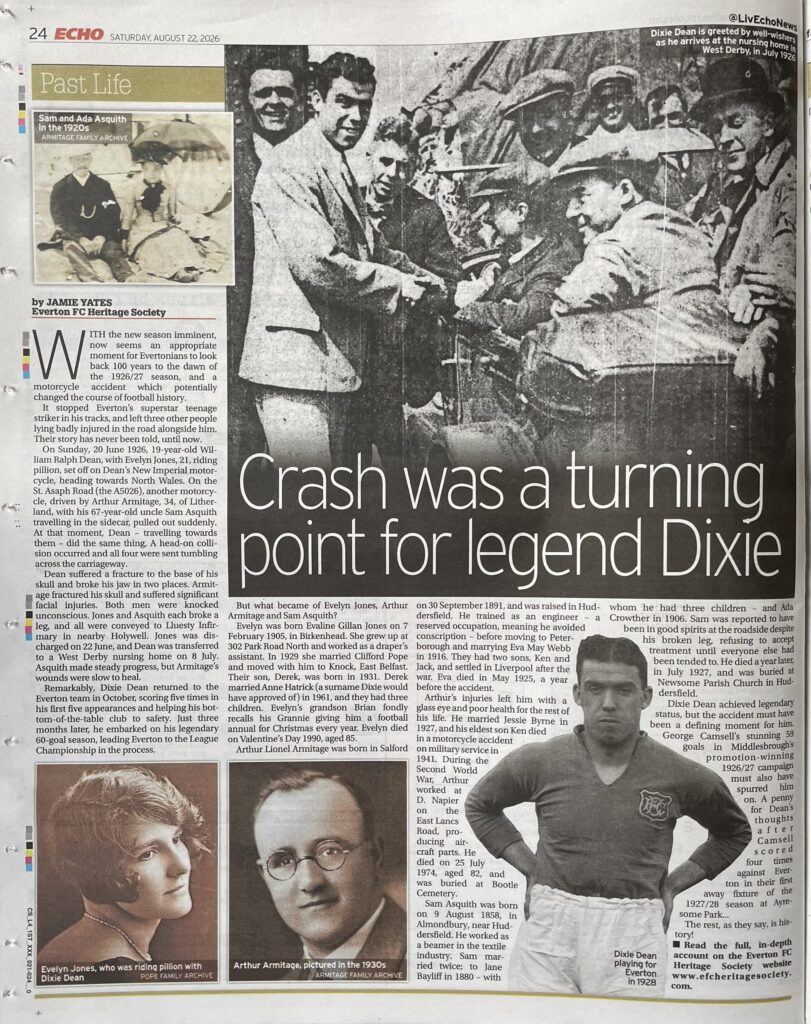
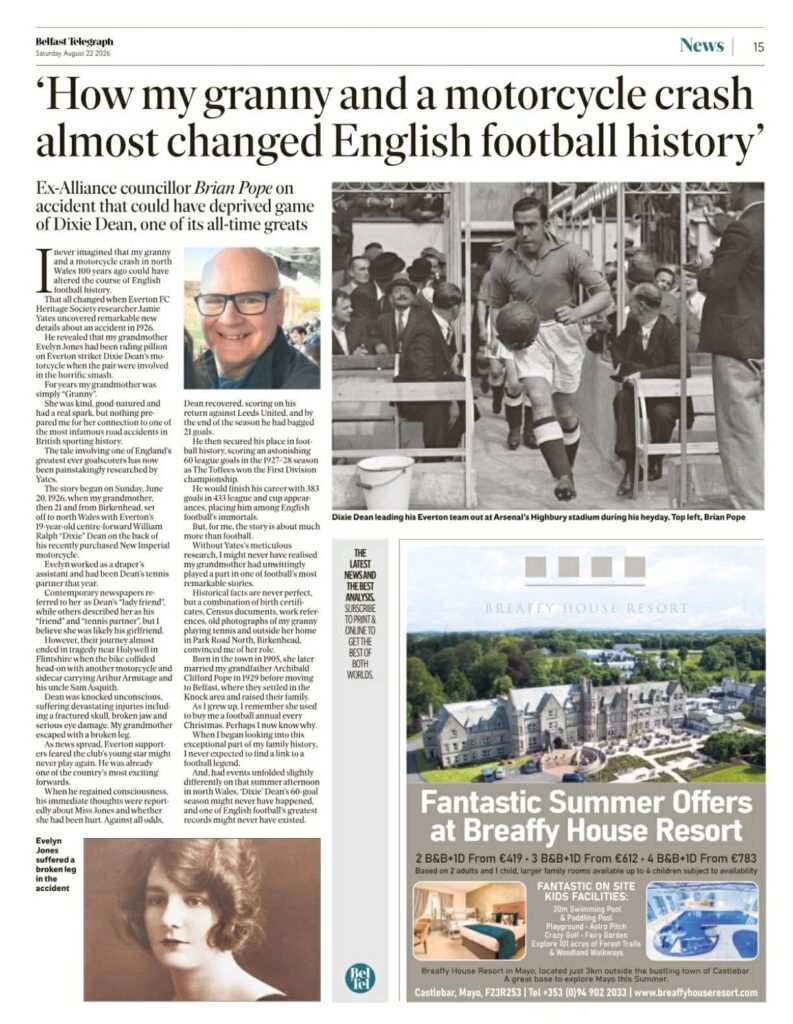
Following publication of this article here on the Everton FC Heritage Society website, the above story was picked up by the Liverpool Echo and Evelyn Jones grandson, Brian Pope, submitted his own reflections to a piece in the Belfast Telegraph.
***********************
Acknowledgments:
With thanks to Jan Armitage for providing such insightful biographies of her grandfather Arthur Armitage and great grand uncle Sam Asquith, plus the accompanying photographs.
Thanks also to Brian Pope and his siblings Susan and Ian for helping me confirm that I had the correct Evelyn Jones and furnishing me with the wonderful photographs of her.
Sincere thanks to my friend Melanie Prentice, granddaughter of William Ralph Dean, for her endorsement of this article, which means the absolute world.
Steve Johnson’s goldmine www.evertonresults.com makes life so much easier. Thanks Steve.
Thanks also to my pals Paul Owens, Tony Turner and Rob Sawyer for proofreading and making suggestions,
and to Rob for supplying some of the texts used in researching this piece of writing.
Finally, thanks to my great friend Mike Royden for his patience and support in helping me make my full debut editing an article on our brilliant website!
Images gathered from a variety of sources, all credited where possible.
Bibliography:
Keith, John, Dixie Dean: The Inside Story Of A Football Icon (Robson Books, 2001)
Walsh, Nick, Dixie Dean: The Life Story of a Goal Scoring Legend (Morrison & Gibb Ltd., 1977)
Roberts, John, Everton: The Official Centenary History (Granada Publishing Ltd., 1978)
Rowlands, John K, Everton Football Club: 1878-1946 (Tempus Publishing Ltd., 2001)
Keates, Thomas, The History of Everton Football Club 1878/79-1928/29 (Thomas Brakell Ltd., 1929)
Rogers, Ken, The Lost Interview: Dixie Dean Uncut (Trinity Mirror Sport Media, 2005)
Johnson, Steve, www.evertonresults.com
Everton Board Minutes, The Everton Collection (online), Liverpool Record Office
Liverpool Echo
Flintshire County Herald
Daily Express
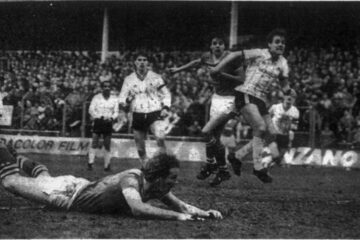
Header photo: Christmas Day 1926 – Dixie Dean scoring against Sunderland, one of four in a 5-4 victory.
Jamie Yates, 20 June 2026
–
Brilliant article, Jamie! What a legend was WR Dean. One of our own, and the best to ever do it. Lovely stuff!