Richie Gillham
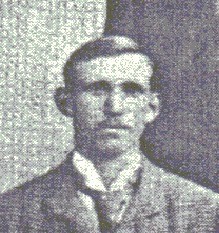
John “Jock” Gillespie was born on Tuesday 15 November 1870, in Falkirk. Jock and his three brothers were all good footballers. His brother, George L. Gillespie, was a well-known player of the day who played for Queen’s Park, another brother, Alexander, played for both Queen’s Park and Falkirk. William Gillespie, a third brother, also made occasional appearances on the football field and was a keen cyclist. Their father John, a Ship Carrier , too, was known as an athlete of some prowess. George was one of the founders of the Falkirk Amateurs Football club too.
Like George and Alec, Jock excelled at athletics, especially the 100-metre sprint. An example of his athletic prowess came in 1898 at the Queen’s Park Athletic Meet:
“The annual athletic fete amongst the members of the Queen’s Park F.C. was concluded on Monday in presence of a good crowd of spectators. The heats of the one hundred yards were won by R. McFarlane (7), D. Sillars (scratch), E. Hamilton, A. Burnett (7), John Gillespie (5), and J. Burnett. The final was a good race, and finished—1, A. Burnett; 2, J. Gillespie; 3, R. McFarlane.” (Scottish Referee, 1898)
He was a towering figure and a very handy lad in the tackle in Scottish sport, a man who combined footballing excellence with military service and civic duty. Best known as a stalwart defender for Queen’s Park FC – a team known as the Spiders – Gillespie also represented Scotland internationally and briefly wore the blue of English football giants Everton alongside playing for the mighty Glasgow sides of Celtic and Rangers among many more clubs. Away from football, the local press reported that Gillespie fought gallantly for the Queen’s Own Royal Glasgow Yeomen in South Africa during the Boer War.
At the age of 18, Gillespie played for Clydesdale Harriers against Falkirk in a friendly at Brockville Park, Falkirk, on 5 January 1889. Two weeks later, on 19 January, he made his debut at half-back for the Spiders in a friendly against nursery side Queen’s Park Strollers, As the documents from his playing days show, Gillespie played for many teams. As he was an amateur, he turned out for different teams in the same season though at this early stage he shone with Falkirk where he won the Stirlingshire Cup and the Falkirk District Charity Cup in 1889/90 and was a runner-up in the District Cup in 1890/91. Additionally, he was twice runner-up in the Falkirk Infirmary Shield (1889/90, 1890/91). Overall, Gillespie played a total of 66 games for Falkirk, scoring on three occasions.
Gillespie was described as a pillar of strength at the back and unflinching when faced with five forwards coming his way – as would happen at the time. On 2 May 1891, he picked up further silverware in the 9-1 hammering of Northern in the replay of the Glasgow Charity Cup final.
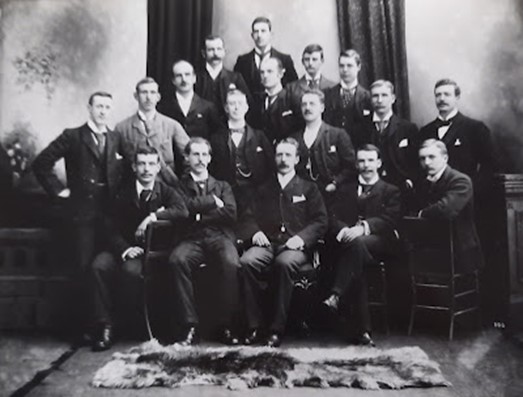
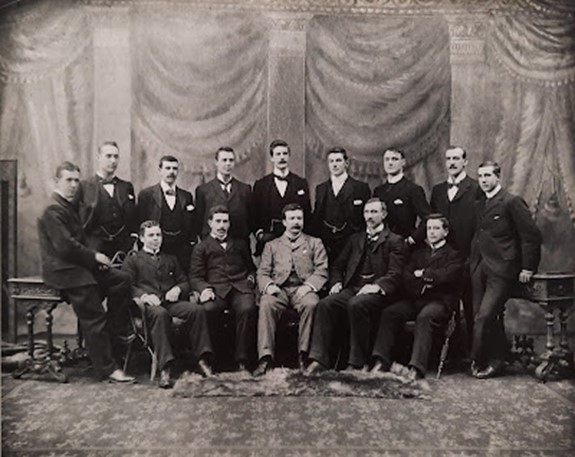
(Fourth row from left) – W Arnott, W Stewart, and W Berry. Third row – H Jones, A Baird, and W a Lambie.
Second row – W Gulliland, J Gillespie (light suit), J McTavish, G Gillespie, T Robertson, and W Sellar.
First row – J Hamilton, R Smellie, R Browne (President), T S Waddell, and D Sillars.
After gaining some great press reports, Gillespie started to be recognised outside of his club and in 1892, whilst a Queen’s Park player, he was chosen for a Scottish Inter City game alongside five of his team-mates, David Stewart, William Gulliland, Tommy Waddell, Jimmy Hamilton and Bill Sellar to play for Glasgow at Logie Green in Edinburgh. Hamilton scored both Glasgow goals in a 2-2 draw.
Back at Queen’s Park, they made it to the Scottish Cup final that year, but on 9 April 1892 received a lesson against the might of Celtic in a 5-1 defeat.
The following season, on 11 March 1893, Queen’s Park got their revenge by beating Celtic 2-1 in the Scottish Cup final. This was their 10th cup success but unfortunately their last victory in the competition. Further defeats came in other competitions: 2-1 in the Glasgow Charity Cup Final against Celtic on 12 May 1894 and then -in what must have been a ding-dong battle 6-3 in the Glasgow Cup final on 16 May 1896, at Ibrox Park in front of 25,000 fans. Gillespie’s steady performances for the Spiders continued to get him noticed by the national-team scouts and eventually won him a place in a trial game on Wednesday 25 March 1896, representing the Home Scots against the Anglo-Scots. It was the final trial match before the big game with England, and it attracted a crowd of 17,000 to Ibrox.
The Scottish selectors were so impressed that Gillespie was made captain for the visit of Wales to Dundee in March 1896. Almost 12,000 were at Carolina Port to see it, a 4-0 win over Wales 0 in the British Home Championship. The Scotland team that day R. MacFarlane , D. McLean, R. Glen, J. Gillespie(C), R. Neil, W. Blair, W. Thomson, D. Paton, R. McColl, A. King and A. Keillor, the goals came from Bobby Neill (19’, 71’), Alexander Keillor (39’) and Daniel Paton (59’).
Unfortunately, that was the only cap that Gillespie would manage as the competition for places was tough with players like Peter Meehan, the one-time Everton half-back, featuring regularly in the international side.
Back at club level, Gillespie’s side regularly reached local cup finals over the next few years but could not get rid of their bridesmaid’s tag when it came to overcoming the might of the Glasgow giants, Celtic and Rangers.
Gillespie continued his career at Queen’s Park in the Glasgow league and cup competitions. As already noted above, as he was an amateur, he could make guest appearances elsewhere and once such appearance was for Celtic against Aston Villa in a match for the unofficial ‘Championship of Great Britain’ with Gillespie getting a winner’s medal in a 3-2 victory. A later report, in 1912, discussed how well Gillespie played for Celtic that day and how proud he was to wear his winner’s medal so many years later.
On 20 September 1897, on the Edinburgh autumn holiday, John Gillespie turned out for Rangers alongside his Queen’s Park team-mate Glen in a Scottish league match against Hearts at Tynecastle which ended 2-2 in front of 10,000 spectators.
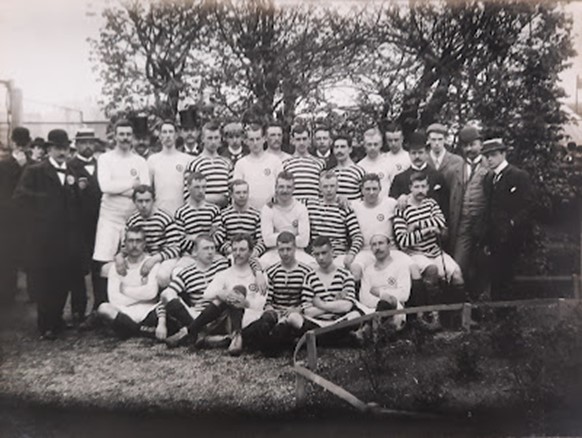
Back row – R S McColl, C B Miller, A J Christie, W A Lambie, R Anderson, K Anderson, J Ritchie, J Allison, R A Lambie.
Front row – J Irons, D Stewart, W Sellar, J Gillespie, H Butler.
A highlight for Gillespie was the Queen’s Park overseas tour to Denmark, with the Spiders invited to visit Copenhagen to take part in two exhibition matches at an International Festival of Sports and Gymnastics.
Gillespie was amongst the 12-man squad with staff and supporters also making the journey. He replaced the unavailable custodian, Kenny Anderson. Gillespie’s importance was underlined as he kept two clean sheets in Queen’s Park’s two matches against Dansk Boldspil-Union (Danish Football Union) sides at the Festival Ground in Copenhagen. They won the first match 7-0 on Monday 30 May in front of around 7,000 and the second 3-0 on Wednesday 1 June, with some 4,000 spectators in attendance.
“This was the first time an Association club from Scotland had played in mainland Europe and the tour was viewed as a great success both at home and in Denmark. Queen’s Park had introduced the Danes to a new swift short-passing style of football. Scottish Sport has this to say, “Football, not only in Copenhagen but throughout the continent, will receive a great impetus from the visit of the Queen’s Park.”
“Scots Wha Hae!
Queen’s Park have nobly upheld their own and their country’s honour in the land of the Dane. They vanquished the Danish Ballspiel Union by seven goals to none in the first match and combined Copenhagen by three goals to nothing in the second, so that muscular John Gillespie had little opportunity to display his marvellous fisting out abilities.” (Scottish Referee, 1899)
In March 1899, Queen’s Park drew 0-0 with Aston Villa in the Sheriff of London Charity Shield (the predecessor of the FA Charity Shield and now Community Shield).
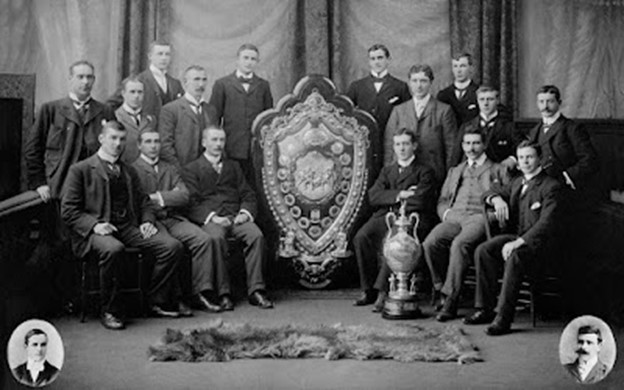
Back row (from left) – T A Bowie, D Berry, D Wilson, and J F Templeton.
Centre row – C B Miller (Secretary), W S Stewart, J Gillespie, J Walker, J Clarkston, and A McEswan.
Front row – K L Anderson, R A Lambie, J Lawrence (President), R S McColl, D Stewart, and J H Irons.
Inserts – W H Waller and A J Christie.
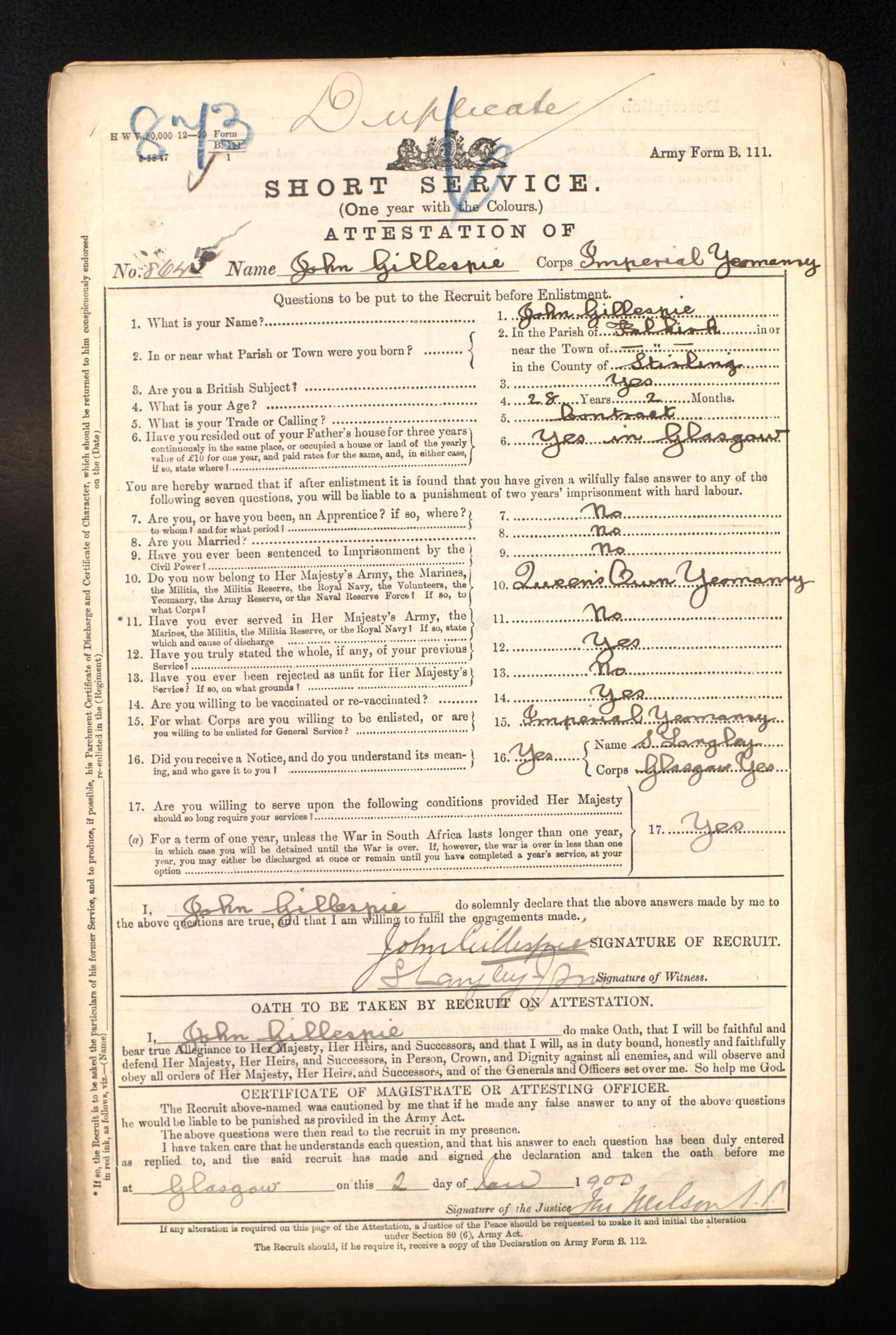
GILLESPIE ENTERS THE THEATRE OF WAR
Gillespie like many service men was well liked by his fellow Queens Park teammates, Management and the fans wanted to show their appreciation of his enlistment and started a Shilling subscription fund raising 200 shillings for him and his family, which was presented to him after an inter-city league game against Celtic Queen’s Park at a farewell dinner at Glasgow’s Bank Restaurant, presenting a gold ring and the purse of sovereigns.
Gillespie’s patriotism was as strong as his tackling, So much so that he volunteered for the Imperial Yeomanry to serve in the Second Boer war in South Africa, serving as a sergeant in the Queen’s Own Royal Glasgow Yeomanry. He was praised as “one of the best for this business” and “a man who does not know what fear is”.
“Among the volunteers in Scotland who have offered themselves for service at the front are quite a number of athletes well-known in local football, gymnastic, and pedestrian circles. Included in the members of the Lanarkshire Yeomanry Cavalry who have handed in their names is Mr. John Gillespie, full back of Queen’s Park F.C., who is canvassing for volunteers in his native place, Falkirk.” (Falkirk Herald, 1900)
Newspapers predicted he would make “a capital trooper,” citing his horsemanship and courage as per the following extract from the Daily Record.
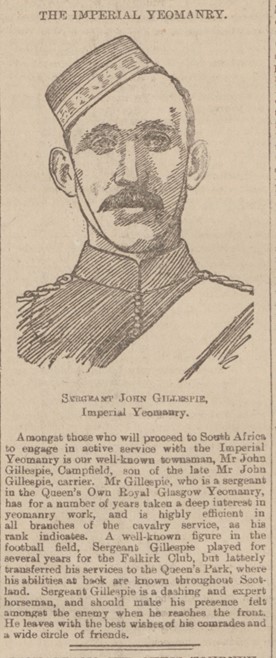
“Forward. ‘Brave Boys!’
In the Nation’s hour of need we are extremely pleased to see so many footballers volunteer for service at the front. One of the best we can think of for this business is John Gillespie, of Queen’s Park, who has gallantly offered to go forward. A good horseman and a man who does not know what fear is, he should make a capital trooper. Well known in the football world, we are sure all applaud his patriotism and hope he may be as distinguished in the field of battle as he is on that of football.” (Daily Record, 1899)
Allan H Ronald – historian of the Falkirk Local History Society, captured the following information about Gillespie and his time in the Transvaal in his work – Bairns and Boers – Falkirk and the Second Anglo-Boer War;
Gillespie, took to writing accounts to his family and the local press , he was described by one of those newspapers as “a dashing and expert horseman should make his presence felt among the enemy when he reaches the front.”
Sergeant John Gillespie, 16th Company, 4th Battalion, Imperial Yeomanry, continued to send his graphic and detailed accounts home to friends in Falkirk. He began with an account of the fast-moving campaigns that ended the second stage of the war. We camped there [Warrenton] for five days, and were attached to General Hunter’s Brigade.
We were his only cavalry in that long march of his when he took Christiania. Then we went across country to Taungs via Pokwani, where we managed to cut off about 6000 Boers who were on their way to ‘mak siccar’ with Mafeking, but there was no such luck for them. At this time we were the support to the Mafeking relief column…After the relief of Mafeking our men had a race with Baden-Powell as to who would first enter Lichtenburg and our 17th Company were in the town about five minutes, and had the flag hoisted, before Baden-Powell entered.
During this march we were introduced to our first real experience of campaigning. Throughout the whole march from Warrenton to Vryburg we rarely knew what it was to be in bed (what we called bed being a waterproof sheet under us and two rugs above us, with our saddles for pillows and the sky for our roof) after two o’clock in the morning. Reveille was sounded at 2 am, parade at 3.45, march at 4, and we were kept marching until about 4 or 5 o’clock in the afternoon with one hour’s rest about midday. Our rations at that time consisted of two biscuits per day, and one pound of bullock beef which, if it was not good feeding, was at any rate grand exercise for our jaw muscles . . .
On arriving at Johannesburg, we marched as escort to a convoy from there to Heidelberg . . . We left General Hunter’s Brigade at Heidelberg and were attached to the Mounted Infantry Brigade. With them we marched to Frankfort and then to Reitz. From Reitz we went to Heilbron with an empty convoy train. While we were encamped at Frankfort, I had a visit from two Falkirk ‘Bairns’, members of the Seaforth Highlanders. In the marches I have mentioned we never fired a shot, and it was on the second day out from Frankfort that I heard for the first time the ping of a Mauser bullet passing over my head . . . Just about a mile outside of Heilbron we came 3 across some ‘kilties’, and they turned out to be members of the A & S H. It was from them that I learned of the death of poor young Hunter. Whenever we got properly camped, I went across to the A and S H camp, which was at the station, and as I knew the quartermaster of the regiment I thought he would be the best one to tell me of Hunter’s illness, and also where I would find the rest of the ‘Bairns.’ Lieutenant Williamson told me of Hunter’s illness and said that he was at the hospital when Hunter died, and he deeply regretted his death, for he said that he was a real nice lad. He also told me that his servant, Crum (of whom he spoke in high terms of praise) had nursed him as no other nurse could have done. I did not see any of the Volunteers that night at the camp, but when I returned to our own camp, Paton was there waiting to see me.
Next day the A & S H left but I saw all the ‘Bairns’ before their departure. There is something deeply moving about Sergeant Gillespie’s account of the devotion of Private Crum to his dying master, and about his concern, deep in the vast veldt, to keep up contact with his fellow Bairns, so far from the ‘Dear Auld Hame.’ He displayed this concern again in later letters home: We stayed in Heilbron for three days and then we marched to Kronstadt.
At Kronstadt I met a lot of Glasgow medical students, who are out here as volunteers serving in the Scottish Red Cross Hospital. I asked for young Mr Fraser, but it seems he is with the Edinburgh branch at Cape Town. This hospital is doing great work here. I was talking to several of the patients. One or two of them had been in other hospitals, and they all say this is really the best one they have been in both for treatment and the care that is taken of them . . . I assisted the football team that the orderlies had got up. We played against the 4th battalion, Argyll and Sutherland Highlanders. The result was one goal each. That was on the Saturday. Next day (Sunday) – this is the British Army’s busy day – we entrained for Winburg. There is no such thing as a carriage when the authorities here give us a journey in one of their trains. We are just packed like sardines in a box….When we arrived at Winburg we were ordered back to Ventersburg Road Station, where we arrived on Monday at 7 am. We marched to the town of Ventersburg, a distance of nine miles. At this place we had a taste of what I am told is still to come – namely, the rainy season. If the rainy season be worse than what we had at Ventersburg, I would sooner face the Boer bullets than have a lengthy experience of it…our poor horses standing over the fetlocks in glaur.
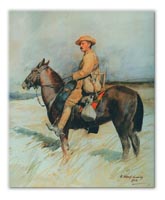
In May 1901 Sergeant John Gillespie and Trooper Peter Thomson, of the local troop of the Queen’s Own Royal Glasgow Yeomanry, and Mr Alistair Fraser of the RAMC and Private Bell of the Volunteer battalion of the Argylls, arrived off the 6.33 pm train from Glasgow to a tremendous reception. “Some six or seven hundred people lined the road from Parkfoot to the High Station…the Falkirk contingent of the Queen’s Own Yeomanry were in attendance, and with their imposing brass helmets and spirited chargers, presented a fine spectacle. An open carriage had been procured 12 in which to drive the active service men from the station to the town, but a band of working men unyoked the horses from the carriage and declared their intention to themselves drag it down. The Burgh band was also in attendance.” The procession headed off to the Crown Hotel where a smoking concert had been organised. “The band played ‘Soldiers of the Queen’ on leaving the station, and the procession passed through the High Street, where the enthusiasm of the crowd was unbounded, to the strains of ‘The Dear Auld Hame’.”
There is something very pleasing, having met several of this quartet through their letters from South Africa, in seeing them safe home and heading for a jolly on the town. Other soldiers returned individually from South Africa and the local press recorded their necessarily less public arrivals; Private John Porteous, Royal Marine Light Infantry, of Ladysmith and Peking fame, was, however, “carried shoulder high through the streets of [Grangemouth], accompanied by a pipe band, on his return from the front.”33 Others returned seriously ill from wounds or disease; Private Arthur Abbie of the Argylls, for example, had been invalided home, and, while he lived, was supported by money from the Grangemouth Dockyard War Fund. This fund also paid the costs of his funeral and donated a lump sum to his widow, another example of a man and his family being looked out for by his fellow-workers. Allan H Ronald, Bairns and Boers – Falkirk and the Second Anglo-Boer War.
During his time in South Africa, Gillespie met up with Hope Robertson, who had also enlisted with the Yeomanry, He had set sail for South Africa after completion of his training. There, he kept his hand in as a footballer with the army team and, amazingly, met Jock Gillespie, another player with a Queen’s Park connection, who would go on to play for Partick Thistle and Everton. After just over a year there, Robertson took ill and, back on British soil, he received treatment under the auspices of the Chelsea Military Hospital (making him a Chelsea Pensioner), before being discharged in April 1902.
The Everton Episode
In late 1901, Gillespie shocked Scottish football by agreeing to assist Everton in English Cup ties. This move was controversial, as Queen’s Park upheld strict amateur principles.
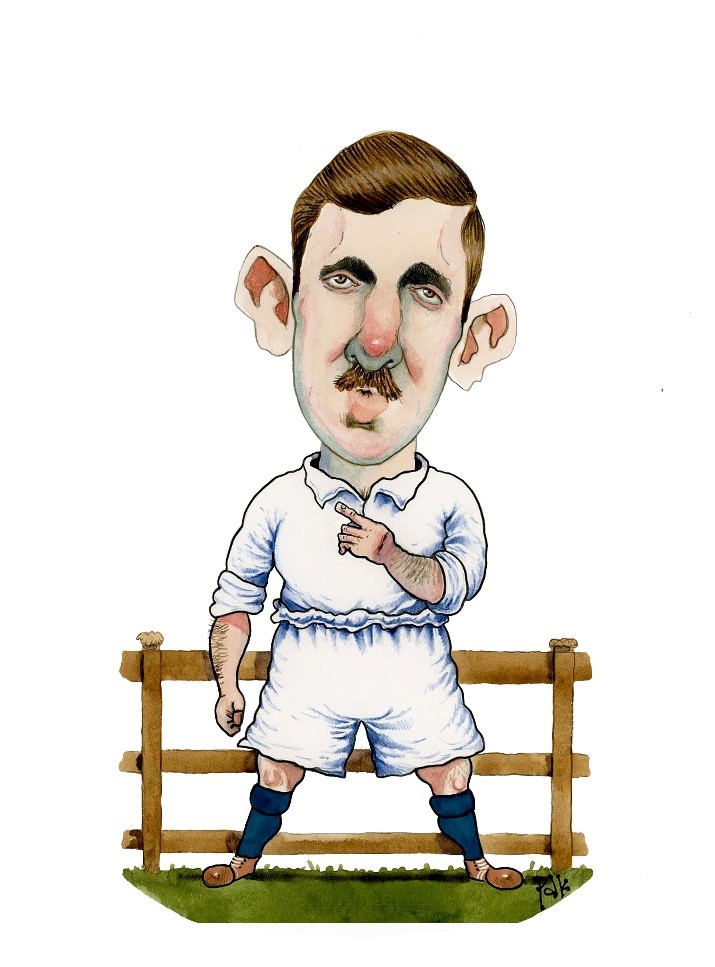
(Image courtesy of Dr David France, ‘Dr Everton’s Toffeemen’. Artwork by Peter-King)
Initial announcements confirmed Gillespie’s intention to play for Everton. Later, the Everton secretary issued a denial, stating Gillespie was “not coming at all,” highlighting the confusion and tension surrounding the question of amateur vs professional status.
Everton’s denial was reported in the following fashion:
“The Everton secretary denies that John Gillespie, of Queen’s Park, has consented to play as an amateur for the Goodison team. The denial carries with it no reservation; Gillespie is not coming to Goodison as a ‘paid’ amateur a la MacLaren, or a full-blown ‘pro.’—he is not coming at all.” (Lancashire Evening Post, 1901)
Everton’s signing was soon confirmed, however.
“GILLESPIE, OF QUEEN’S PARK, AND EVERTON.
A week or two ago we reported that John Gillespie, the well-known full back of the Queen’s Park, had signified his intention of playing for Everton. The accuracy of our statement was questioned in some quarters, but we can now say that Gillespie has, in fact, decided to play for Everton in the English Cup ties.” (Dundee Evening Post, 1901)
On Monday 21 April 1902, Gillespie did indeed turn out for the Toffees firstly against Hamilton Academical at Douglas Park. Indeed, Gillespie was not the only guest for the Blues, a Stenhousemuir Hearts player whose surname was Hamilton also joined the Everton line-up. The Blues won the game 4-0, with Gillespie helping secure a clean sheet with special mention given to his strong clearances from the penalty box. For the record, the Everton scorers that day were Jack Sharp, Jimmy Settle, Jack Taylor and John Proudfoot.
Gillespie would miss the Raith Rovers 4-4 draw, for Everton though he did return to Everton’s Scotland tour, a few days later, in front of a crowd of around 1,500, Gillespie returned alongside Hamilton at Falkirk’s Brockville Park. This time the goals were scarce with the only strike coming from Jimmy Settle from a corner.
“The two local men in the Everton team –J. Gillespie (the old Queen’s Parker) and Hamilton (of the Stenhousemuir Hearts). Gillespie defended in his usual vigorous style, and Hamilton made a good show. Everton intended to have had some other juniors on trial” Falkirk Herald, April 1902
The Blues without Gillespie in the side then moved on to Glasgow, from where they travelled to Belfast to play Glentoran – a match that finished goalless in front of 3,000 fans.
The whistle-stop tour was not over yet, as Everton returned to Scotland, where the might of Celtic awaited them at Parkhead. The crowd was 1,500, and both sides had a few trialists playing, with the visitors bringing in John Russell and Jimmy McMenemy from Rutherglen Glencairn and Jimmy Sheridan from Cambuslang Hibernians. Everton took the lead through Jack Taylor, but the game ended 1-1 when Celtic’s Hamilton equalised.
The next stop for the Everton party was Dens Park and a 1–1 draw with Dundee. McPherson scored for the home side and John Proudfoot for the Blues in what was described as a dour game. Gillespie returned to the side after missing the Celtic game and gave another fine display in his final game for Everton was.
The Another club who looked to Gillespie were Partick Thistle. Whenever they came knocking, he was always accommodating – indeed the Jags never lost a game when Jock donned the jersey! The defender first appeared as a guest for Thistle in March 1902, having most recently been with Queen’s Park. Now aged 31, he made his debut on Saturday, 15 March 1902, in a 2-1 win at home to Morton in the Western League. Jock scored his only goal for Thistle on Wednesday, 26 August 1903, in a 1-1 friendly draw away to Port Glasgow Athletic.
He played his last game for the club on Saturday, 12 March 1904, in a 3-0 win at home to Airdrieonians in the SFL First Division, having appeared as a Jag on six occasions.
After returning from South Africa, Gillespie worked as a commercial traveller for a Glasgow brewing firm and continued his association with the Yeomanry, notably when he helped recruit volunteers in Falkirk for World War One. Gillespie did not give up his footballing career completely, and would also play occasionally for Falkirk and St Johnstone in charity matches.
Ultimately, when he did retire from playing, the long list of clubs whose shirts he had worn contained Comely Park, Falkirk, Clydesdale Harriers, Queen’s Park, Camelon, Celtic, Rangers, Falkirk Amateurs, St Johnstone, Partick Thistle, Everton and Scottish Amateurs.
Gillespie was something of a sporting all-rounder with golf being his next area of success – indeed he won tournaments in Falkirk and Glasgow. His proficiency was reflected above all by his winning an open tournament on the Carmuirs course. Additionally, Gillespie was a well-respected referee in junior football and amateur men’s leagues and helped as a legislator. He retained his connection with Queen’s Park, taking an active interest in club affairs as a member of the committee. In 1932 became the club’s vice-president. Sadly, he passed away a year later, in 1933, in a nursing home in Edinburgh.
………………………………………………
Acknowledgements
Simon Hart – Proof Reading
Mike Royden – Proof Reading and layout
Bibliography
- Anglo-Boer War Forum https://www.angloboerwar.com/forum
- Allan H Ronald, Bairns and Boers – Falkirk and the Second Anglo-Boer War Part 1, October 1899-September 1900, The Falkirk Local History Society
- Smith, Billy – Blue Correspondent
- Scottish Referee, 1898–1899. Reports on Queen’s Park Athletic Meet and Copenhagen tour.
- Falkirk Herald, 1900. Coverage of Gillespie’s enlistment and local recruitment efforts.
- Daily Record, 1899. Commentary on footballers volunteering for the Boer War.
- Dundee Evening Post, 1901. Confirmation of Gillespie’s Everton signing.
- Lancashire Evening Post, 1901. Everton’s denial of Gillespie’s transfer.
- Ulster Football and Cycling News, 24 April 1896. Jock assisted Celtic
- The Thistle Archive http://thethistlearchive.wikidot.com/jock-gillespie
- Queen’s Park Football Club – An Early History: Season 1895/96. http://www.qphistory.com/
- Match reports and club records from Queen’s Park F.C., Everton F.C., and Partick Thistle F.C.
- Historical match summaries and player statistics from Scottish football archives and local newspapers (1890–1933).
- Find My Past