1890-1899

Rob Howarth – a Former Everton Captain

The host of FA dignitaries who had been present at the opening of Goodison Park had now left Liverpool and the Everton committee assembled to start the new Football League season in earnest.  (Goodison had been officially opened on 24 August 1892 by Lord Kinnaird and Frederick Wall of the Football Association. No football was played; instead the 12,000 crowd watched a short athletics event followed by music and a fireworks display). Their first opponents would be Nottingham Forest. The much published decision to move from Anfield was complete and the new club, now a limited liability company, would be…
Read More
William H Parry, a former Captain of Everton Football Club

William H Parry, a former Captain of Everton Football Club

The clean-shaven young man, seated on the right of the middle row, is an eighteen-year-old player who had recently established himself in the first eleven of an Everton Football Club at the time of the photograph. As he gazes towards the camera and watches for the 'birdie', he is unaware that, in the course of the forthcoming football season, he will score the goal that will earn his club the right to lift their first piece of silverware. His football career, however, is destined to be cut short by injury. William Henry Parry was born in 1864 in the north…
Read More

The Life and Times of Frank Brettell

The name of Everton forward Francis Edward Brettell first appeared on the Liverpool census in 1871 when he was reported as living at No 5 house, Court 13, on Boundary Street. His Father, William Brettell, listed his occupation as that of a nut and bolt maker, and gave his birthplace as West Bromwich in Staffordshire. His wife Harriet, the mother of Frank, was  born in Devonshire. Nine year old Frank, born at Smethwick in Staffordshire, was the eldest of her three children. The premature death of Harriet, in 1881, saw Frank, along with rest of the family, move in with…
Read More

The Men Who Bankrolled Everton

The original History of the Everton Football Club, by Thomas Keates, published in 1928, tells us that James Clement Baxter, who was reported to have loaned them £1,000 [worth around £135,000 today] was the man credited with financing their move away from Anfield and over to Goodison Park. This alas, according the Liverpool newspapers, does not appear to be the case. The good Doctor did indeed make a generous donation to aid their departure but he was not alone in doing so. Several other people, some prominent local businessmen amongst them, were also credited with giving the club their support.These…
Read More

A Christmas Tale from Liverpool

The retail stores of Liverpool had filled their windows with Christmas gifts to remind their potential customers that the festive season of 1888 was near, when a twenty years old Scotsman arrived at Tithebarn Railway Station to be greeted by the representatives of Everton Football Club. The weary traveller was John William Angus and he had been spotted while playing football in Glasgow, by a talent scout who dispatched him down to Liverpool, where he was to spend a trial period at Anfield. The Scot would have then been taken by the club conveyance, to meet the lady with whom…
Read More
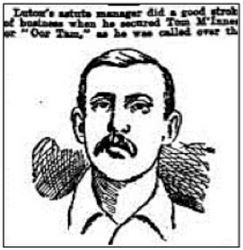
“Our Tam” McInnes, an Everton First

“Our Tam” McInnes, an Everton First

[NB. This article first appeared in the run-up to the Merseyside derby April 2016] When the football clubs of Everton and Liverpool run out to meet each other in the forthcoming Merseyside derby, it will be for the 194th time in the League.   No other city in England can claim to have staged more local derby games at the top level of English football than Liverpool.   The game will take place on the former home of Everton at Anfield before a capacity and fiercely partisan crowd. The atmosphere will be electric.  Yet, when these two deadly rivals first…
Read More
The Magnificent Footballing Andersons of Liverpool

The Magnificent Footballing Andersons of Liverpool

When asked recently who was the first Liverpool-born man to play Association Football for England or score a goal in an FA Cup final, I was not able to answer the question. I then commenced to trawl through the FA records, and after much deliberation, appeared to have found the two most likely candidates to fill these roles. I was surprised to discover that they both belong to the same family. Rupert Darnley Anderson was born on 29 April 1859 and baptised the following June at St Paul's church in the Princes Park area of Liverpool. He was the fifth…
Read More

The Hope of Everton

In November 1890, the Everton executive dispatched their club captain, Andrew Hannah, back to his native Scotland and instructed him to find a player who would strengthen the side and help them clinch the Football League Championship. They informed him he could offer a signing on fee of £50, plus a weekly wage of three pounds and ten shillings a week. Hannah later returned with Hope Ramsey Robertson, who had agreed to join the Anfield club from Patrick Thistle. Robertson was born on 17 January 1868 in the Govan area of Glasgow, and was the third child born to assurance…
Read More
Alex Lochhead, the Everton Wing Half from Neilston

Alex Lochhead, the Everton Wing Half from Neilston

Over the years many Everton players have been asked to make their debut in some tough 'must win' situations. But the first of these must surely be a young Scotsman who arrived in Liverpool during November 1891 at a time when his new club were challenging to take the Football League Championship away from Preston North End. Alexander Lochhead had been born 27 June 1865 in the rural community of Neilson in Renfrewshire, where he began his football career playing for the village team. His style of play soon caught the eye of a talent scout, who invited the young…
Read More

The Life and Times of John Cameron

It had been just four weeks since the first football knockout competition, won the by The Wanderers, had taken place on the Kennington Oval ground in London, when a boy was born on the South West Coast of Scotland. He was destined to make FA Cup history. John Cameron was born on 13 April 1872 in the Newton district of Ayr, where his family, who were in the grocery business, had finally come to settle. The 1881 census recorded the business premises on Waggon Road, where John was by then an eight-year-old scholar. He later attended Ayr Grammar School. In…
Read More