Jamie Yates
Think of Goodison Park and what comes to mind? So many memories. Walking up to the ground from whichever angle your matchday routine dictates, that bright flash of green as you emerge up the steps and take in the pitch for the first time, the towering Goodison Road main stand, Archibald Leitch’s famous lattice steelwork patterns adorning the front of the upper balcony of the Bullens Road in blue and white. Leitch became the preeminent architect during the first wave of great football stadia in the early decades of the twentieth century. His work became part of the fabric of the game across the United Kingdom and rightly so. He was an artist, a genius at work, who earned his place forever among the key off-field innovators in the history of our game.

Archibald Leitch’s work was pivotal to the evolution of modern stadia, and he would go on to design entire stadiums including the new Ibrox for Glasgow Rangers in 1899 and Ayresome Park for Middlesbrough in 1903, but it should be remembered that he made his name by redeveloping or replacing existing stands, such as our own Goodison Road stand (second incarnation, 1909-1970), Bullens Road (third incarnation, 1926-) and Gwladys Street (second incarnation, 1938-).

If Goodison really was purpose-built from scratch on a bedraggled plot of scrubland, then someone had to design the whole thing starting with a blank sheet of paper and a few basic measurements. Perhaps a glance was cast at the primitive facilities across Stanley Park at Everton’s previous home, Anfield. Other local sporting venues such as Aintree racecourse may have been examined on the hunt for inspiration. The first grandstand at Aintree opened in 1829 and was designed by John Foster junior, who served as surveyor to the Corporation of Liverpool 1824-1835 and designed several notable Liverpool buildings, as well as St. James’ Cemetery, below the later site of Liverpool Anglican Cathedral, where he was buried in 1846.
Who came before Leitch? Who was brave enough to attempt a first go at something nobody had ever done before? We laud Goodison Park as ‘the first purpose-built football stadium in the world.’ Yet I for one had never asked the question “who designed it?” As a proud Everton Football Club historian, once I realised that I couldn’t answer my own question, I felt a bit daft to tell the truth. I knew it wasn’t Leitch. But who was it?!

Regaling memories of the origin of Goodison Park in his History of the Everton Football Club: 1878-1928, A Jubilee History, well-known Evertonian, shareholder and club director Thomas Keates explained that ‘Mr. J. Prescott, a prominent local architect and surveyor… lived in a fine old house on the border of the estate, and was an enthusiastic, jolly sportsman in his leisure hours.’ It was this line which sparked my interest into who this mysterious, elusive Mr. J. Prescott was, the life he lived, and why his name had disappeared from the conversation. In the months after Everton Football Club’s final match at Goodison Park, their home of 133 years, on 18 May 2025, I delved into the archives to see what I could find out.
What follows is his story.
Appropriately, given the role he was to play in the advancement of Everton Football Club, James Prescott was born in Everton, on 4 September 1846, at The Bay Horse Inn, 33 Soho Street, from where his father Thomas was making a living as a cow keeper and publican.


Soho Street, which runs parallel to Scotland Road, was a lively thoroughfare in those days, home to a blend of pubs, tightly packed housing, shops, stables, factories and an industrial, or ‘ragged’ school for destitute and orphaned children. It was also the location of Clarkson’s brewery where a young John Houlding, the Vauxhall-born son of a cow keeper, first found work in the 1850s. St. Domingo Methodist Chapel Sunday school pupil, early St. Domingo and Everton footballer and long-serving club director Alfred Riley Wade was born at Eldon Place, close to the entrance to the Wallasey tunnel today, and legendary Everton administrator William Charles Cuff, on Byrom Street. All within a short walk of one another across the Everton-Vauxhall boundary. Little did any of these young men know what a lasting impact they would have on the development of Association Football on Merseyside, nor that Everton Football Club would one day settle right on the waterfront in Vauxhall with their move to Hill Dickinson in 2026.
Thomas Prescott was born in Aughton on 17 March 1803. His first marriage was to Elizabeth Jones, on 1 December 1833 at St. Nicholas Parish Church in Liverpool. Sadly, Elizabeth died aged around twenty-six in May 1834 and was buried at Christ Church in Aughton. Thomas was left to raise the couple’s only child, a baby girl named Elizabeth after her mother. Just six months later, on 27 January 1835, he married Mary Burgess, a native of Rainhill, at St. John’s Church, on Old Haymarket, in Liverpool. James was raised the second youngest of at least seven children, three sisters and four brothers, including their older half-sister, Elizabeth.
A decade passed and, by the taking of the 1861 census, the Prescott family had relocated nearly nineteen miles west of Everton, to Newton-le-Willows, near St. Helens. Thomas had taken on the licence at the Legh Arms Hotel at the top of Mill Lane, and his fifteen-year-old son James was conspicuous by his absence from the family census return. By now aged fifteen, James was in fact boarding at Chadwick Fields Commercial School, some twenty-five miles south of Newton-le-Willows, outside Middlewich in Cheshire. Advertisements appeared for the school in the local press around the time:

‘Chadwick Fields, Middlewich: Commercial School, conducted by Mr Buckley, assisted by efficient resident and visiting teachers. The school is pleasantly situated about half a mile from Middlewich, and about two and a half from the Winsford Station on the London and North-Western Railway. The most satisfactory references can be given. Terms £20 to £25 per annum.’

Moving from the industrial toil of life on Soho Street in Everton, where his premises – and family home! – was regularly frequented by drunken sailors and prostitutes, to take the role of landlord at the Legh Arms Hotel was the opportunity of a lifetime for Thomas Prescott. The Liverpool and Manchester Railway opened in 1830, providing the first exclusively steam-powered locomotive operated inter-city railway passenger service in the world. This effectively made Newton Bridge station (renamed Newton-le-Willows station in 1888), the sole stop on the line, the first commuter suburb, with daily access to both major towns, and all the opportunities they presented, an immediate reality. As a result, The Legh Arms was the first major en route station hotel of its kind and business would have been brisk with the sheer volume of travelling salesmen and members of the public in general taking advantage of the service and facilities on offer to hold meetings, conferences, etc.


The first Legh Arms was built right alongside the station platform in 1830 but was replaced in 1854 by a new building on Mill Lane. The original structure became part of the printing works of Messrs. McCorquodale and Company, which was destroyed by a fire in 1865, but the ‘new’ Legh Arms still stands today, although it was converted to private accommodation in 2017. Thomas Prescott would have found himself in a much stronger position to provide for his family than he had ever known. The £25 annual fees paid to Chadwick Fields were equivalent to around £2,500 in modern terms, and James repaid his parent’s investment in his intelligence and determination handsomely by qualifying as an architect, surveyor and civil engineer.

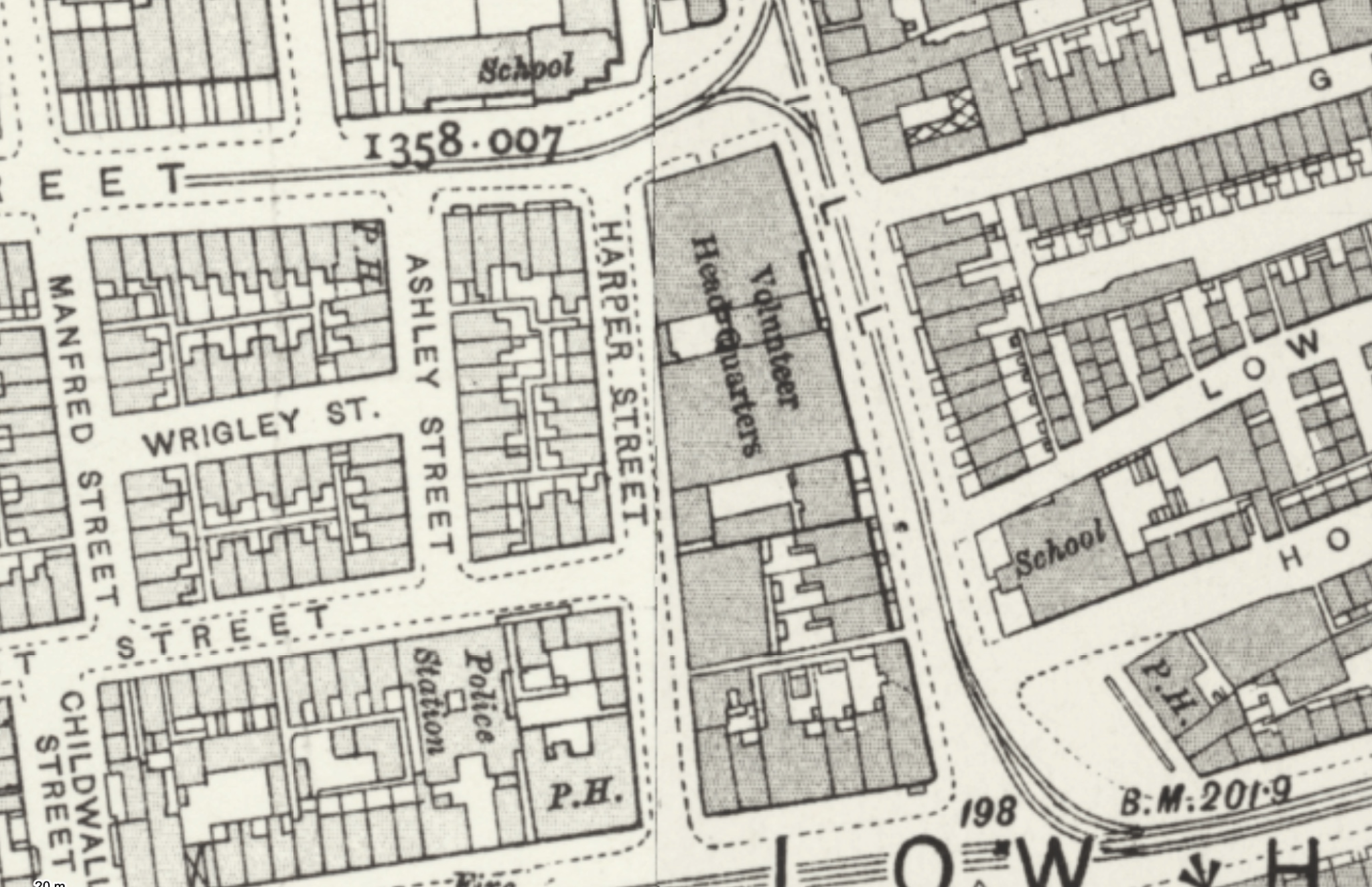
By 1869, into his early twenties, James was in partnership with his friend and fellow architect Thomas Bibby Troughton. Troughton and Prescott: Architects, Surveyors and Civil Engineers operated from offices at 13 Cambridge Chambers, 79 Lord Street (British Home Stores occupied the site where Cambridge Chambers once stood for many years, it is now a branch of H&M), in Liverpool’s bustling town centre. An advertisement in the Southport Independent and Ormskirk Chronicle stated that they also kept an office at 34 Derby Street in Ormskirk. In October that year, Building News reported that Thomas Troughton and a Mr. Sherlock ‘of the firm of Troughton and Prescott, of Liverpool’ won the tender to design ‘new quarters for the First Lancashire Volunteer Rifles… at the corner of Low Hill and Gloucester Place’ in Everton. Troughton and Prescott also oversaw development of a detached villa at Freshfield, near Crosby.

Ever the ‘enthusiastic, jolly sportsman,’ throughout this period James Prescott found himself competing in and judging at athletic events held at local sports days. He earned a silver medal for winning the ‘200 yards handicap’ race at the Atlas Cricket Club Athletic Festival in September 1866, and he and Troughton served as judge and race starter respectively at the Bootle Hospital Bazaar and Fancy Fair at Bootle Cricket Club in August 1870.
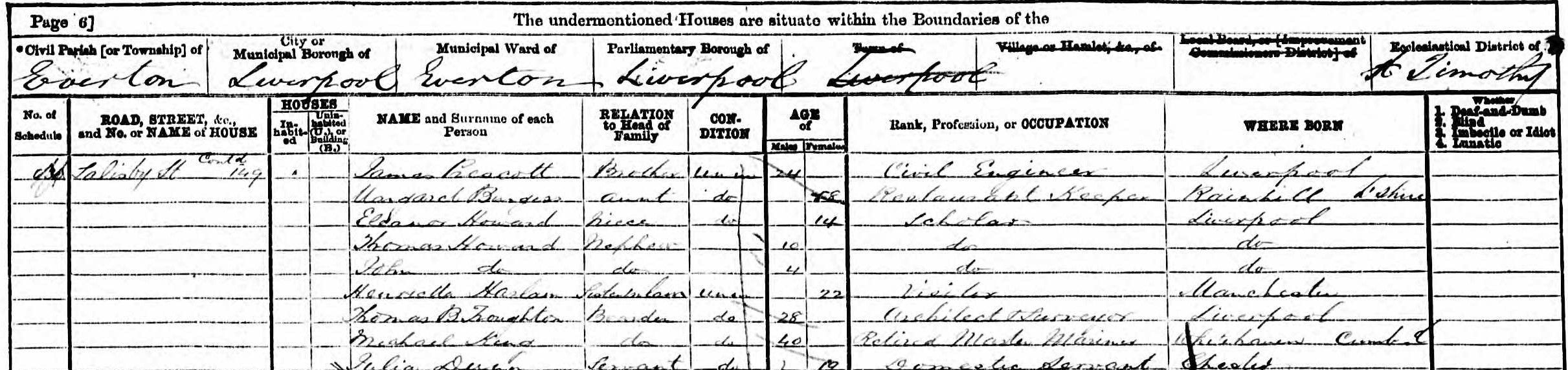

As of the 1871 census, James and Thomas were both lodging with James’ older brother John, who had qualified as a marine engineer, his young family and the boys’ parents Thomas and Mary, at 149 Salisbury Street in Everton. In 1872 the partnership oversaw development of land off Prescot Road in Newsham Park and a pair of semi-detached Villas at Knotty Ash.


On 18 January 1873 at St. Philip’s Church on Hardman Street, James married Sophia Adelaide Gannon, the 24-year-old daughter of George Gannon, a contractor. Less than a fortnight later the opening ceremony took place for a major development built to Troughton and Prescott specifications. The new St. Paul’s School opened on Brasenose Road in Bootle, beside St. Paul’s Church and stood for almost a century, until 1972 when the Brasenose Road area was demolished and converted to industrial premises. The original, hand drawn and rubber-stamped Troughton and Prescott plans for the St. Paul’s school building can be viewed at Liverpool Record Office.


In March 1873, a dispute was reported in the Liverpool Daily Post between a Mr. Clark and Troughton and Prescott after a set of architectural drawings which had been adapted by Troughton and Prescott were passed off as the work Duckworth and Metcalfe, another architectural company. Troughton and Prescott sought £14 14s compensation, claiming that a man named James Chesworth, owner of the plot in Newsham Park which was being developed, had stolen the drawings from their offices. It transpired that Mr. Clark was the landowner, having purchased the plot from Mr. Chesworth, that the Troughton and Prescott drawings had indeed been used in completing the work, but that Mr. Clark had no idea as to how they had been obtained. The jury found in Troughton and Prescott’s favour and Mr. Clark was ordered to cover costs for the drawings. Chesworth wrote to the Liverpool newspapers after the court hearing to deny having had anything to do with his having ‘surreptitiously obtained’ the drawings from Troughton and Prescott’s office and bemoan his not having been granted the opportunity to give evidence and clear his name at the hearing.
In August 1873 the Liverpool Daily Post published details of Troughton and Prescott overseeing planning for upgrades to ‘the sewering, channeling, kerbing, and paving of a portion of Rathbone Road, Old Swan, near Liverpool.’ The partnership advertised development of freehold land in Ellesmere Port in May 1875 and worked on housing developments on Kearsley Street, Walton Road and Bousfield Street in Kirkdale and Hygeia Street in Everton around the same time.
In the summer of 1875 Thomas Troughton inadvertently became embroiled in another legal case which went before the Liverpool courts. According to a Liverpool Mercury report on 16 November, a 24-year-old man by the name of John Bromley Williams was charged and held on remand ‘with obtaining £50 by means of false pretences’ after posing as a financier. Alfred John Dobson, a civil engineer based in New York, had sought a mortgage of £35,000 on a plot of land in America and had applied to Liverpool solicitors Crozier and Lumb to negotiate a loan on his behalf.
John Bromley Williams had previously negotiated a mortgage worth £8,500 for Troughton and Prescott and had earned Thomas Troughton’s trust. As a result, Troughton recommended Williams to Crozier and Lumb to handle negotiations. Mr. Dobson gave Williams £5 to cover expenses and arranged to pay him a commission on successful delivery of the loan. Williams failed to raise the funds from his contacts as initially promised but promised to secure the money from his father who he claimed, ‘was worth from £80,000 to £85,000 and had recently presented him with a 100-ton yacht.’ Williams requested £150 from Dobson to secure the cash from his father and Dobson agreed to transfer £50 to him.
At this point Thomas Troughton sailed to America with Dobson and Crozier (at a cost revealed during the court hearing of £1,000) to survey the plot and Troughton provided a comprehensive report. Upon returning to England, Dobson met with Williams, in the company of Crozier and Lumb. Williams again stalled on providing details as to whether terms of the loan had been agreed with his father. At the court hearing Williams’ father, John Williams senior, of Anglesey, was called to give evidence. A Welsh speaker, apparently unable to speak any English, Mr. Williams spoke via an interpreter and revealed himself to be a miner who ‘had never owned £200 in his life’ and ‘had had no communication in respect to this subject with the prisoner.’ Unsurprisingly perhaps, Mr. Williams also informed the jury that he had never given his son ‘a yacht of any description.’ Williams junior continued to claim that he had friends who would be willing to advance the money to Mr. Dobson and that he would seek damages for his time in prison once he had cleared his name.
When the case came to trial at the sessions court in Liverpool in December 1875, Mr. Shee, counsel for the defence highlighted a flaw in the original indictment, the venue for which had been ‘laid out’ in Lancashire, not the borough of Liverpool. As a result, the case could not proceed at the borough sessions in Liverpool and Williams was discharged.
James Prescott’s mother, Mary, passed away in November 1875, approaching her seventieth birthday and his father Thomas died in April 1878, in his mid-seventies. Mary and Thomas Prescott are buried together at Christ Church in Thomas’ hometown of Aughton. A few months later, the cricket team of St Domingo Methodist Chapel in Everton made their first outing as an Association Football team on the pleasantly landscaped lawns of Stanley Park, which had opened in 1870, designed by the renowned landscape architect Edward Kemp.
On 6 May 1876, the Liverpool Albion reported that Troughton and Prescott had submitted plans for ‘a skating rink on the New Chester Road, occupying an area of 1,000 square yards,’ while plans were also being discussed for ‘a public hall suitable for balls, concerts, masonic meetings, etc.,’ in the area. Most likely James Prescott’s first – and he may well have assumed only – involvement in designing any form of sporting facility, the Rock Ferry skating rink was later acquired by the Salvation Army, who bought up a number of skating rinks across the country at this time as the skating fad of the 1870s died out. The site was redeveloped as a mission hall. It later became the Palace Picture House, then the Palace car dealership. After the building was demolished, the plot on New Chester Road lay empty for some years before modern housing was erected in the mid-2020s.


In October 1876, James Prescott was present at the annual dinner of the Stanley Cricket Club at the Stanley Park Hotel in Walton. The following year, in August 1877, Troughton and Prescott attended the annual holiday of the Dock Board employees at Knowsley Park, the seat of the Earl of Derby. Around 10,000 people attended, enjoying the athletics events where Troughton and Prescott once more filled the roles of starter and judge. Over £300 was raised on the day for the benefit of the Training Ship Indefatigable, a large vessel moored at the Sloyne anchorage in the River Mersey, off Rock Ferry. Formerly HMS Indefatigable, launched in 1848 as a fifty-gun sailing frigate, the ship was retired in 1857 and loaned to the Indefatigable committee in 1864. It was converted to serve as a training school for boys joining the Royal Navy or the British Merchant Navy and provided education for generations of young sailors over almost half a century until it was rendered unfit for use in 1912 and replaced by the HMS Phaeton.
A lengthy Liverpool Mercury article published in autumn 1880, revealed James Prescott’s political leanings as he was listed among attendees at the annual Great Conservative Picnic, at Hooton Hall in Cheshire, on his thirty-sixth birthday, 4 September. There, he and Thomas Troughton once more acted as judge and starter at the athletic events on the day. They also mingled with well-known figures in Liverpool society including Lord Sandon, Lord Tollemache, Edward Whitley, M.P., Alderman Thomas Rigby, Thomas Bland Royden, who had served as Lord Mayor of Liverpool for a year from 1878, and a certain John Houlding among others.

The following month, a letter from Troughton and Prescott appeared in the Liverpool Mercury of 16 October, raising the issue of anonymous landowners employing ‘jerry’ (or cheap, unskilled and invariably slapdash) builders to illegally erect unlicensed public houses on plots allocated for housing in north Liverpool. The partnership listed the Elm House and Anfield Lodge public houses and Willow Bank estate as recent projects overseen by them. A few days later Mr. John Davies responded to Troughton and Prescott’s accusations in a letter of his own, denying that anything untoward had taken place in relation to his development of the Winchester Arms on Townsend Lane.
The 1881 census recorded James and Sophia, who never had children, living with Sophia’s mother and brothers at 174 Walton Village. In June Troughton and Prescott served as judges at the annual athletic sports day at Bootle Cricket Club, under the direction of Mr. William Poulsom, Mayor of Bootle. The following year Troughton and Prescott worked on alterations to the Grove Hotel on Falkner Street.
On 26 March 1885 at 32 Newark Street in Walton, Ralph Joseph Cullen, husband of Sophia Prescott’s younger sister Clara, passed away at thirty years of age from pulmonary tuberculosis. Clara and her two-year-old daughter, Ada Beatrice, moved in with James and Sophia at their new house, the ‘fine old house on the border of the estate’ referred to by Keates, Daisy Mount, at 14 Mere Lane in Everton.

That same year the Belmont Hotel public house was constructed at the junction of Belmont Road and West Derby Road in Everton to Troughton and Prescott designs. The building features a large terracotta liver bird at the apex of its curved facade and would doubtless have been a popular watering hole for the early generations of Evertonians, prior to watching their team play at Anfield. Everton Football Club was beginning to make headlines in those pre-Football League days thanks to the dazzling displays of players like George Farmer, who later lived at 123 Belmont Road and may well have frequented and even sung (he was a popular performer at inns around the area during his playing days) at the Belmont Hotel. Today it is very much a Liverpool Football Club pub and regulars were surprised to hear about the origins of their ‘local’ when I visited the establishment to take photographs in May 2026.


A few weeks after the building was completed, a dispute arose over payment for a selection of decorative tiles selected in person by Prescott at the yard of Doulton and Company on, of all places, Soho Street. The invoice for the tiles had never been paid and Doulton were seeking payment from Troughton and Prescott. At a hearing in January 1886, Troughton and Prescott’s solicitor, a Mr. Mulholland of Messrs. Haugh and Son, stated that the contractor, a Mr. Barlow, who had since gone bankrupt, was liable for the payment, not Troughton and Prescott, who had simply selected the tiles in their role as architect. Doulton and Company’s representative claimed that Mr. Barlow’s name had never previously been mentioned to them, and that Troughton and Prescott had repeatedly promised to settle the bill but had failed to do so. No verdict was arrived at by the jury on the day.
A year after the Belmont Hotel court hearing, in January 1887, various ‘dwellings, yards, workshops, stabling, etc., suitable for cow keepers, cab proprietors, wheelwrights, or bottlers’ were advertised in the Liverpool Mercury as being available at both the north and south ends of Liverpool. The advertisement appeared under the name of James Prescott, C.E., of 13 North John Street, suggesting that Prescott may have been working alone at this point, from new offices.
In April 1889 James Prescott attended the annual general meeting of the Lancashire and Cheshire County Bowling Association where he was elected a vice president. He was already president of the Walton Bowling Club and spoke at the annual dinner of the club which was held at the Black Horse Hotel on County Road, Walton that October.
That July, Prescott oversaw alterations to the Nag’s Head Inn, on Warrington Road in St. Helens and the Liverpool Journal of Commerce edition of 1 August 1889 reported his attendance at a meeting regarding: ‘The paving of the streets: A special meeting of merchants, manufacturers, cart and car proprietors, and other owners of horses’ which took place at the Liverpool Cart Owners’ Association offices on Fenwick Street. Issues discussed included the ‘high crown’ in Dale Street and the ‘unsuitable pavement’ of Moorfields, Chapel Street, New Quay and Queen Street. South Caernarvonshire stone was suggested as a more suitable material for flagstones, and Prescott joined a deputation to meet with the Health Committee to discuss these matters.

The 1891 census recorded James and Sophia Prescott settled at Daisy Mount, barely a mile as the crow flies from Prescott’s Soho Street birthplace. Mere Lane turns east off St. Domingo Road in Everton and Daisy Mount would have stood just a couple of minutes walking distance from the methodist chapel of St. Domingo on the corner of St. Domingo Vale. Clara Cullin, the widowed sister-in-law of Sophia, and her, by now, seven-year-old daughter, Ada Beatrice were still living with the Prescotts, along with one domestic servant, a local girl named Ellen Thorpe.
As per the London Gazette of 24 December 1890, James Prescott and Thomas Bibby Troughton formally dissolved their partnership, and James was working independently as an architect and surveyor from his own offices at 13 North John Street. Thomas Bibby Troughton had evidently been in poor health, as he was listed living at 20 Monastery Road, Anfield, in the 1891 census, a ‘retired architect,’ aged just forty-eight.


Maps of the Goodison Road area and the course of the Walton Stiles footpath, published 1850/1 and 1894 (surveyed before the construction of Goodison Park in 1892) – Many thanks to Darren White for the route mark and pitch highlights.
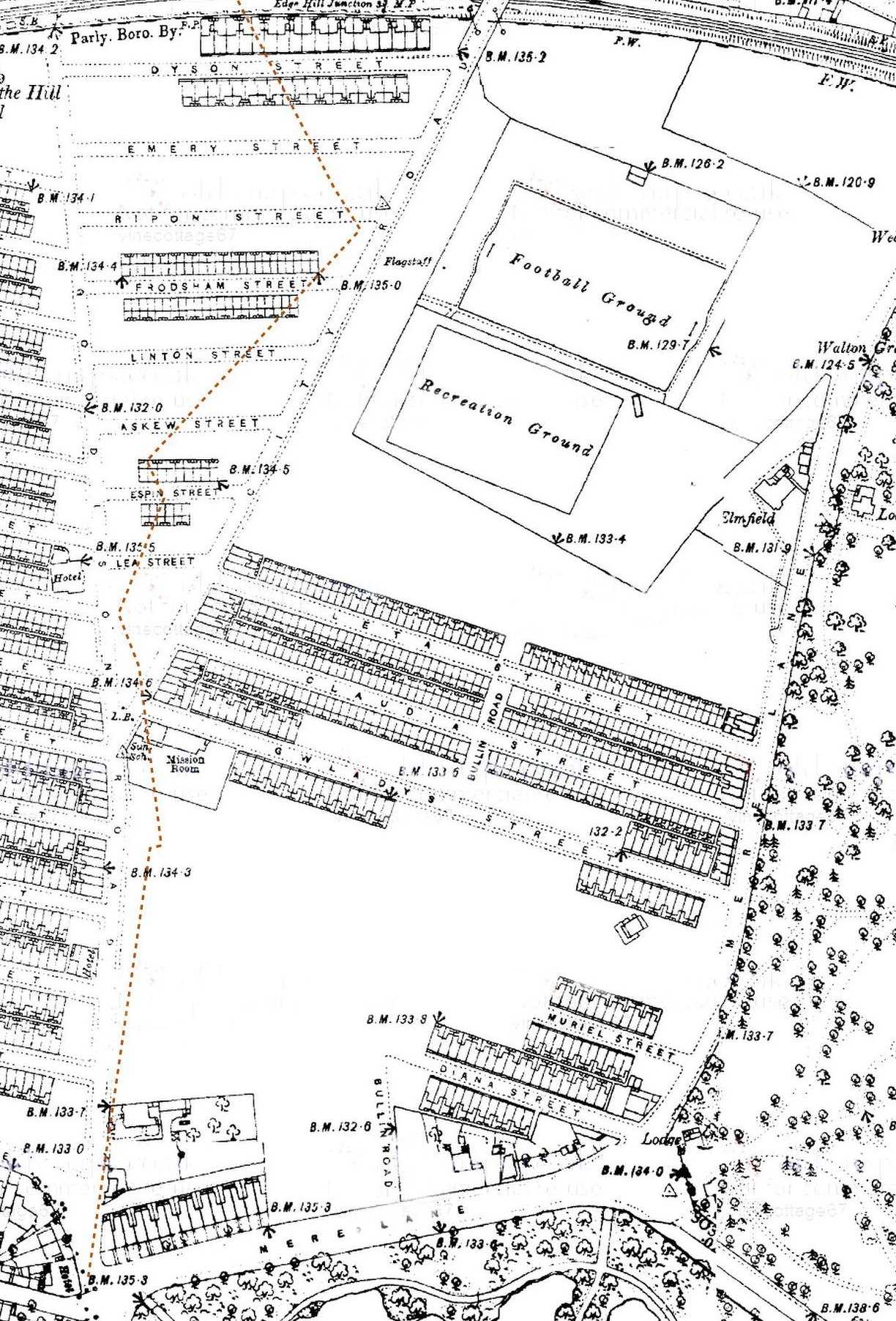
Terraced houses were already under construction in Gwladys Street, while the ‘Bullins’ Road was yet to be laid out in full
Goodison Park
At this time, of course, boardroom tensions were bubbling away not far away at Anfield, the home of Everton Football Club. ‘The Split,’ as it became known, occurred in the spring of 1892, and on 22 March, at a meeting of the club committee it was agreed, according to the Everton Football Club minute books, that ‘a sub-committee of Messrs Griffiths, Coates, Davies, Atkinson, Clayton, Wilson and Hartley be appointed to confer with Mr Prescott re: Stands, etc.’ At a subsequent meeting on 23 May, it was ‘resolved that the Secretary communicate with Mr Prescott as to his taking the level on the ground and to see that Kelly Bros. carry out their contract satisfactorily.’ Kelly Brothers were a prominent Liverpool building firm, of which long-serving future Everton director Ben Kelly was a director.


Mr. Hartley listed on the sub-committee was William Pickles Hartley, a local entrepreneur, philanthropist and member of the Primitive Methodist movement, perhaps best known as a jam manufacturer, who contributed £200 to the construction of Goodison Park. Another Hartley later involved in development of the stadium was Henry Hartley (1845-1928), who designed the Park End stand which stood from 1905 until 1994. Hartley – no relation to the famous Mersey dock architect Jesse Hartley – was a prominent architect and surveyor in Liverpool who designed the famous Ogden’s Tobacco Factory on Boundary Lane in Everton. Among other notable projects, Hartley also designed the clock tower of Birkenhead Town Hall as part of restoration after fire damage in 1901. That same year he drew plans for both the grand Century Buildings on the corner of Victoria Street and North John Street, and number 75 Renshaw Street, home for many years to Quiggin Brothers ironmongers, Horsman’s motorcycles in the 1950s and, in more recent times, a much-loved antique and curio shop which is still in business today. Henry Hartley also served as chairman of the Liverpool Architectural Society.


At the Everton Football Club committee meeting of 31 May 1892, club directors ‘resolved that the architect (Mr Prescott) be asked to prepare plans, sections and elevation for stands at a cost of about £15.00. This amount to include two end stands to hold about 3,000 each; 1 covered stand to hold about 3,000; two dressing rooms under covered stand (baths, etc., not included) also banking up between field of play and stands.’


Remarkably, all work was completed over the next two months in time for the formal opening of the ground by Lord Kinnaird on 24 August. According to a report in the Liverpool Mercury, James Prescott was among a select party including club president George Mahon, vice-president Dr. James Clement Baxter, Dr. Morley (vice president of the Football Association of England and president of Blackburn Rovers), J. J. Bentley (chairman of the Football League and secretary of Bolton Wanderers), H. Lockett (secretary of the Football League), R. P. Gregson (secretary of the Lancashire Football Association), R. E. Lythgoe (secretary of the Liverpool Football Association), M. Earlam (secretary of the Combination), Inspector Churchill (secretary of the Liverpool Police Athletic Association) and the contractors W. and J. Kelly who attended a lavish dinner at the Adelphi Hotel in Liverpool before proceeding by horse-drawn carriage to Goodison Park to attend the festivities, which included exhibitions of athletics, fireworks and music. Prescott received complimentary tickets to the opening games against Bolton and Nottingham Forest, and for Everton matches over the next few seasons. A son of the Everton district and a keen sportsman as proven by his continued involvement in sporting activity throughout his life, it is not unreasonable to assume that James Prescott was himself a committed Everton supporter.

The Liverpool Mercury of 17 September 1895, in reporting on forthcoming municipal elections, stated that ‘Yesterday a numerous and influential deputation waited upon Mr James Prescott, C.E., architect, to ask him to be a candidate in North Walton in the Conservative interest.’ Prescott received high praise for his experience and character and ‘expressed his deep sense of honour’ for being put forward for such a role. He accepted his nomination graciously and‘promised to faithfully fulfil all the duties of a representative of the important ward of North Walton.’ As it transpired Prescott was not nominated for the election after all, with alternative Conservative candidates preferred.
.
.
The Land Purchase of 1895 and the new Bullens Road stand
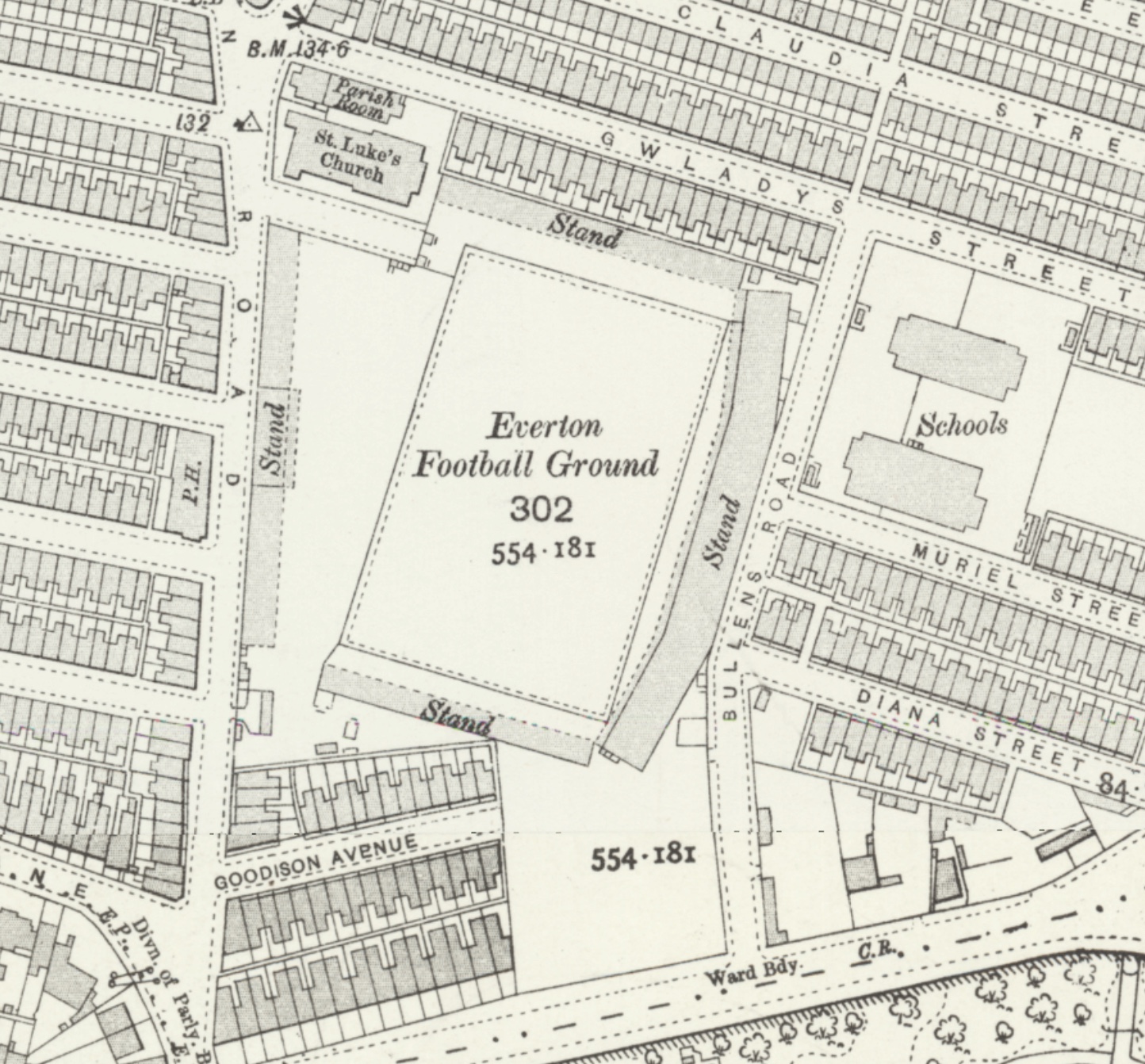
That same year the first major redevelopment of Prescott’s original Goodison Park structure took place. Manchester-born architect John Henry Woodhouse (1847-1929) won the tender to design a new Bullens Road stand, which became known as the Beaty stand, after the advertisement painted on its roof for local tailors Beaty Brothers. Throughout his career Woodhouse designed numerous impressive buildings across the Greater Manchester area and beyond, including London Road Fire Station. He was elected president of the Manchester Architectural Association, a Fellow of the Manchester Society of Architects and, in 1893, became a Fellow of the Royal Institute of British Architects.


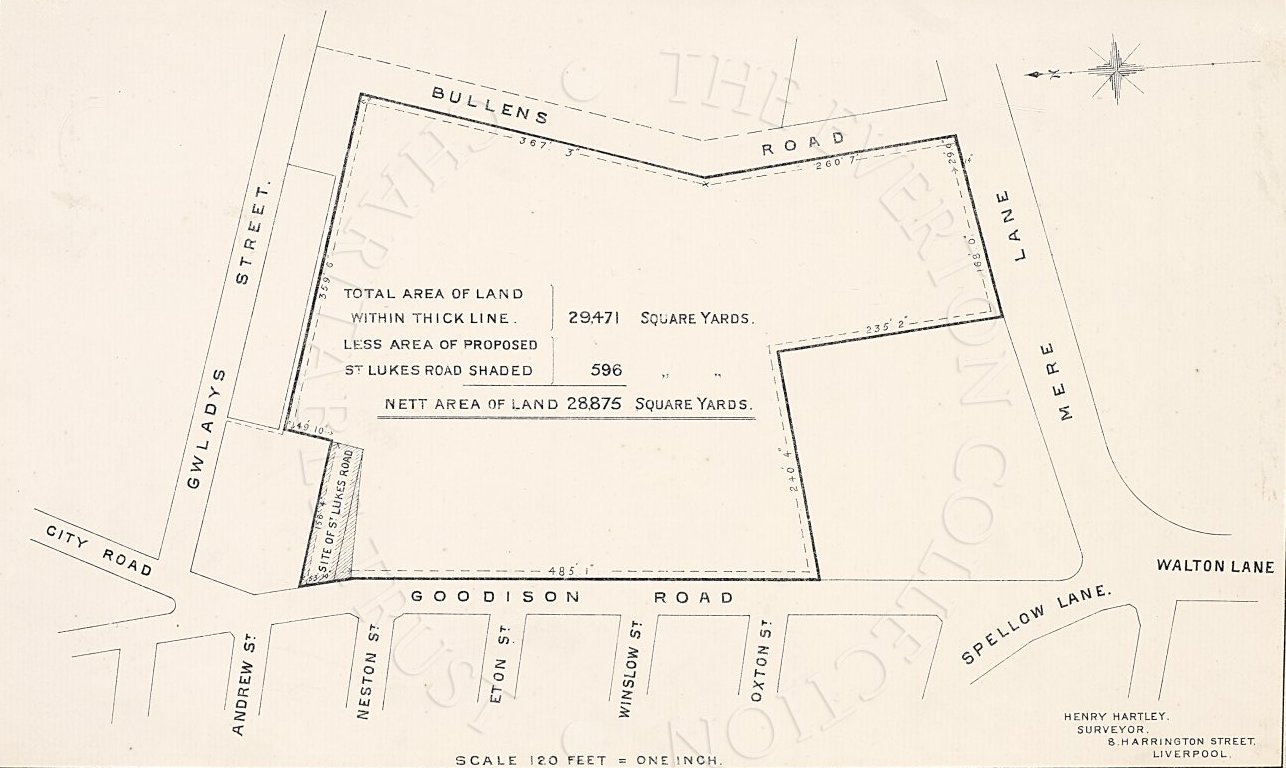
(The Everton Collection)

Tragedy befell the Prescott household on 19 December 1897, when Sophia died at home aged only forty-eight. An inquest was held on 21 December and Thomas Edward Sampson, coroner for Liverpool, recorded Sophia’s cause of death as ‘epilepsy due to excessive drinking.’ She was buried at Anfield Cemetery on 22 December and James was left to mourn her passing over Christmas 1897.


As the twentieth century dawned, James, along with sister-in-law Clara and her daughter Ada, moved north to 40 Birchdale Road in Waterloo. Prescott named the property ‘Adelaide House’, presumably in memory of Sophia whose middle name was Adelaide.
I could find no further mentions of any architectural work carried out by James Prescott after the completion of Goodison Park in 1892. Mentions of him in the Liverpool press after Sophia’s death are scarce. He presented prizes at Aintree Bowling Club in July 1901 and attended the silver wedding celebrations of Mr. John Roberts, assistant clerk to the city magistrates, at the Angel Hotel on Dale Street in December that year. According to the Liverpool Daily Post report, Prescott presented Mr. Roberts with a ‘valuable massive gold pencil-case and a purse of gold’ paid for by his friends.

James Prescott’s former business partner, Thomas Bibby Troughton died aged sixty-one on 8 July 1903 at the Turner Memorial Home for Male Incurables, on Dingle Lane in Liverpool. His occupation was listed as ‘formerly an architect’ and cause of death was recorded as ‘Gout and chronic uraemia.’ Gout and uraemia are both caused by excessive build-up of uric acid and other toxins in the blood, due to kidney failure. Kidney failure can itself be triggered by alcoholism and use of opiates, many of which were available over the counter in Victorian times and were acceptable forms of pain relief. Laudanum was known as ‘the aspirin of the nineteenth century,’ while both cocaine and opium were freely available at high street chemists. The Dangerous Drugs Act did not come into force until 1920.


James Prescott died, aged fifty-eight, on 1 July 1905, at Adelaide House. He was buried with Sophia at Anfield Cemetery beneath an impressive marble monument within view of Goodison Park, which bears the following inscription: ‘JAMES PRESCOTT, C.E., Who departed this life on 1st July 1905 in his 59th year. Sadly missed, he suffered much. We watched him day by day, with aching hearts, grow less and less until he passed away.’

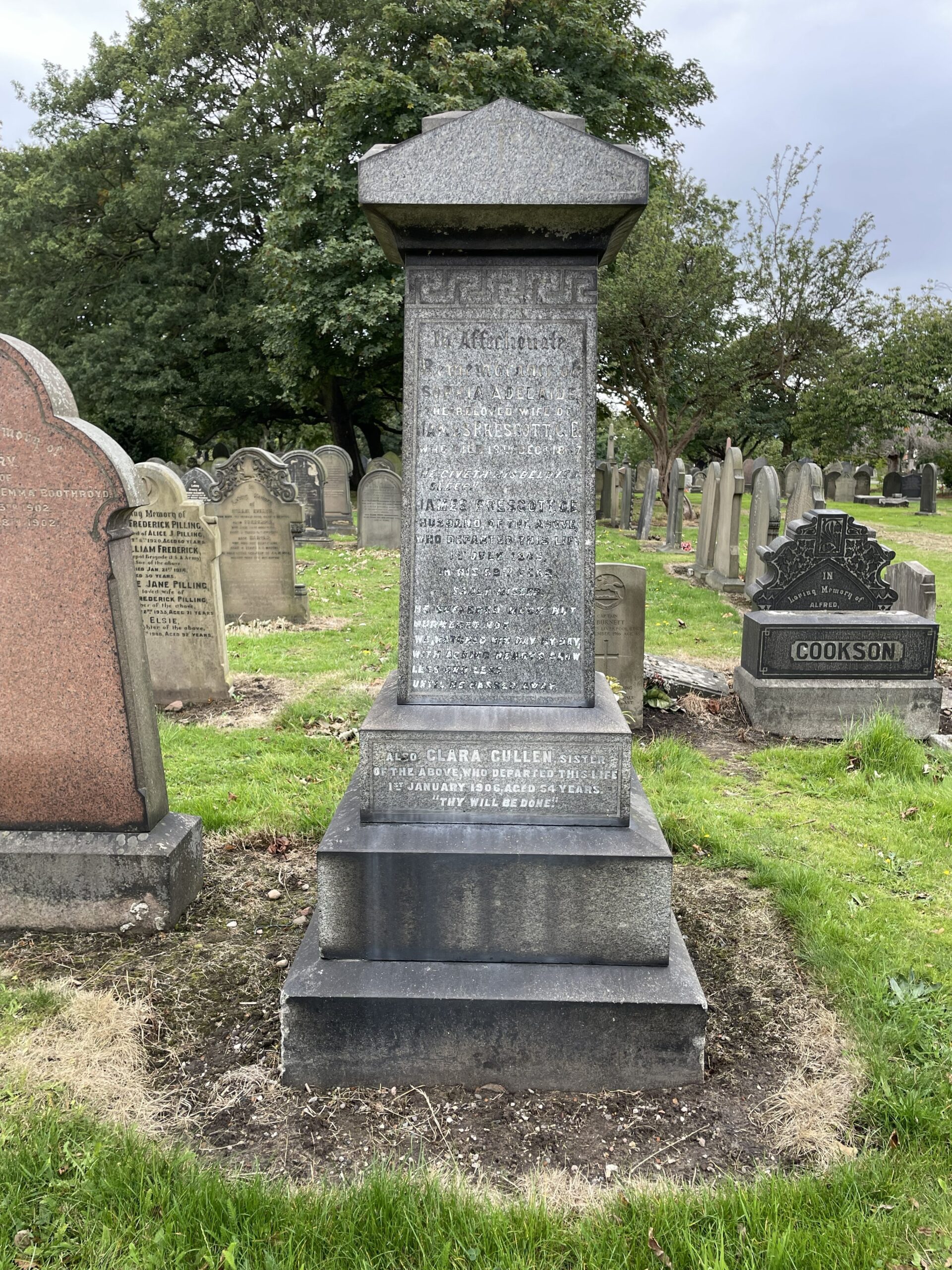


Clara Cullen, who had continued living at Adelaide House with Ada, died only six months later and was buried with James and Sophia.
James Prescott’s cause of death was recorded as ‘cirrhosis of the liver, exhaustion and uraemia,’ while Clara’s was recorded as ‘uraemia and convulsions.’ It seems possible that James Prescott drank himself to death after the sad loss of his wife, and that alcohol and – quite possibly opiate use – was common in their intimate circle, with the relatively premature passing of both Sophia Prescott and Thomas Troughton attributed to alcoholism and kidney failure respectively.
Seizures and convulsions are recognised symptoms of withdrawal from alcohol and opiates. Opium was commonly used in Victorian times, in tonics such as Godfrey’s Cordial to treat what was termed hysteria, notably in menopausal women, as well as a means of pacifying babies and hyperactive children. Uraemia – also known as Bright’s Disease after Richard Bright, the English physician who pinpointed the symptoms in 1827 – became a recognised term for kidney failure, with presentation of the disease identifiable as ‘convulsions and coma leading to death’. The deaths of all four people from such a close social circle seem to follow too similar a pattern not to be related in some respect. It is also difficult to overlook the sad irony that James Prescott, who was born in a pub, grew up in pubs and designed and oversaw the building of pubs throughout his working life, ultimately died from chronic liver damage, very likely caused by excessive consumption of alcohol.
Clara Cullen’s daughter Ada married Henry Latham Blundell, a member of the well-known and historic Blundell family of Crosby Hall, an estate which they had occupied since the Middle Ages. The couple had five children, all of whom went on to have families of their own. Ada died in Liverpool in 1954, aged 70.
His name may not have resonated prominently over the years among the pantheon of great Evertonians, but, with his original, hand drawn blueprints – plus a very tight deadline to work to – James Prescott brought George Mahon’s vision of a permanent home for Everton Football Club on the overgrown, unkempt site at Mere Green to life. In doing so he helped Mahon preserve the heritage, heart and soul of our beloved club, safely removed from the capitalist, Conservative clutches of John Houlding and his Anfield acolytes. He also presented a ground which lives up to the high standards to which the club has always been held by its members, officials and supporters.
In the years that followed, Goodison Park became internationally recognised as a benchmark, one of the finest football stadiums in the world. A historic founding home of the professional game and still a site of innovation to this day. In summer 2025, 133 years after ground was first broken on the site under the watchful eye of James Prescott, Goodison Park became the permanent home of Everton Women.
References and further reading:
Keates, Thomas, History of the Everton Football Club: 1878/79-1928/29: A Jubilee History (1929)
The Everton Collection website (www.evertoncollection.org.uk)
Liverpool Record Office
www.Ancestry.com
The British Newspaper Archive (via www.FindMyPast.com)
Newton-le-Willows Heritage Trail website (www.newtonheritagetrail.com)
Information on Uraemia from my mum, Christine Yates, Msc FIBMS (ret.), and PubMedCentral at the National Library of Medicine (pms.ncbi.nlm.gov).
Information on use of opiates and alcoholism in the Victorian era from various online sources including The Victorian Web (www.victorianweb.org) and Ellen Castelow’s article ‘Opium in Victorian Britain’ from www.historic-uk.com.
With special thanks to fellow Evertonians, father and son John and Rob Jopson, who attended the Everton Football Club Heritage Society social night at The Denbigh Castle on 7 May 2026 – where I gave a talk alongside my colleague Lewis Royden on the life and work of James Prescott – and provided key information on the significance of The Legh Arms Hotel in the era when Prescott’s father was landlord there.
With added thanks to Emma Carey for photographs of the Belmont Hotel taken in May 2026.
Mike Royden – Additional picture research (to add to the extensive material provided by Jamie) plus webpage layout.
…………………………………………………….

For more on the opening of Goodison Park see
The Opening of Goodison Park! – A Picnic, a Firework Display, a Friendly, the First League Game
by Mike Royden