A new book by Kieran Smith
Rob Sawyer
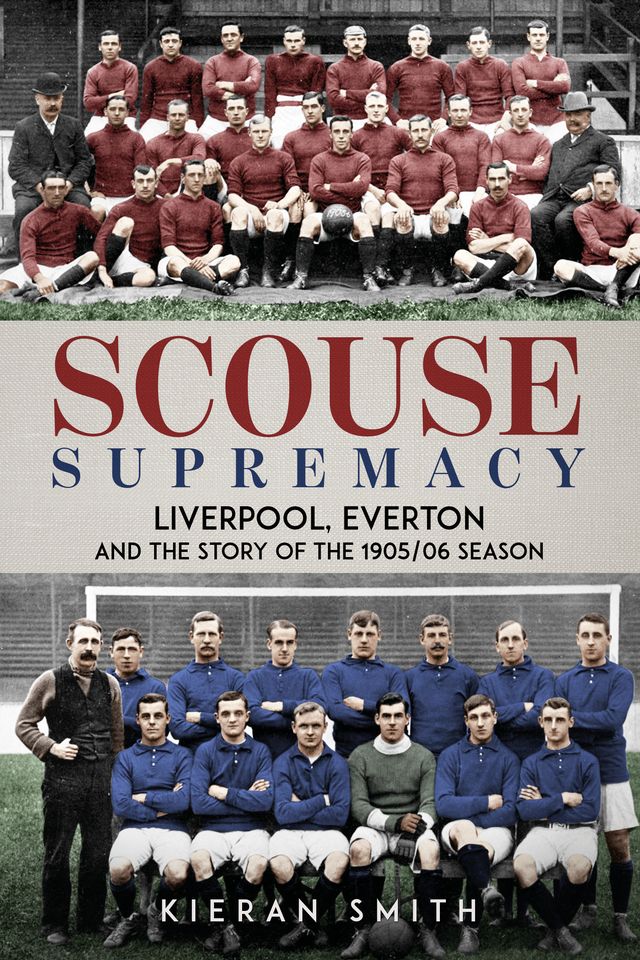
Writing a book on football that crosses the Blue-Red sporting divide is no simple task, hence relatively few books have catered for both sets of fans (exceptions include Three Sides of the Mersey, Two Tribes, and Crossing The Park). It’s a task Kieran Smith set himself with Scouse Supremacy (Pitch Publishing, 2026), which tells the story of the 1905/06 season, in which the two Merseyside giants dominated domestic football.
An Associate Member of Everton FC Heritage Society, Kieran is a Liverpool supporter who maintains a healthy respect for the Red/Blue rivalry. Accordingly, the book takes an even-handed approach, with both clubs getting their fair share of coverage. Early chapters provide an overview of the environment that clubs operated in during the Edwardian era, and explore how clubs operated before de facto team managers became the norm. Those already familiar with this may choose to skip forward to when the match action begins.
For this reader, the most gripping chapter was that concerning the 1906 FA Cup Final, the Blues having defeated their Merseyside rivals in the semi-final. This would be their third appearance at the final stage of the competition, but the first to result in victory. The scenes in London are vividly described in print, as are the post-match events, including a cruise on the Thames the following day for the victorious Everton and vanquished Newcastle United teams. There follows a description of the team’s return to Liverpool, being met at Central Railway Station by a fanatical reception committee, prior to the triumphal parade on a coach and four to Goodison Park.
Kieran’s book documents well the season in which ‘Merseypride’ in the city of Liverpool’s football teams was fully justified. It also, rightly, raises the profile of key administrators and players at the clubs (secretaries Tom Watson and Will Cuff) plus players like Raisbeck, Doig, Goddard and Dunlop (Liverpool) and Settle, Taylor, Makepeace, the Balmer Brothers and Sharp (Everton).
Dogged research by the author has unearthed some lovely nuggets, like the Toffees’ goalkeeper Billy Scott keeping details of his nuptials secret from even his clubmates and the club getting sanctioned for fielding a weakened team in the week before the cup final. What also comes across is the rapprochement between the rivals after the bad blood in the wake of Everton’s move to Goodison Park and their former president, John Houlding, setting up Liverpool FC to play at the vacant Anfield ground.
Two teams from the city of Liverpool with common roots, spurring each other on to reach the zenith of the English sport; what’s not to like? Kieran’s book ably recounts how they got there.
Scouse Supremacy: Liverpool, Everton and the story of the 1905/06 season by Kieran Smith is published by Pitch Publishing and available through bookshops and online retailers.
………………………………………….
Kieran, congratulations on the new book, Scouse Supremacy. How did you become interested in writing about football history?
My first foray into the idea of writing came through my work alongside Jeff Goulding. Jeff highlighted the importance of social context and storytelling, and what better way to bring old stories to life than through the pages of a book? The brilliant work of many members of the Everton Heritage Society is also inspirational, and the articles produced for the matchday programme are a great example of how writing can bring to life the stories of yesteryear.
What inspired you to write about the 1905/06 season, 120 years on and why is it such an important season on Merseyside, and beyond?
I have been interested in the 1905/06 season for a long time, with the initial spark coming from the famous newspaper cartoon of Jack Taylor and Alex Raisbeck, sitting on top of the footballing world. The league title and FA Cup were the biggest prizes in football and for me, this season marked the beginning of the city becoming one of the footballing centres of the world.
You’re a Liverpool supporter, but are also an Associate member of EFCHS. How did you approach this book and what are the challenges of one that covers both Merseyside footballing giants?
I guess the obvious challenge for me personally is to bring a balanced book. I wanted to ensure that, despite my allegiance, both stories were told with accuracy and passion. Also, there is the scale of research – there are two stories of the 1905/06 season to detail – both of which required a great deal of time to research.
What were your primary sources of information and how long did it take to conduct, what was clearly, through research?
The British Newspaper Archive was my virtual home for months! I have to say that the reports of the Liverpool Echo’s Ernest ‘Bee‘ Edwards were a Godsend. He really was the man with insider knowledge and it helped me greatly when piecing things together. I also worked through many reference books, and the LFCHistory.net and Everton FC Heritage Society websites were also a key element in my research. Overall, the research covered a period of two years.
What nuggets of information that you unearthed surprised you?
Two things stood out for me. Firstly, the amount of preparation that went into each game, with player welfare being a huge part of the game. Training camps are certainly not a modern phenomenon. And secondly the game was developing quickly, and its growth was aided by the railways. The railway companies, ever enterprising, spotted a growing market, ensuring that teams could be transported to and from away fixtures, as well as transporting an ever-growing army of supporters.
There are a few individual stories and facts that pepper the book, which I hope the reader enjoys.
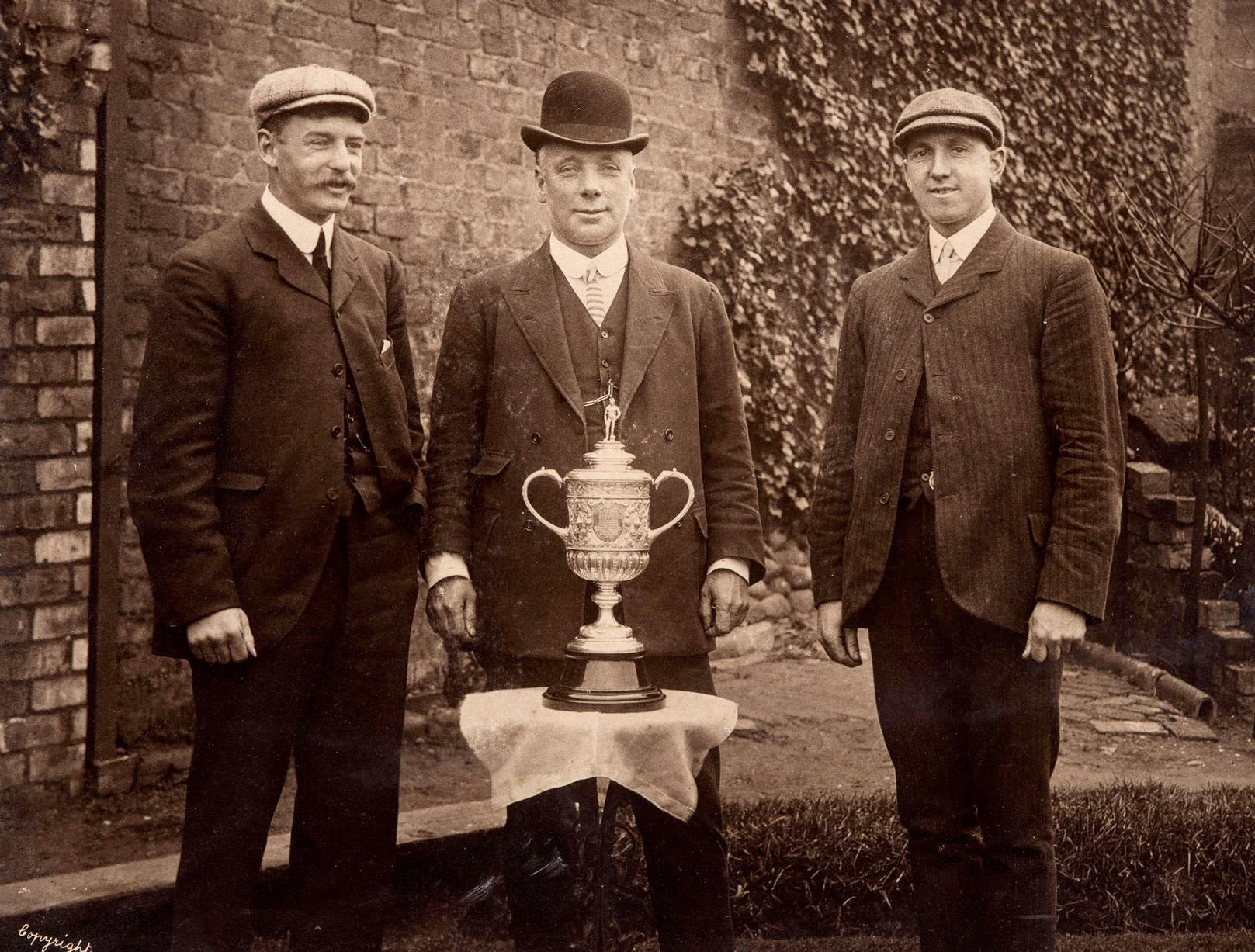
posing with the F.A. Cup Trophy in 1906
Which players and officials at both clubs did you find yourself particularly drawn to?
When you dedicate so much time to research you feel that you get to know each individual, to a certain extent at least. There are some great characters, but the obvious choice would be Jack Taylor and Alex Raisbeck. Both formed by their Scottish roots, they led by example and helped guide their men to greatness.
How did the two clubs compare in terms of status at the dawn of the 1905 season, and why had the bad blood of 1892 subsided by this point?
It is fair to say that Everton were the dominant club. They were of course the more established, had the better stadium and were one of the best run clubs in the country. But Liverpool were ambitious and had won the league for the first time in 1901. Everton came into the 1905/06 season as hot favourites for honours, having missed out on the league title by a solitary point the previous season, as well as reaching the FA Cup semi-final. Liverpool on the other hand were not expected to claim any silverware, having just been promoted.
I think the passage of time helped to clear the air, as it were. There is no doubt that ‘the split’ of 1892 produced a degree of animosity, brought on by various factors, including political and business. A mix of municipal pride, mutual growth and being physically so close to each other, aided a unique ‘friendly’ relationship.
With the club’s tying up the domestic honours between them, why didn’t they go on to dominate English football in the arts that followed?
Edwardian football was an unpredictable beast. With standardised tactics and small squad sizes, a football dynasty would be rare. Liverpool epitomised the often yo-yo-like nature of football during the era. Relegated in 1904, league champions in 1906 and finishing 15th in the 1906/07 season.
Financially, clubs were competitive. Here, clubs were constantly rebuilding, with the odd club attempting to buy their way into the challenging pack. 1905/06 saw Middlesbrough make attempts at this, whilst the likes of Aston Villa, Manchester United and Newcastle United were able to build championship winning teams. In fact, between Liverpool’s 1906 title, and Everton’s in 1915, those three clubs provided five title-winning teams.
Both clubs had periods of rebuilding, prior to the outbreak of WWI. For Liverpool, Tom Watson had laid the foundations of the team that would eventually win back-to-back league-titles in the 1920’s. Everton, of course, managed to claim the last league-title before the outbreak of the Great War. The subsequent disbanding of organised football due to the conflict led to the disruption of team building. Like any organisation, both clubs shared the heartache of losing personnel.
What has changed most in football on Merseyside since 1906, and what has remained fairly constant?
One of the obvious changes has been the recent move from Goodison, to Hill Dickinson Stadium. For the first time since the two clubs became neighbours in 1892, there is a distinct geographic difference between the two.
The modern game has seen the make-up of the team take on a much more cosmopolitan flavour. 1905 saw the Everton and Liverpool line-ups predominantly comprising players from England and Scotland, with Ireland and Wales also represented. Today we see players from across the globe.
There has always been more than a passing interest on Merseyside when the two meet. Football is a part of the city’s DNA, and its double helix is red and blue. As you will read in the book, the entire city seemed to turn up for the Derby games, with the stands literally creaking at the seams. The game could be fervent, with some players going full-on with tackles. I guess this is one constant that the spectator today would recognise. Football has become one of Liverpool’s defining features. Talk about Liverpool to anyone around the world and the conversation will almost always cover The Beatles and football. Few places in the world can boast such an identity.
What/s next for you? Maybe something on the double years of 1966 and 1984?!
There is always an idea for the next project. Hopefully, Scouse Supremacy is received favourably and for the foreseeable future I might have a bit of a break, but there are a few ideas in my mind. ’66 and ’84 would be great to get stuck into and are certainly much more modern than my previous endeavours.
Rob Sawyer