The Remarkable Story of Harry Cook – Everton’s ‘Blind Masseur’
Rob Sawyer
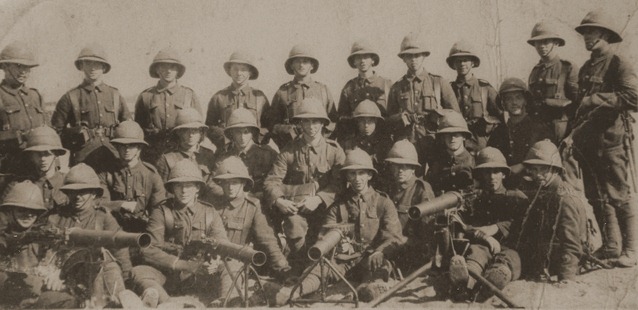
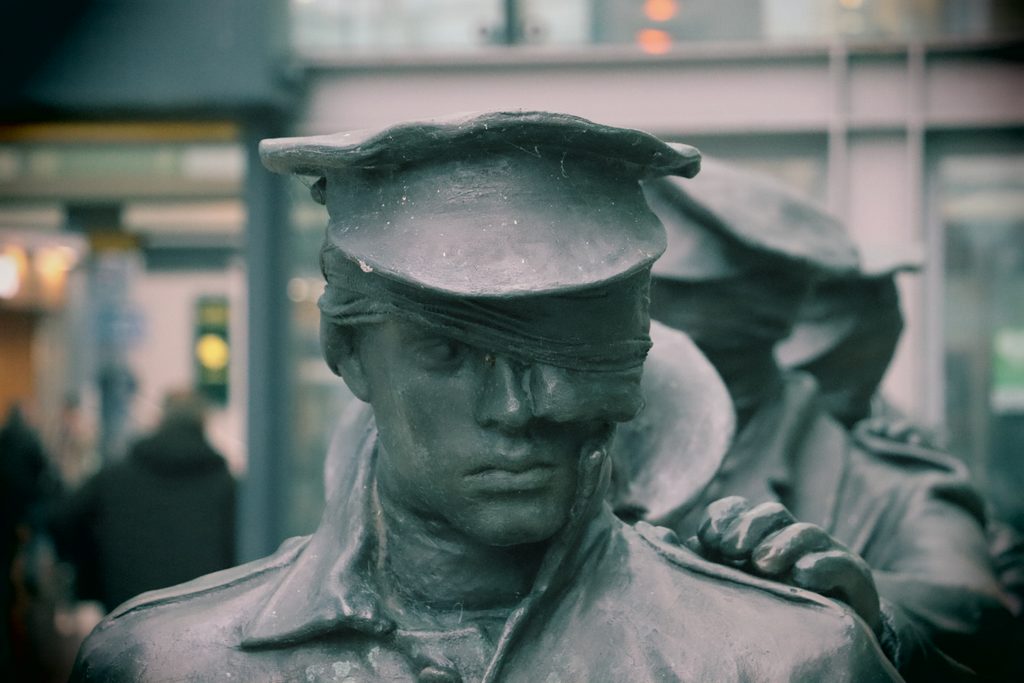
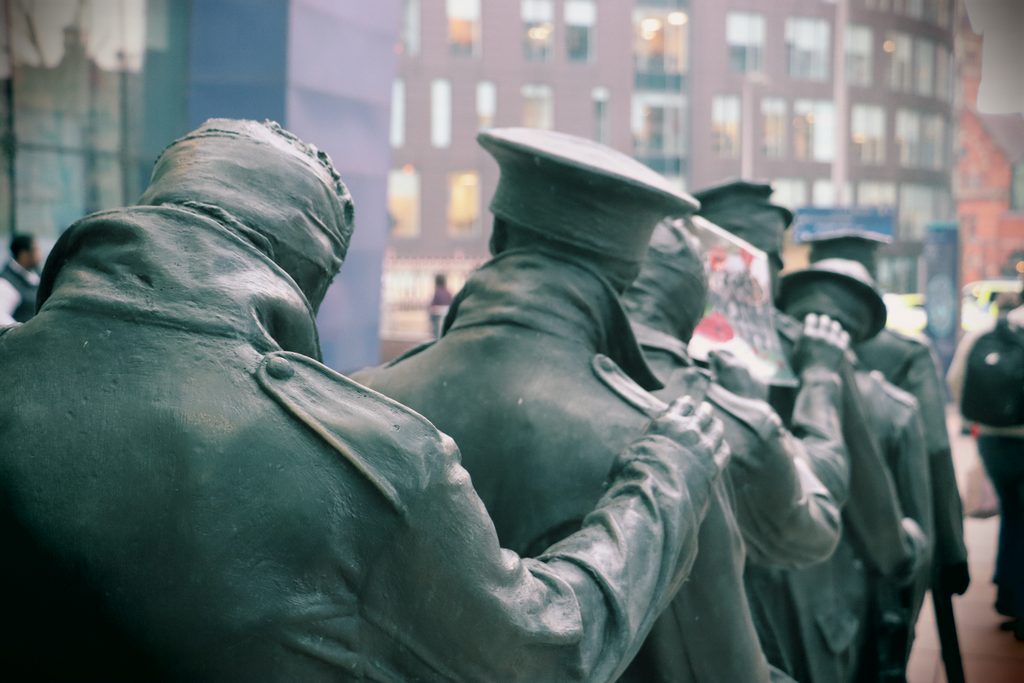
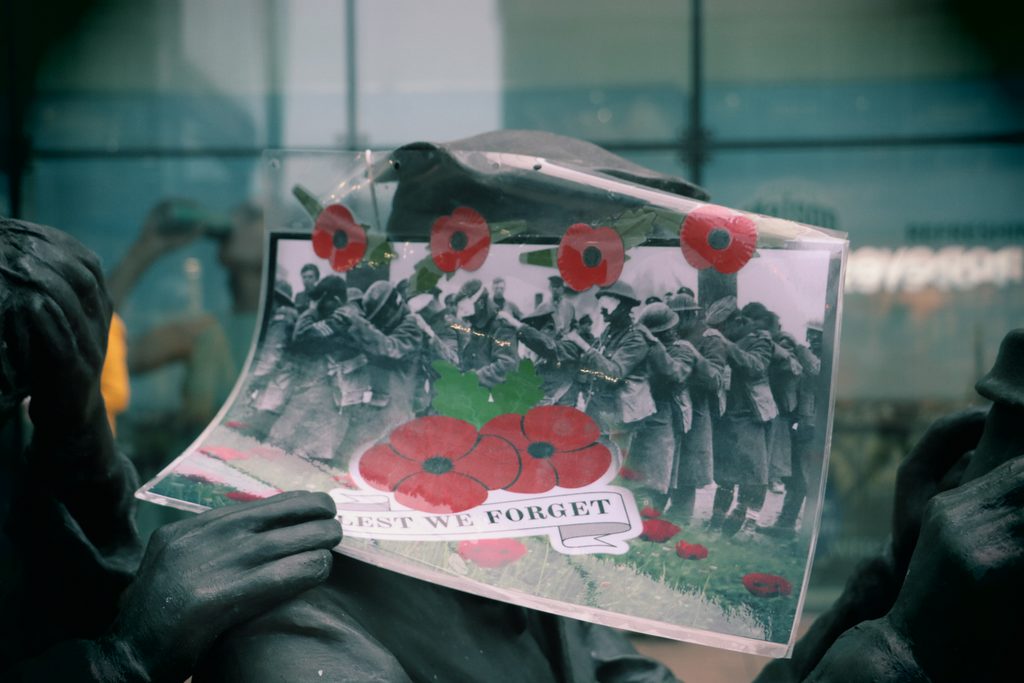
While British, Anzac and French Allied troops were engaged in the doomed Gallipoli campaign against the Ottoman forces during 1915, further British forces were despatched from home to protect the Suez Canal during the withdrawal of the battle-weary from the Dardanelles to Egypt. Among those arriving at Port Said in the midst of a violent thunderstorm at 7.30am on 5 January 1916 was a nineteen-year-old Lancastrian, Private Richard Henry Cook. By mid-February, he was with his battalion on the front line defending the canal, and it was here the teenager came into close combat with the enemy: ‘I fired at the Turk: missed. The Turk threw back a grenade which exploded a yard or so in front of me. Everything went black – I was blind.’
This life changing moment would lead young Harry on the road to a ‘hands-on’ role in three Football League Championships and an FA Cup victory for Everton FC.
Richard Henry Cook was born on 11 January 1896, the son of a journeyman butcher and raised in Clitheroe, Lancashire. Although he became an apprentice in a firm of printers and dyers, he turned out as an amateur forward for his hometown club, whilst dreaming of playing for a top side like Everton.
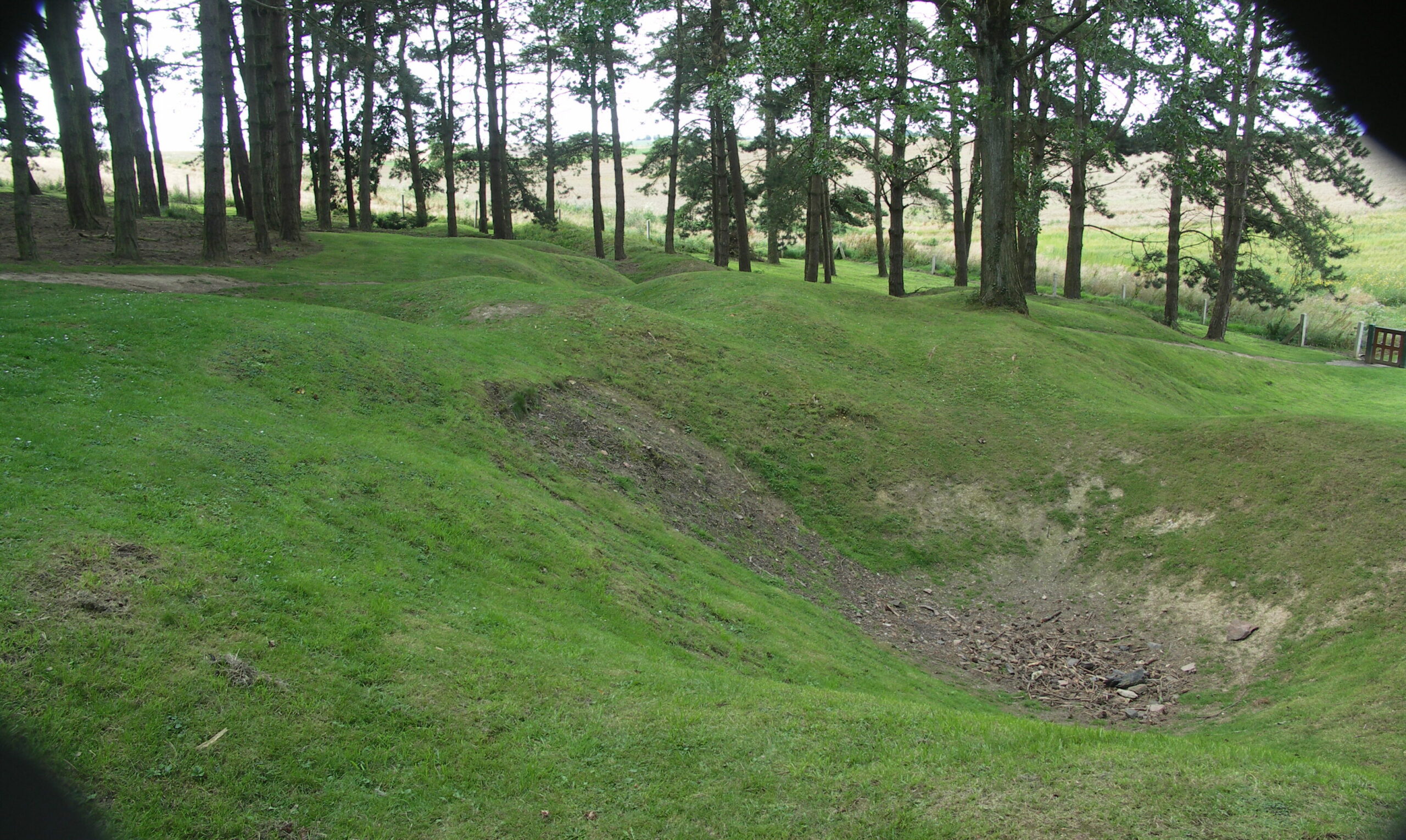
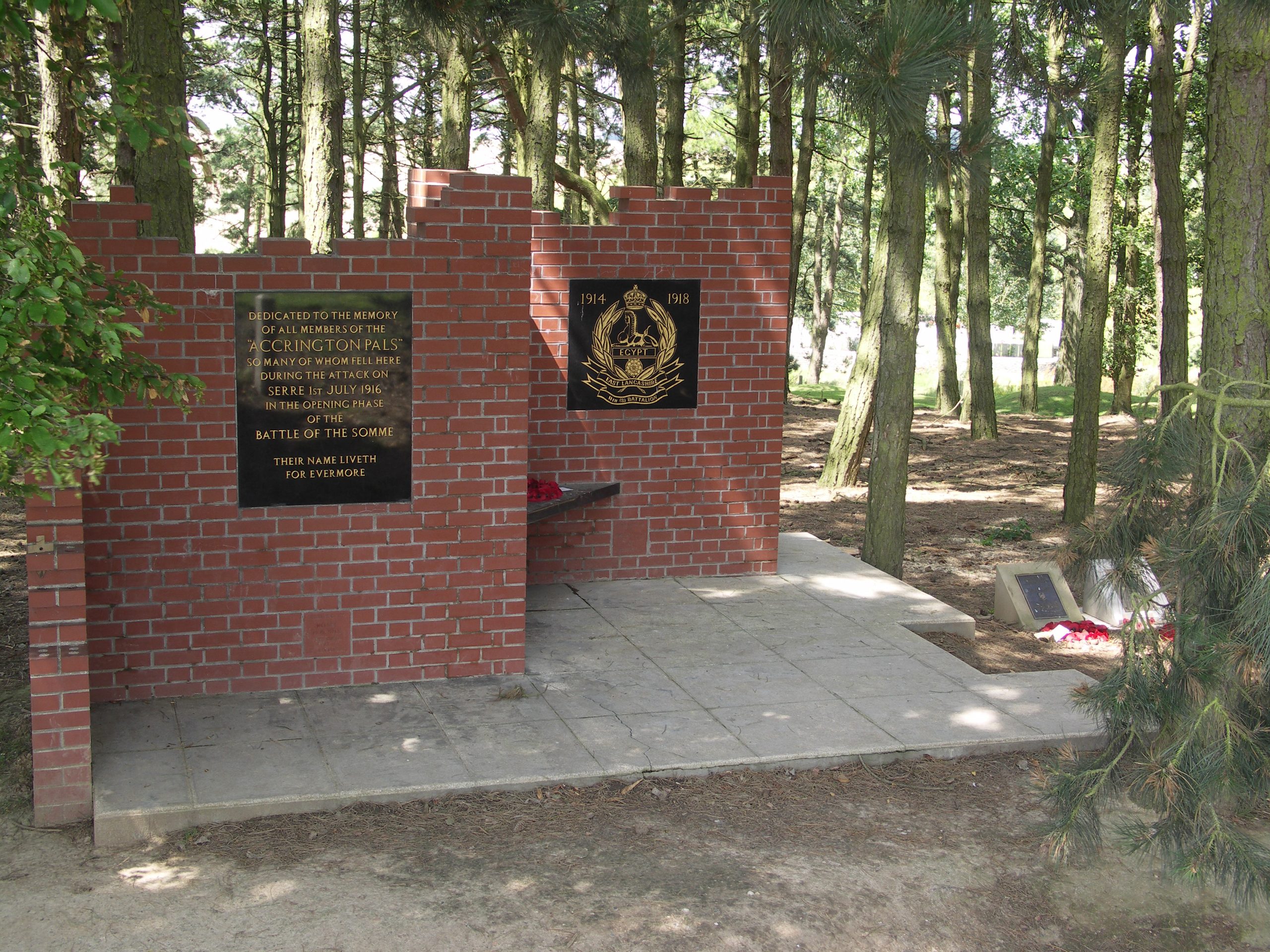
With the outbreak of the Great War in the summer of 1914, masses of young men signed up for the army, and Harry (as he subsequently came to be known) was no exception. Within a month of the declaration of hostilities, he enlisted with the the 11th (Service) Battalion, East Lancashire Regiment, also known as the famous Accrington Pals Battalion. In early 1916, the Pals were deployed around Suez, defending the canal from the threat of Ottoman forces. After the encounter in which he lost his sight, he was shipped back to England. The Accrington Pals meanwhile, were pulled out of Egypt and reposted to France on 8 March 1916, only to be practically annihilated on 1 July 1916 – the first day of the Battle of the Somme. A memorial stands in the preserved trenches as a reminder of the sacrifice made by these local men – Cook’s former comrades.
[NB. In some of the sources which follow, Harry Cook is described as losing his sight at Gallipoli or the Dardanelles. These locations were often applied in a general sense to describe the campaign of 1915. The Accrington Pals arrived after that campaign ended, and were based in Egypt where Cook lost his site]
St Dunstan’s Hostel, Regent’s Park, London
British attitudes to disability had moved on little since Victorian times, and the loss of sight normally presaged a life of struggle, poverty and isolation. Fortunately for Harry and others, the newspaper magnate Arthur Pearson had, upon losing his sight to Glaucoma, devoted himself to helping others in the same situation. He realised that blindness was ‘not an affliction but a handicap which…can be surmounted.’ Thus, was born St Dunstan’s Hostel, in London’s Regent’s Park, where up to 600 injured servicemen at any one time would receive support and training to compensate for their disability. As Sir Arthur said: ‘My men are not blind, they are simply men without sight.’
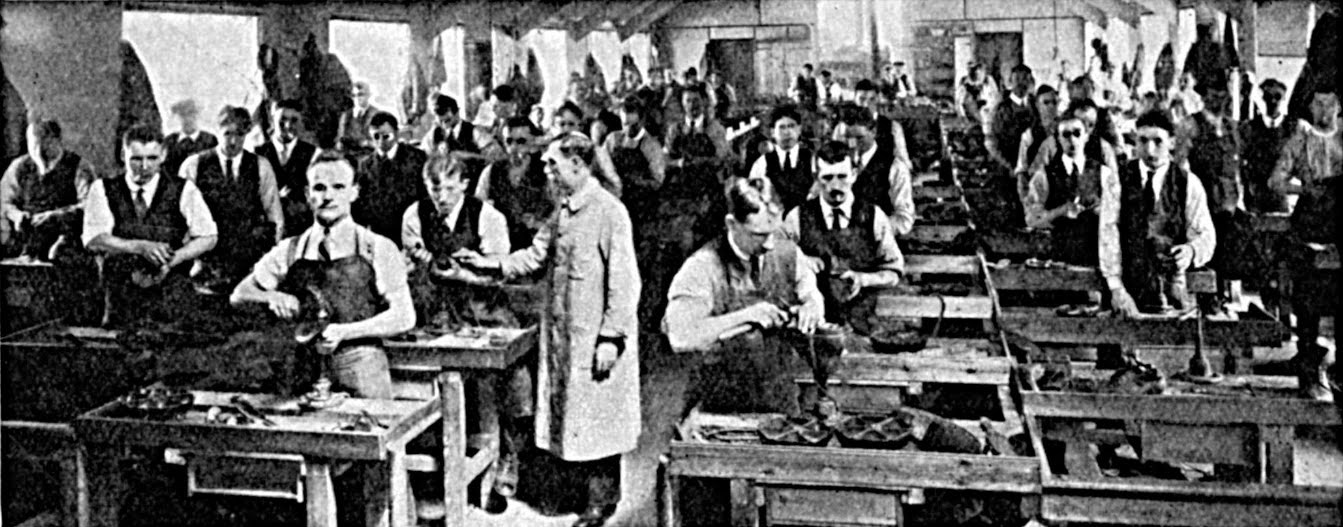
Upon his return to the UK, Harry was soon moved to the 2nd London General Hospital, Sir Arthur’s preferred location for the treatment of blinded servicemen. By September 1915, he was fit enough to come to St Dunstan’s and embarked on courses in reading and writing Braille.
As well as receiving care and training, the residents were encouraged to take part in sports, ranging from athletics to shooting and rowing. With many of the men being keen football supporters, it was unsurprising that St Dunstan’s sought to foster links to clubs. Fundraising collections were common at matches, including at Goodison Park, whilst, across the country, blinded servicemen were invited to attend matches as guests. Arsenal forged particularly strong links with the organisation, and played blindfolded ‘shoot-out’ matches against the St Dunstaners. In 1921, Everton accepted an invitation to visit St Duntan’s whilst in London to play Chelsea on 21 February. Sadly, a promise to return for a match in March, when in London to play Tottenham, never came to fruition.
Residents at the facility were encouraged to train for a new career in which they could make a living without the gift of sight. Shorthand typing, telephone operating, poultry farming, carpentry and shoe repairing were amongst the jobs that the veterans went into. Harry would later recall a staff member taking a look at his hands and saying: ‘Massage for you my son.’ Therefore, like many a St Dunstan’s resident, he trained to become a so-called ‘Blind Masseur’ – what we would today refer to as a physiotherapist. Harry showed great aptitude in training on a salary of £3 per week, before graduating in December 1916. Whilst resident at St Dunstan’s, Harry would fall in love with Kate Penfold, a nurse who treated him during his recuperation.
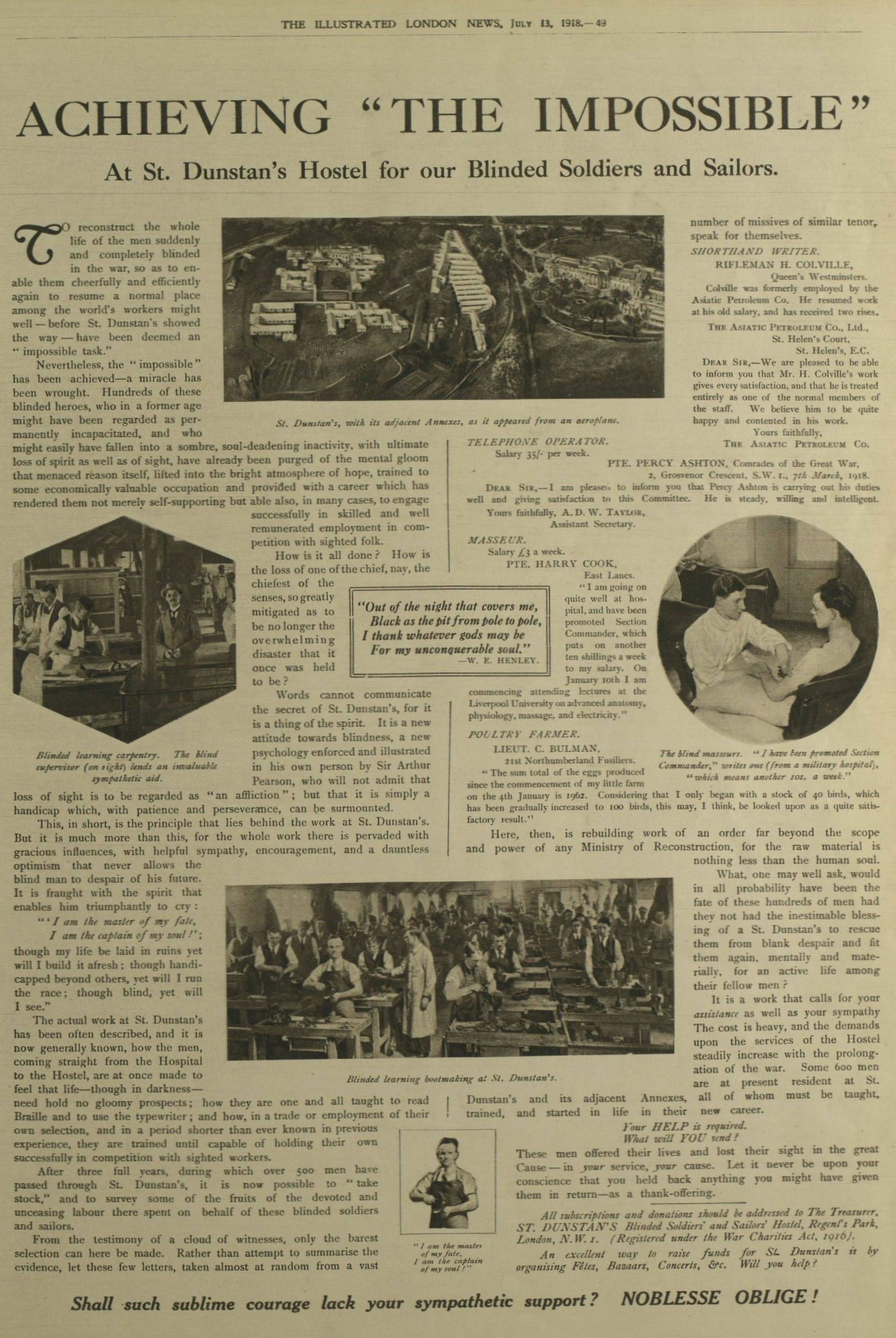
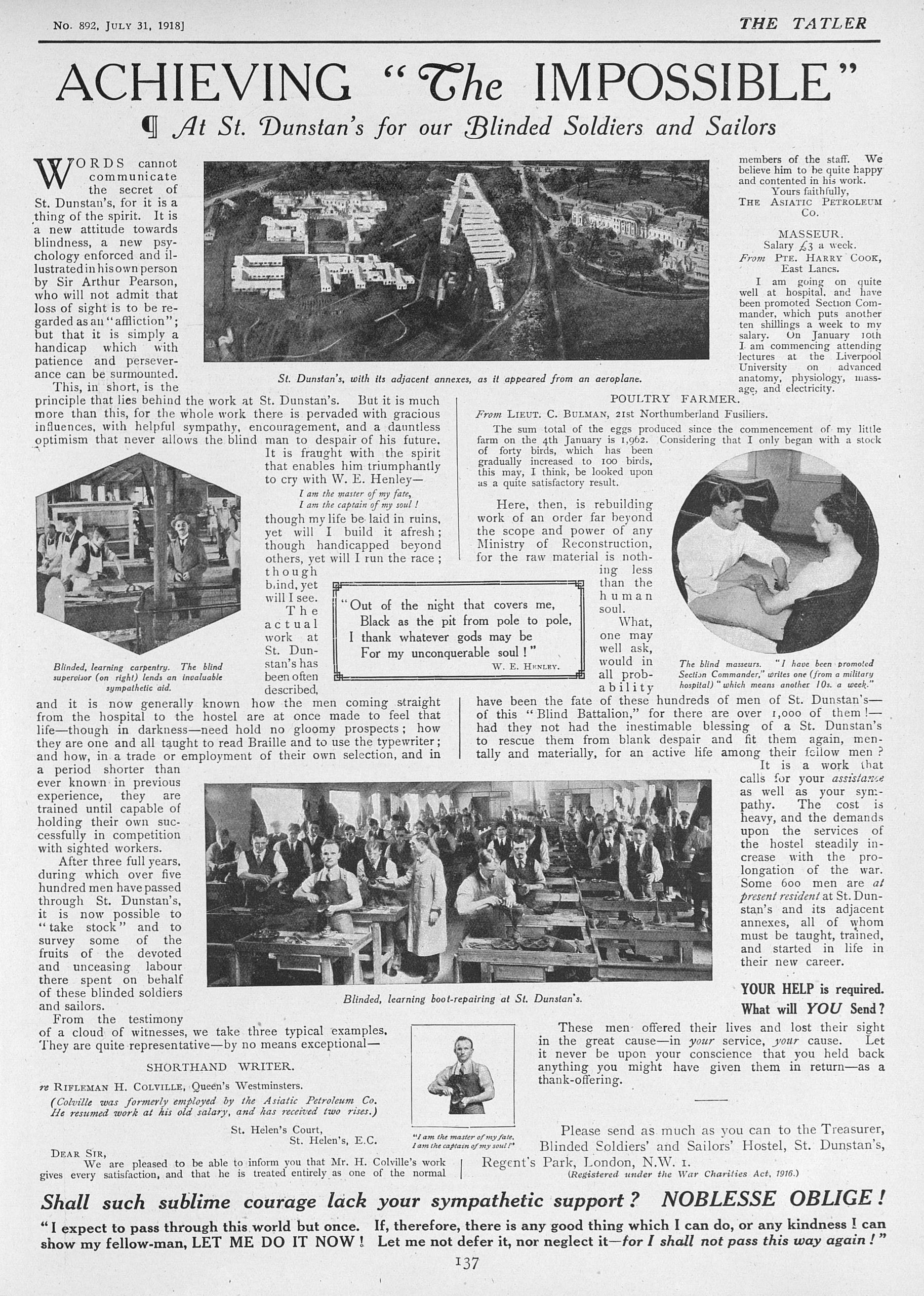
With a job secured at Liverpool’s Alder Hey Military Hospital, he returned North to live with his mother, within earshot of Goodison, at 30 Haggerston Road. In January 1919, Harry embarked on a post-graduate course at Liverpool University – in the theory of massage, practical anatomy and electro-therapeutics – alongside thirteen sighted students. In the end-of-course examinations, he came top with an average score of 90%.
Such was his success at Alder Hey, that he was joined by three other St Dunstaners, with whom he would eventually set up a successful partnership at 4 Hargreaves Buildings on Chapel Street. This ran until 1924, whereupon Harry set up a private practice, living at 5 Cambridge Road, Wallasey. As well as carrying out massage therapy, he also offered the then revolutionary ‘sun lamp’ treatment.
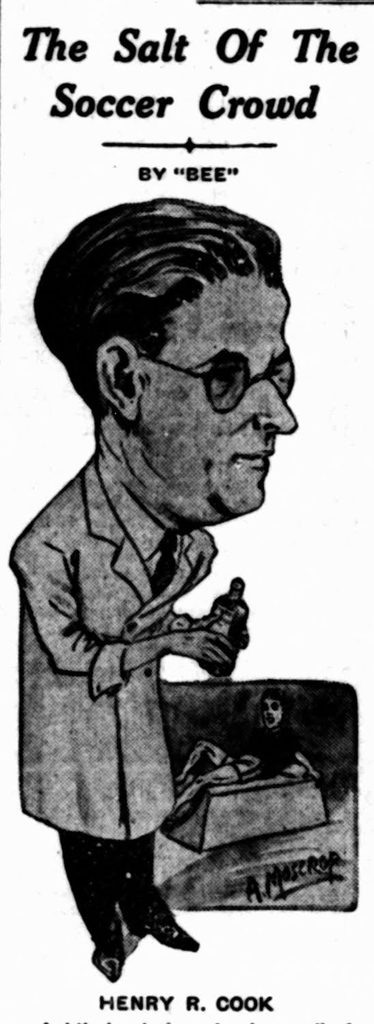
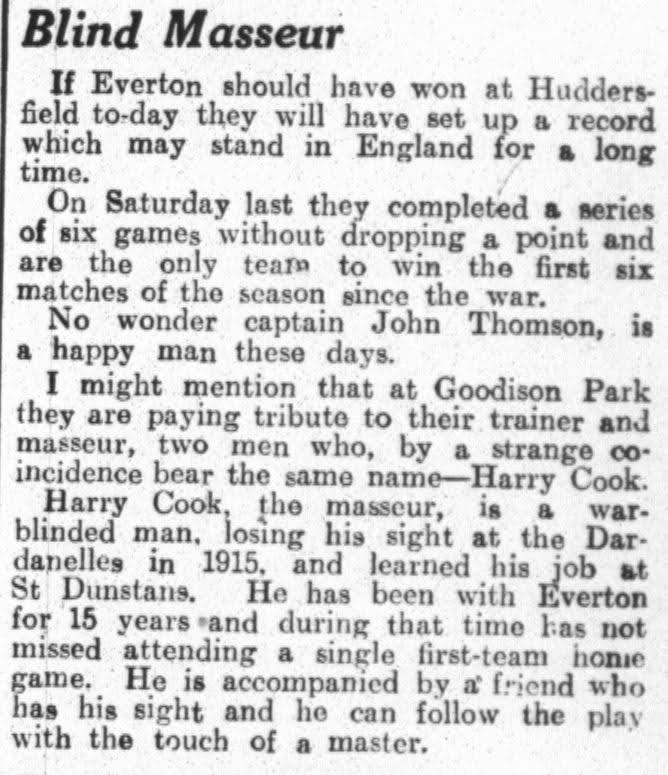
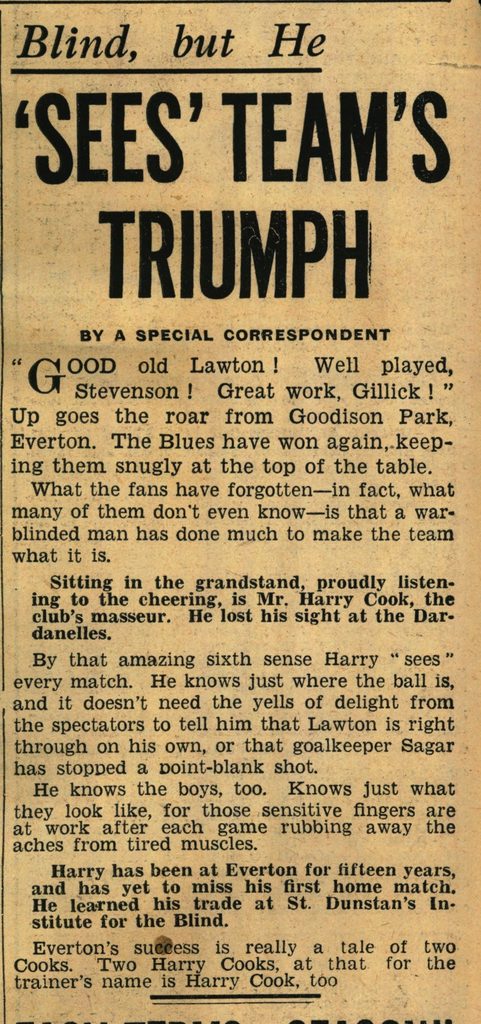
For Harry, the shattered dream of playing for Everton had been superseded by a desire to work for them as a masseur. He wrote to the Everton Board in August 1923 offering his services. Having obtained glowing references, the Blues directors engaged Harry to work on Tuesdays, Thursdays Saturdays, and Sunday mornings for £2 2s 0d per week. ‘Blind Harry,’ as he was affectionately referred to, became a vital cog in near-namesake trainer Harry Cooke’s backroom machine. Harry was also a regular attendee at Goodison Park: ‘I never miss a home match at Everton,’ he recalled. ‘I always know what is happening through listening to the crowd, and feeling which way they are turning and swaying. I follow every movement on the field from the sound of the ball, yells of the crowd, and the running commentaries, often for my benefit, from Harry Cooke.’ According to Ernest ‘Bee’ Edwards, in a 1934 Liverpool Echo profile, if Harry heard that the Blues were doing badly, he’d slope back to the changing room and await the post-match post-mortem.
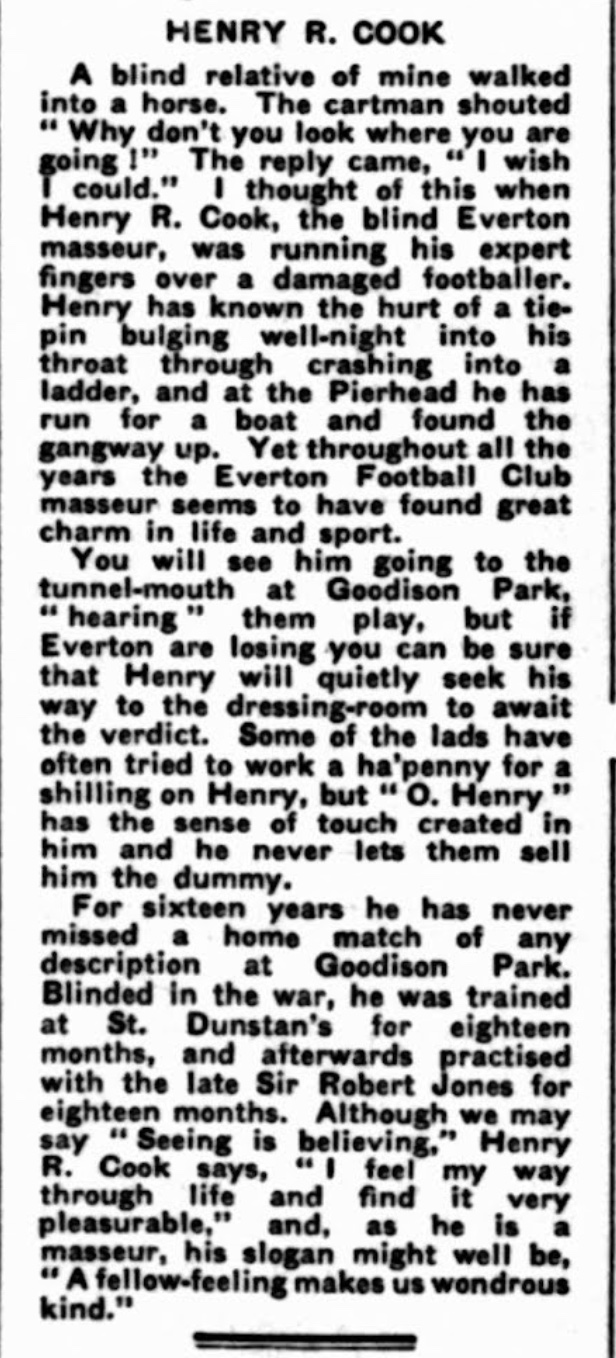
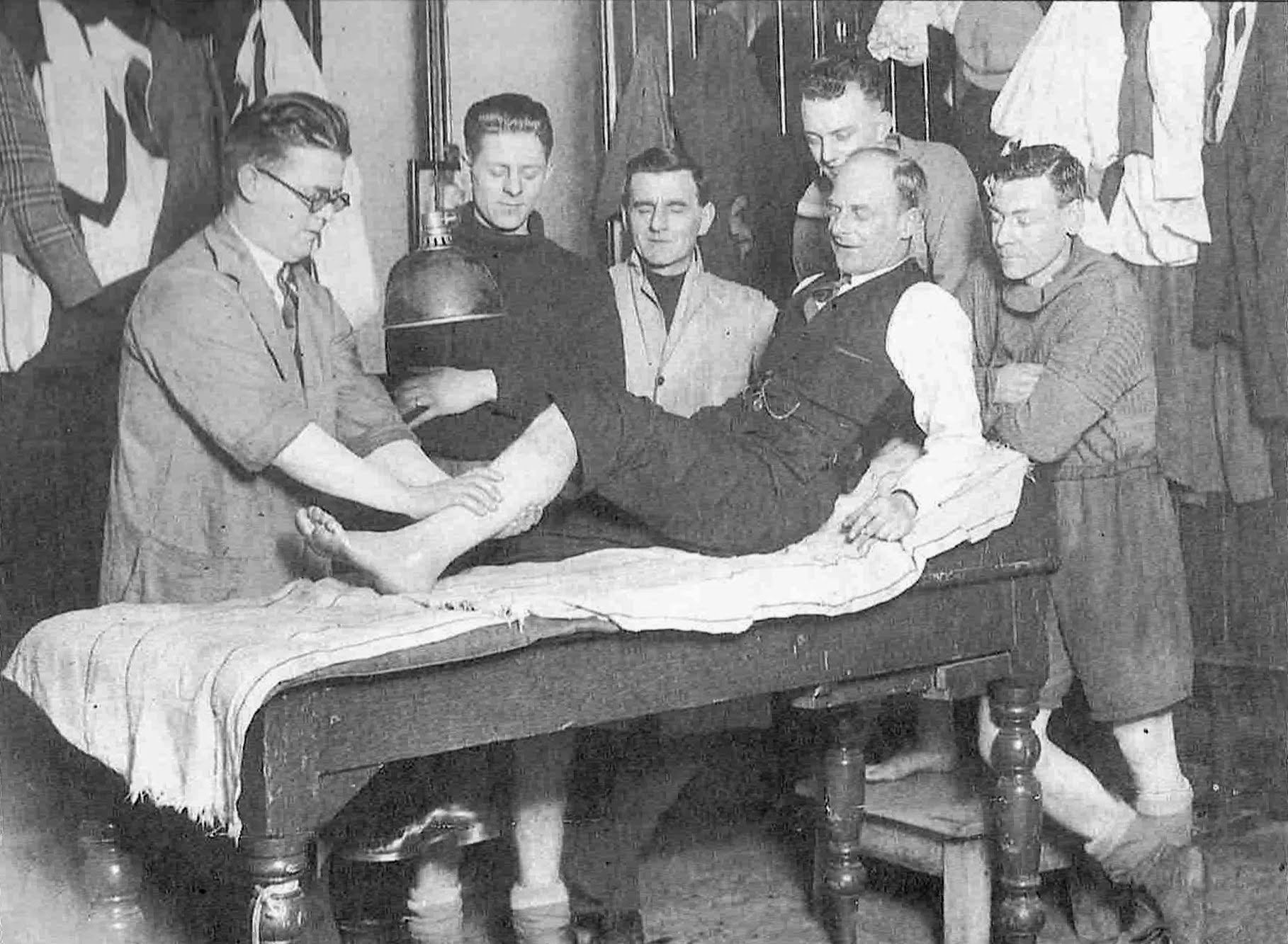
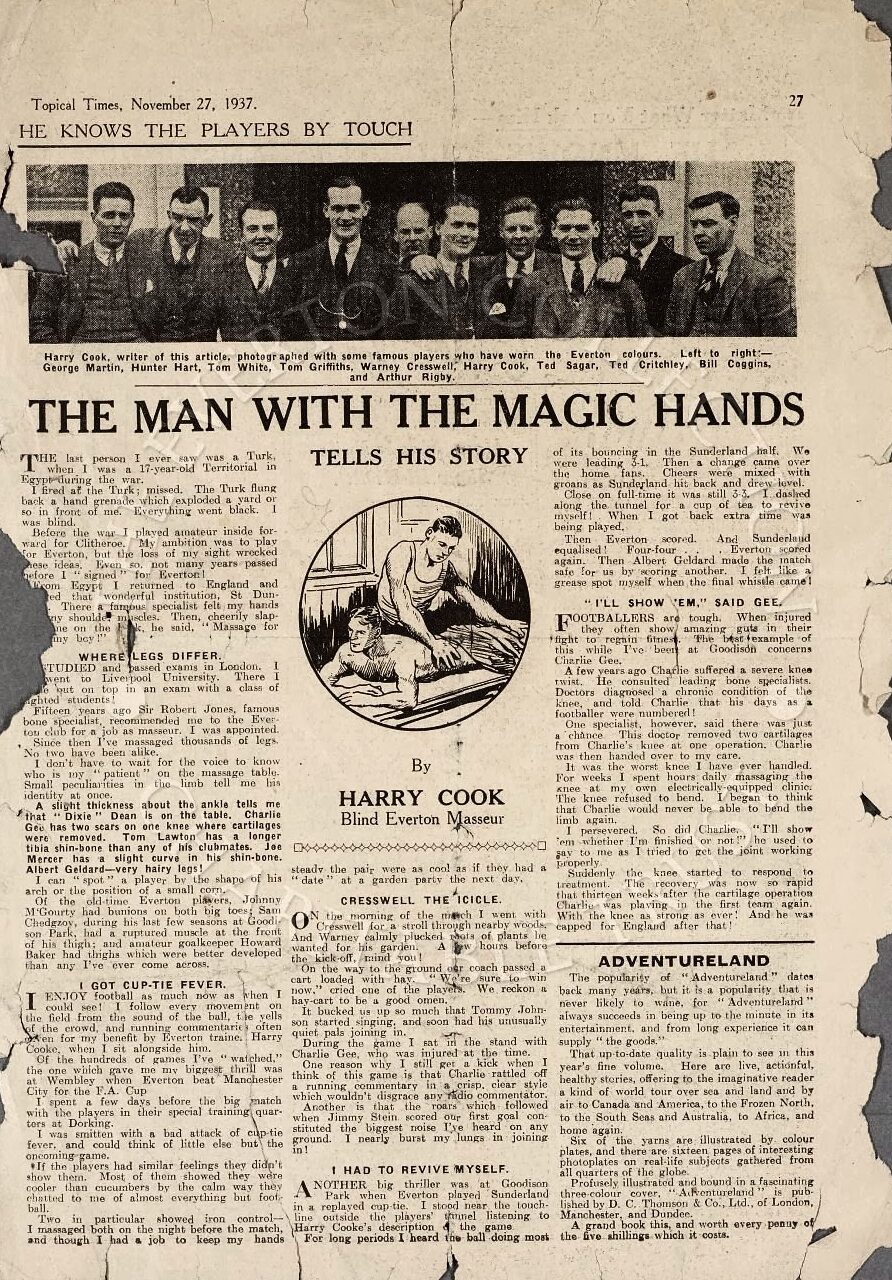
Such was his skill and memory that he came to recognise every player by touch, as he told the Topical Times in a 1937 article titled The Man With Magic Hands:
‘A slight thickness of the ankles tells me that Dixie Dean is on the table…Tommy Lawton has a longer shin bone than any of his colleagues. Joe Mercer has a slight curve in his shin bone; Albert Geldard has hairy legs!’
Wing-half Gordon Watson would recall to David France that, in the 1930s, the players would attempt to trick Harry, but he always recognised his patient – even an attempt to pass off the tea-lady as a player failed.
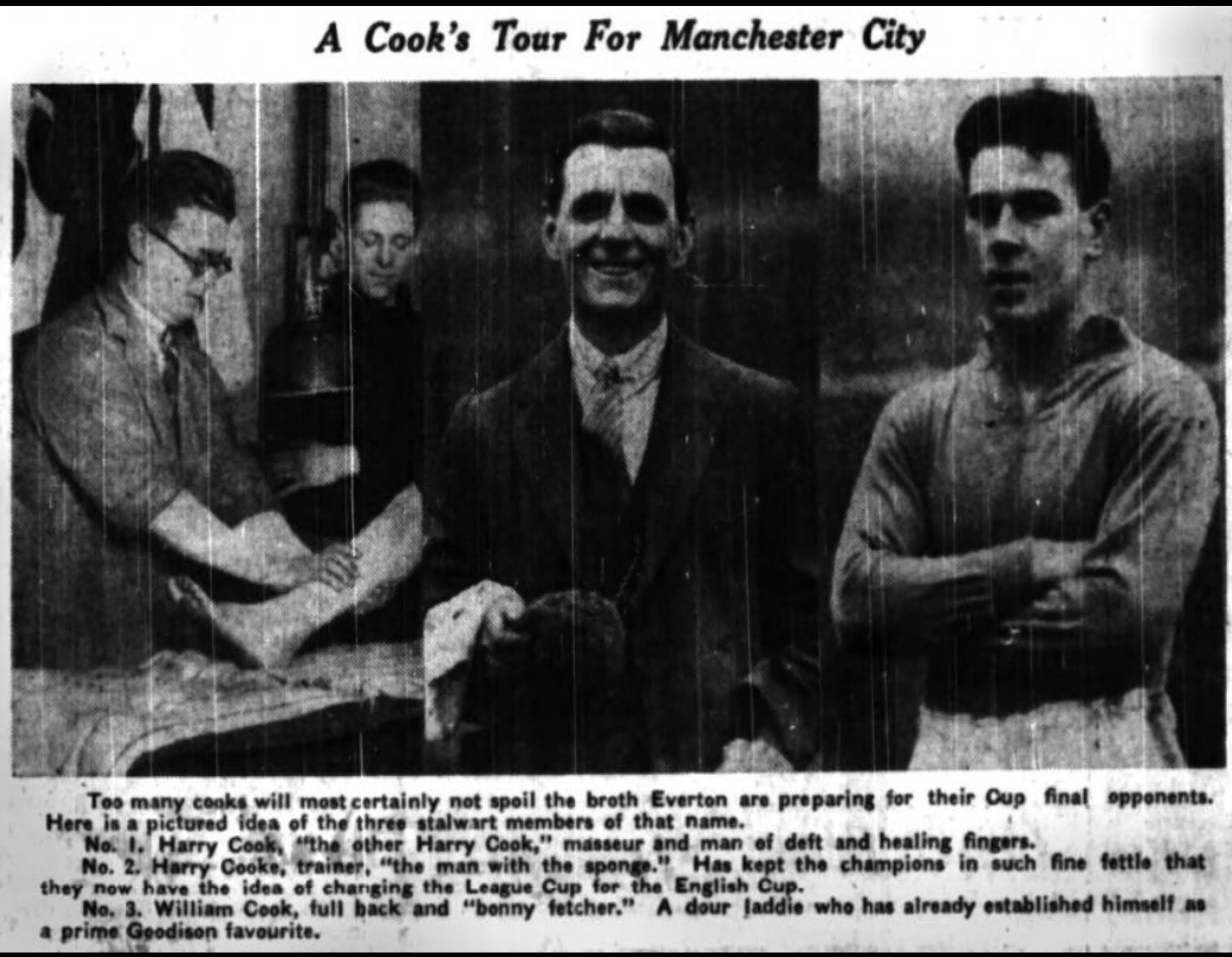
He would accompany the squad on training camps at Buxton, and to major away matches in the 1920s and 1930s – and he was at Wembley for the 1933 FA Cup Final. As the big day at Wembley approached, Harry was present at the team base in Dorking, and available to give several players treatment the evening before the match. Although Harry was feverish with nerves, he was struck by the sang-froid of Warney Cresswell. The Prince of Full Backs accompanied the masseur on a walk in a woodland close to the hotel, and spent his time plucking roots that he wanted for his garden. During the match, Harry sat alongside the injured Charlie Gee, who delivered a running commentary in his northern tones. He was overcome with joy when Jimmy Stein netted the first goal for the Toffees.
The rehabilitation of Gee, following a double cartilage removal, would become one of Harry’s proudest moments. Despite a prognosis that indicated that Gee’s career might be over after a cartilage operation, Harry worked on the damaged knee on a daily basis at his Wallasey Clinic. Remarkably, some motion in the joint was restored and the player returned to action within thirteen weeks of the surgery – and went on to play for England.
Harry married Kate at Emmanuel Church in Wallasey in June 1925 but there were to be no children. For his trips to Everton, Harry would catch the Mersey Ferry unaided, and then head to Goodison by public transport.
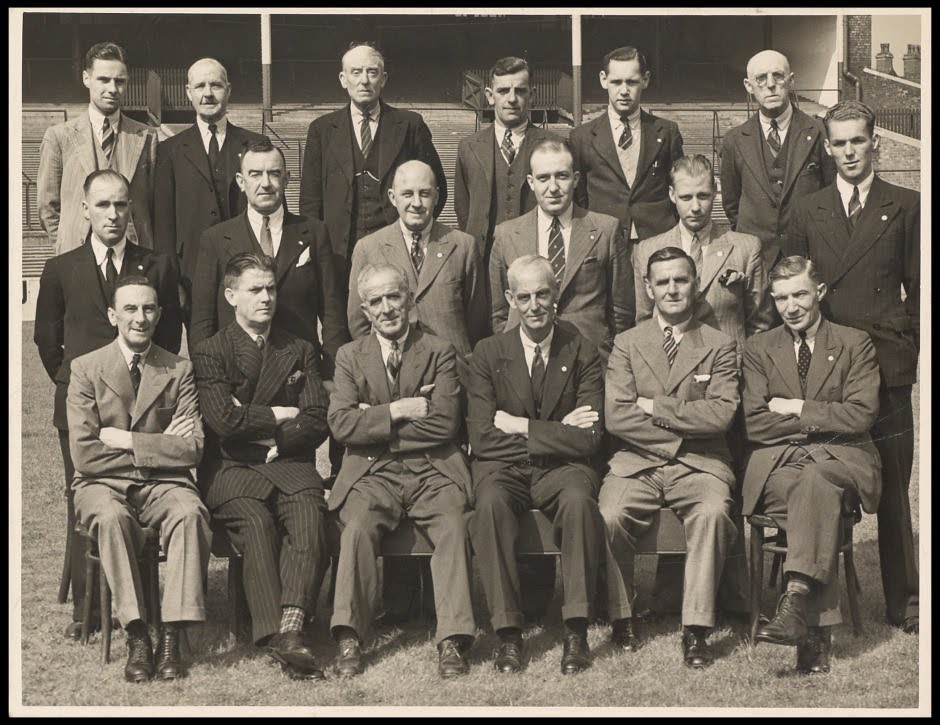
The Cooks became close with neighbours, the Critchleys. Doris, daughter of Ted Critchley (the Everton winger), recalls: ‘My Mother was very ill during her pregnancy and Kate looked after her; so, when the time came to choose godparents for my christening. Mum and Dad both agreed that they could not have anyone better than “Uncle Harry” and “Aunty Kitty.” It turned out to be a good choice as they took the role seriously and saw to my religious upbringing. After my dear father ended his football career, we used to stay with them on the Wirral. I would have been about five or six at the time. I recall that when I came down for breakfast each morning he would ask me if I had done my “daily dozen” and would have me touching my toes and stretching my arms above my head twelve times. He and Aunty Kitty were such lovely people. Uncle Harry’s personality was bubbly, always looking on the bright side of life, cheerful and very kind.’
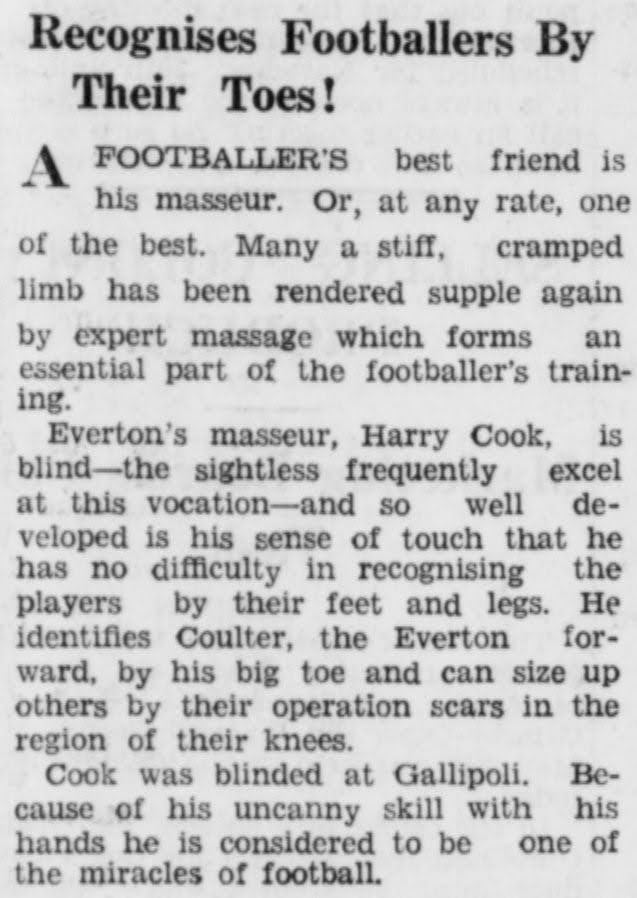
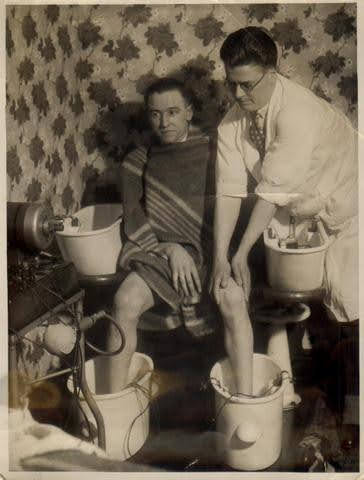
Everton winger Jack Coulter was, like Charlie Gee, indebted to Harry for his hands-on approach to recuperation. In Coulter’s case he suffered a nasty leg break and had a long spell on the sidelines. He would often speak to his family in later years of the care received from Harry, who could recognise Jack by feeling his big toe. They still have a photo of Jack receiving some form of (dangerous looking) electric therapy from Harry.
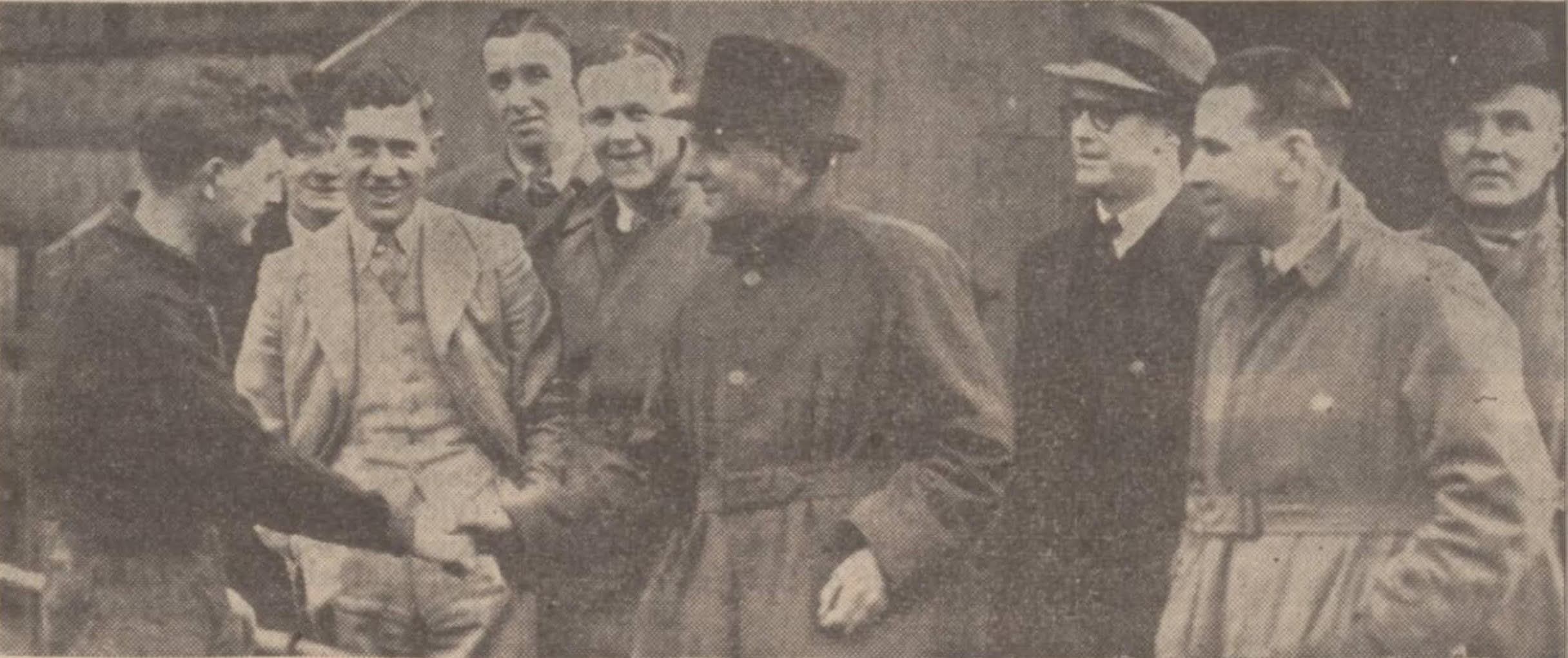
In 1939, with Everton the reigning League Champions, hostilities in Europe brought a premature end to Harry’s Goodison career. He continued in private practice, on the Wirral, before taking up a post in 1945 at Hackney Hospital in London. He got a rare opportunity to catch up with his old Toffees chums in February 1950, when attending their match against Charlton Athletic at The Valley.
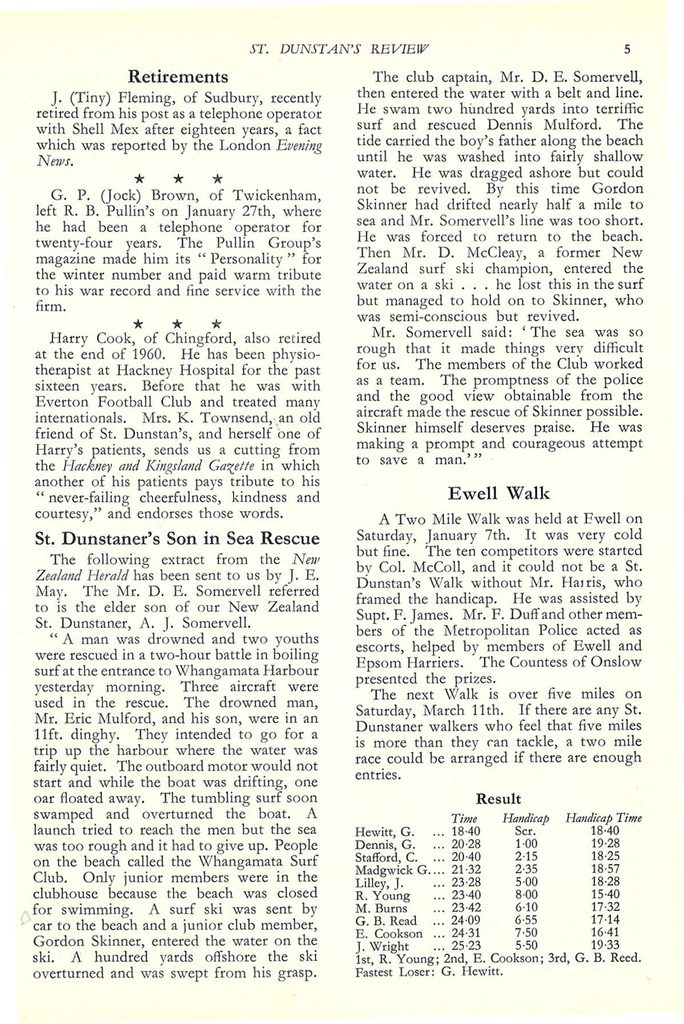
Renowned for his kindness and cheerfulness, he often volunteered his services to the Hackney Boys Club and retained links with St Dunstan’s via their Bridge Club. Tragically, just a few weeks after taking retirement, he died suddenly on 25 February 1961 – hours after playing Bridge with friends. He was survived by Kate, who passed away in 1988. Harry was cremated at Enfield Crematorium.
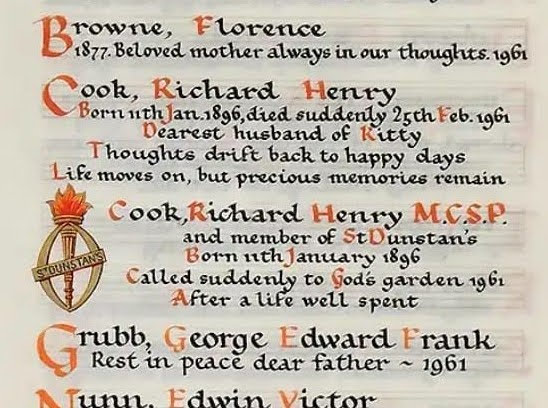
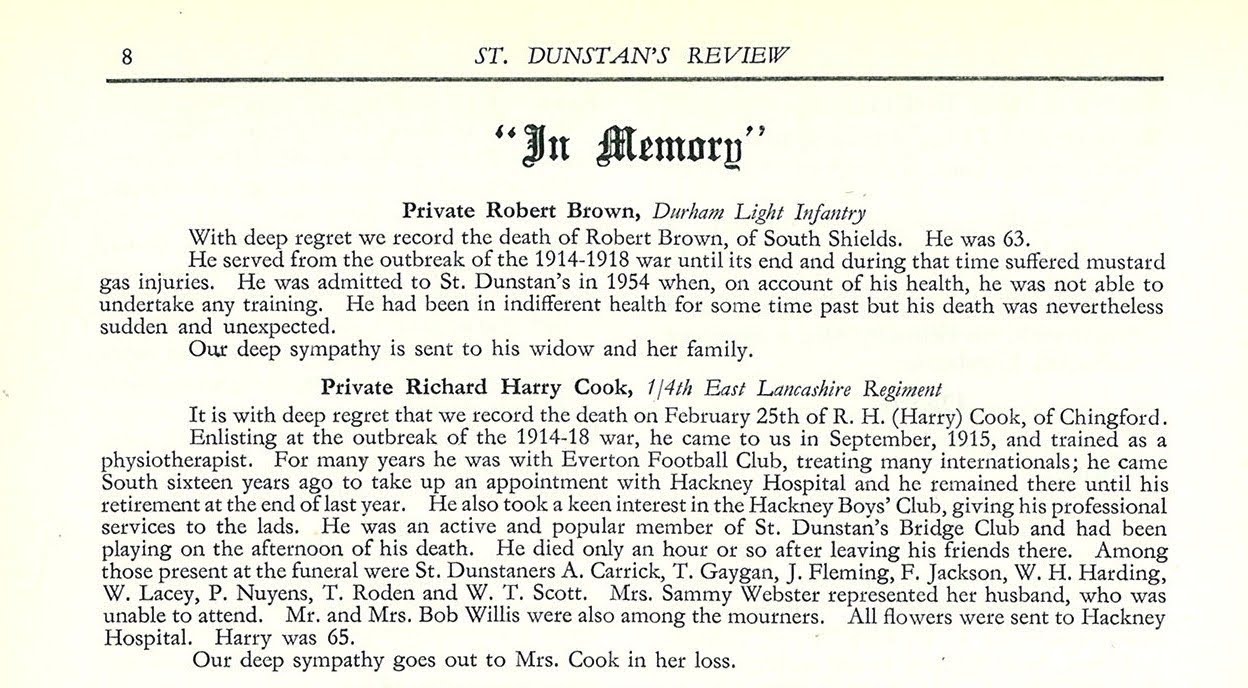
And what became of St Dunstan’s?
The charity has continued to assist people who have suffered loss of vision during, or after, military service. It is now known as Blind Veterans UK (www.blindveterans.org.uk) with a motto that Harry would have endorsed wholeheartedly: ‘Life Beyond Sight Loss.’
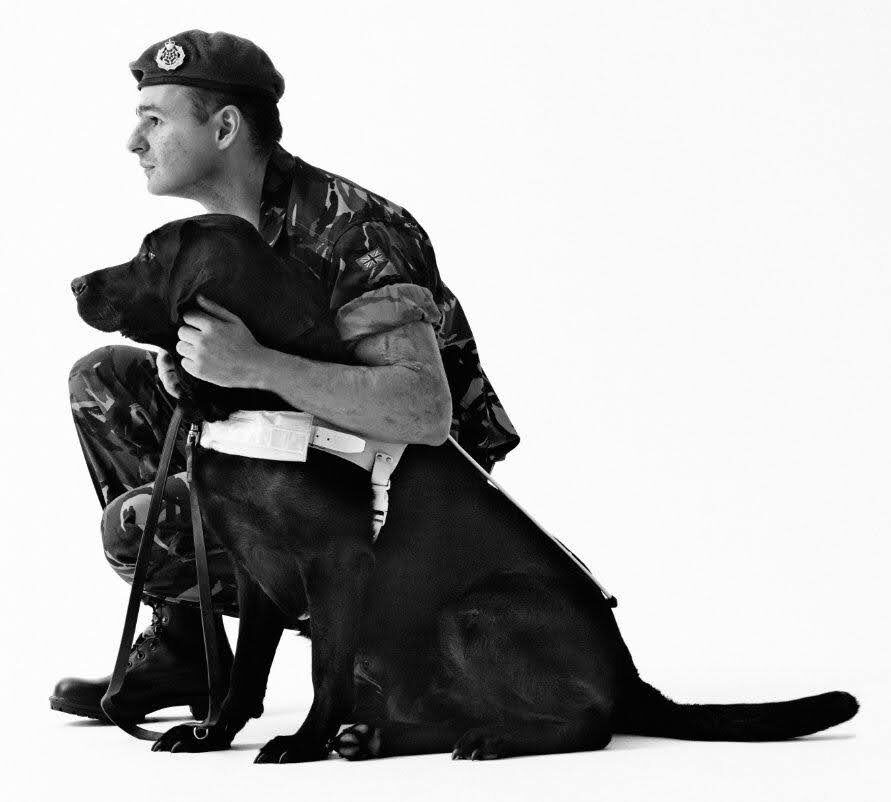
(crossover-showroom.com)
In 2007, Lance Corporal Craig Lundberg lost his sight during fighting in Basra. The impact of a grenade shattered his left arm and sent fragments of burning shrapnel flying into his face. The Merseysider lost his left eye instantly whilst his right eye was damaged beyond repair.
Blind Veterans UK stepped in and arranged a week-long rehabilitation course for Craig (known by his pals as ‘Freddie’) at their specialist centre in Brighton. The charity has gone on to provide a specially adapted house near his family in Liverpool and continues to offer assistance as required. In his darkest days, he received a message of support from Blues skipper, Phil Neville and was subsequently a guest of the club at their training base. This indirectly led to his involvement with the Everton In The Community team and the development of their blind football team. He has since stepped onto the turf at Goodison Park, played blind football for England, carried the Olympic Torch, scaled Kilimanjaro, completed a 350-mile bike ride for charity, and run the London Marathon. He’s the proud owner of a guide dog called Comet. I am sure that Harry Cook would have approved of Craig’s remarkable achievements.
………………………………………………………………………..
Acknowledgements/thanks:
Rob Baker (Blind Veterans UK)
David France/George Orr (EFC Heritage Society)
Jessica Talmage (Mary Evans Picture Library)
Doris Critchley
Steve Lundberg
The Coulter family
Mike Royden – proofing and edit.
Sources
The Everton Collection (Liverpool Record Office)
Topical Times
Illustrated London News
The Liverpool Echo
St Dunstan’s Review
Lance Corporal Craig Lundberg, in Adams, Brian, Wounded: The Legacy of War, crossover-showroom.com/index.php/wounded/craig-lundberg/
Smith, Billy, Everton Chronicles, bluecorrespondent.co.uk
Jackson, Andrew C., Accrington’s Pals: The Full Story (Pen & Sword 2013)
Jackson, Andrew C., The Accrington Pals website https://www.pals.org.uk/