As told to Rob Sawyer

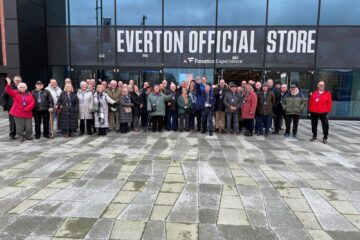
Lindsay Johnson went from kicking a football on a patch of grass as a child, as she wasn’t allowed to play in a boys team, to becoming Everton Ladies’ record appearance-maker, a two-time cup winner and the proud winner of forty-three Lioness caps. She goes down as one of the smartest pieces of recruitment that Blues boss Mo Marley ever made. In May 2026, alongside her former teammate Becky Easton, she was inducted into Everton Women’s Hall of Fame.
I sat down for a coffee with Lindsay and discussed her journey in football. Below is an edited version of what she told me.
Getting into Football
When I was growing up, I went to watch to Hartlepool United a lot with my dad. I thought they were amazing as they were in the Football League at that point. There were some really good games; I remember an FA Cup tie when we beat Crystal Palace one-nil at Victoria Park. Newcastle United was the Premier League team that I followed back them.
It was around then that I decided I wanted to be a footballer. Up until then I’d be playing every sport – athletics, hockey, Taekwondo, netball. I loved them all, but athletics had been my main one; I was a sprinter and long-jumper. My mum thought that football was just a side sport for a bit of fun, but I knew that I enjoyed it the most. I was a tomboy; none of the girls played football, so my peers were the lads. I vividly remember being fitter and stronger than them, but I wasn’t as good technically. I didn’t know why back then, but it was because I didn’t play for a team as I wasn’t allowed to play in one with boys. I was then just playing on my own in the garden or on a grassed area just round the corner. My cousins (boys) were a couple of years older than me and were quite good, so I watched them. I wanted to be as good as they were and I got better.
When I was eleven, we found a girls team, Hartlepool St Francis girls, and it went from there. There weren’t many girls leagues back then, but St Francis was in a local one. As soon as you hit fourteen you were in the open age senior squad, so I was playing in this environment with fully grown women. Looking back, it was a lovely community, but quite challenging, as you had younger girls with their parents still involved and older women merged into one team. So, you had to grow up fast, I was quite small then, I didn’t shoot up until I got to fifteen. I was nimble and quite a wind-up merchant as a forward, so I had to be quick! St Francis had decent success; I played for them for five or six years until it disbanded when the manager and his wife, who ran it, stepped down. If it wasn’t for them and the parents of another girl in the team, I wouldn’t have had the opportunity to play football.
From going into sixth form I didn’t kick a ball properly for two years. When I went to Manchester Metropolitan University to study PE teaching, I started playing all the sports. It was touch and go between choosing football or hockey, but I decided to give football a go. We had a really good university football side which won the national title each year. I went on to play for the English Universities team and through that, in my second year, I met Jody Handley, who was at Liverpool Hope University. She asked me to go along to Liverpool FC. I’d had their green Candy sponsored strip as a girl which my uncle had bought for me; so, I joined them in around 2000/2001 while I was still studying.
That season a lot of players left and they got relegated. I was there for two seasons, I was starting every game, being captain and playing centre-midfield, although I didn’t really know how to play it, as I was more of a winger and had not had any coaching. The manager was lovely, but we did the same drills again and again, so I was plodding along.
Everton Calling
Dawn Scott, who worked at the FA, was a mutual friend and was a former Manchester Met goalkeeper. In the off-season one weekend, she asked me to go along to a seven-a-side tournament, as there was someone she wanted me to meet. That was Mo Marley, she was very cloak and dagger. Apparently, she’d had her eye on me and wanted to meet me and suss me out. She told me that she’d really like me to come and play for Everton, who were in the top division. Then she set her stall out, telling me that she wouldn’t be playing me as a central midfielder but as a centre-half, saying, ‘You’re going to take my position; you have all the attributes of a centre-half and I’m going to make you into one.’ I couldn’t say no to that. So, that was the start of my journey with Everton. Liverpool didn’t want me to leave but you could give just seven days’ notice and sign for another team.
I learned so much from Mo, especially in those first two seasons, as I had never been coached to that level before or played with players of that calibre. After a year, we’d have these long conversations – the others would laugh at me – but I learnt so much from her, I was behind the girls technically and tactically, so I just wanted to learn as much as I could as fast as I could. She’d played for England, captained them, was A-licensed and coached England U19s, so I wanted to take in everything; I could listen to her for hours. Once time, she had me in the car and told me that England manager Hope Powell had recognised me, but as I had not been through the England system, they wanted me in the U19s first. I was twenty-three or twenty-four but said, ‘Yeah!’ I didn’t care about being over-age. In fact, I went with the first U21s trip to the Nordic Games in Iceland. In the five games, I played in every position across the back so they could see me. I got in the next senior camp; sometimes there were six or seven of us from Everton in the England squad and it improved us immensely.

Mo was quietly knocking on the door at Everton, in her own way. At first, we were training at Netherton from 9.00 to 10:30pm. She expected everyone to be there. Mo and Keith were ferrying people everywhere. Fara Williams was coming up from London. I was back in the North East and driving down, Jill Scott was up in Sunderland, Rachel Unitt and Lucy Bronze were in Leeds. All of these girls were coming from different places, plus we had the girls from Liverpool. Sometimes we would share lifts. Later I was working down Crewe way, and Unitt was in Walsall, and we’d car share. Mo and Keith were so supportive of us; without them, Everton would not have been the team that they were.
I had never trained at Bellefield. When we went to Finch Farm, it was amazing, but then reality set in when we were told that we could only train at eight o’clock in the evening. Even the young boys were in before us – that’s how it went and we accepted. You had to go through that – you walk before you run. Women’s Football had been banned for so long that it could not go straight from nought to one hundred. I loved it, but I was so tired – training until 10:30 at night and then driving home or staying over at Jody’s. Sometimes we’d have strength and conditioning with England at seven in the morning, a full day of work and then Everton training in the evening. People ask me how I coped but you just did it. Everybody apart from Arsenal at that point had similar struggles – Arsenal were so far ahead, and they had incrementally done the right things over time.
I loved playing for Everton at Marine’s ground. Nobody liked to go there, all the other teams hated it. The pitch was ok, it had a bit of a slope, but the opponents didn’t like the changing rooms. We didn’t get big crowds but could pack it out for the derbies and Arsenal games. When we joined the WSL, the TV coverage demands meant that we moved over to Widnes, which was a shame. For a rugby pitch it was amazing, like a carpet, but the stadium was too big for us.

We lost the 2005 Women’s FA Cup Final to Charlton at West Ham. We were starting the journey and didn’t have the big players at that point. Our hotel was at Upton Park; you opened the curtains and saw the pitch. We had some young players; the occasion was too much for us and we didn’t play well. Charlton didn’t either, but Eni Aluko scored for them and we lost 1-0.
Mo was building the team in her own way, Browny [Rachel Brown-Finnis] was there and Leanne Duffy was very tactically astute. There was Kelly McDougall and Tammy Byrne. I might have had a season with Tina Mason. Then Fara Williams came in, plus Becky Easton, Jody Handley, [Rachel] Unitt, and Jill Scott a bit later. Most of the girls had played for her at England U19 level and loved Mo, not because she was easy – she was very strict, but she was the one who moulded them and improved them the most.
Fara’s arrival from Charlton brought real quality. She wasn’t easy to play with as she was so knowledgeable and always two steps ahead of us. I loved playing with her, but we had some ding dongs, with us trying to understand where she was coming from. She was so creative and very unselfish. She was best playing in front of the back four.
Jill Scott was here, there and everywhere when she first came, she was eighteen and learning her trade. The first time we met, we bonded straight away, maybe due to the North East connection. I asked her where she was playing next season and she just laughed. I wasn’t trying to get her signed, I think she already knew Mo was interested. I told her that I really enjoyed it at Everton and she ended up coming. I didn’t think she’d get to be where she is now, with all the fame, but there was something about her, this resilience at a young age and always pushing herself. She had been raw but, like me, pushed herself to get better on the ball. After a season under Mo’s guidance, she matured massively. She ended up living with me for two years; it should have been for only two weeks!
Becky Easton doesn’t get the plaudits she deserved – she was an England, Everton and Liverpool legend. She was very quiet, we’d go to her house and chat about the game, and I’d learn how to let things go, rather than dwell on it. She’d say, ‘It’s done now, and next time do this’. So, I learned a lot from Becky. She had resilience, no one liked playing against her. As she got older and the legs were going a bit, Mo started playing her at right-back and she hated it – but she was brilliant, she read the game so well.

Silverware
We were pushing Arsenal but always coming up just short. They had one half of the England team and we had the rest, but maybe they had the ruthlessness that we lacked. Then, in 2008 we beat Arsenal 1-0 in the Premier League Cup Final. They were so annoyed. We got an early goal and then played brilliantly, defensively, like our lives depending on it. We knew that we needed a trophy win to kick-start it, it was only the League Cup, but it was pivotal moment for us and Mo. You need to win to have the experience to draw on.

We played Arsenal in the last game of the season in 2009 – all we had to do was draw to win the league, but we lost 1-0. I always say to Tash Dowie that it was her player who beat her front post! Tash later left and won it with Liverpool, so she experienced winning the WSL.
It was amazing to beat Arsenal 3-2 in extra time in the 2010 WFA Cup Final. We didn’t play amazingly, but we drew on our experience and knew that we could beat them. It was the best thing in my career – and I did get to the 2009 Euros final with England, which people tend to forget, probably as we got battered 5-2 in the final by Germany! I played in every game but got dropped for the final, but it was an amazing tournament. Mo was always there, as a scout, but you could have someone that you trust to talk to. When I got dropped, she helped to put it in perspective and get me out of that bubble. Hope didn’t put any subs on in the final, but all of my forty-three caps were under her, which I’m thankful for.

A Team On the slide
I thought Everton would kick on after 2010, but we didn’t. With the WSL, we lost the spine of the team to Liverpool, like Fara, Becky and Tash, and they signed these amazing players from America and Germany. We couldn’t get near Liverpool when we played them. Then Unitt went to Birmingham, and then Manchester City started developing and we lost Jill.
Losing those players was big, but the biggest loss was Mo, in 2012. I knew it was coming; there was something in the air. You could feel the frustration; we weren’t playing like we had done. Then Andy Spence stepped up as manager – he’d been an amazing assistant manager, the best. Mo was A-licensed and Andy, so enthusiastic and passionate, was going through his course. So, we had these two amazing coaches plus Keith, who sorted things out. Andy Johnstone was the goalkeeper coach and we had Keith Reece, who was in the England set up – we were lucky with the coaches we had. As manager, Andy maybe struggled to say those hard things and make some tough decisions. The players we signed were average, that was the downfall; we had lost these amazing players and the new signings were not the same.
I was thinking about leaving at this point. Jill said, ‘Come to City’ and a couple of teams were interested – but I just couldn’t do it, I wanted to be at Everton. We still had a core of players and I thought we could turn the corner with the right decisions. You had me, Browny and Jody, older players happy to speak up and have professional conversations, but then it was just me left, having a ‘go’ because I didn’t feel the level was good enough. Then we got relegated – which was the worst thing. We played some good football but couldn’t score. Nikita Paris wasn’t getting the service. It was a lot for such a young player who was learning her craft; she was a dangerous player even then at such a young age. Alex Greenwood was another phenomenal player to come through the ranks at Everton; alongside Unitt, she was probably the most gifted defender I had ever played with alongside, and she turned out to be one of the best and consistent players in England, in my opinion. They were aged nineteen or twenty and knocking on the door of the England squad – they could not go down to the Championship, so they left.
It was hard in the Championship. We were playing on the 4G pitch at Widnes, which wasn’t a true bounce. I did not enjoy playing on it and it was taking its toll, but I wanted to play until we got promoted. We had more away stayovers than in the WSL, at places like Yeovil and Charlton. I was away all of the time and helping the younger ones on the team coach with their schoolwork. So, I thought it was the right time to retire. As soon as I finished playing, Andy got me in on the coaching staff. I joined in with training and was the hardest worker and still one of the better players. I think he felt that I was bringing the standard up. And then I was on the bench – on one occasion with a pair of goalie gloves on! I did it for seven months, and then told Andy I was going to stop, and I stepped away around 2016/17.
The Lasting Impact of Everton
Everton haven’t found another Mo since she left. We need a manager who will excite and attract players – and that means money. The club had always produced good players through the academy or brought them in and developed them. I don’t think the youth set up is as good as it had been. They are now full-time professionals, based at Finch Farm and are being looked after with nutrition; so, they have made steps, but Everton have been left behind by others.
Do I wish I was playing now? My biggest regret is not the money, but not being able to be a pro-athlete, training twice a day. I was semi-pro only for my last two years, so you were offered more training then. When we were with England, we were pro-athletes for a week to ten days, and we’d come back to Everton and our touch was so much better. So, Mo loved it when we came back from England, even though there had been the risk of injury.
Although I’m not as connected to the club as I once was, I still enjoy going back whenever I’m doing media work and keep an eye on how things are progressing. Everton was a huge part of my life, and the club means so much more to me than just the football I played there. The thirteen seasons I spent there shaped me both as a player and as a person. It gave me the opportunity to work with some of the very best coaches and managers in the women’s game – particularly Mo Marley and Andy Spence, who helped me develop in ways I could never have imagined when I first arrived. I genuinely do not think I would have achieved what I did in the game without Everton. The standards, the environment and the people around me pushed me to become the best player I could be.
What I treasure most, though, are the friendships. Some of my closest and longest-lasting friends came through Everton. We went through so much together – the late-night training sessions, the long journeys, the disappointments and the successes. Those shared experiences created bonds that have lasted a lifetime. To be inducted into the Everton Women’s Hall of Fame is an incredible honour, and one that I will never take for granted. Everton holds a special place in my heart, and in my family’s heart, for me. It will always feel like home.