Richie Gillham with David France
The Goodall brothers occupy an intriguing place in football history. Despite having Scottish parents and being raised in Kilmarnock, the brothers were ineligible to play for Scotland because of their birthplaces. John was born in London in 1863 and Archie in Belfast in 1864. As a result, they became the first brothers to represent different national teams – John scoring 12 times in his 14 appearances for England and Archie scoring two goals in his 10 outings for Ireland.
While both Archie and John turned out for Everton in the pre-League era when the club relied on a busy programme of friendlies, their involvement was quite different in scale.
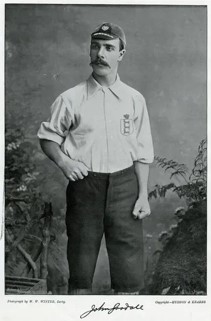
John Goodall
John’s football career began at Kilmarnock Burns and then Kilmarnock Athletic, where he developed into one of the most gifted young forwards in Scotland. Acclaimed for hat-trick while representing Ayrshire against Renfrewshire. he also helped Kilmarnock Athletic reach successive Scottish Cup semi-finals in 1882 and 1883.
Despite suffering serious injuries to his face and eyes working as an iron turner in the Glencairn Works, John moved to Great Lever as part of the wider Scottish exodus in search of better wages. In Lancashire, newspaper reports praised him as ‘a forward of unusual intelligence and craft, capable of controlling matches through movement, combination play and distribution rather than brute force.’
His direct contribution to Everton was fleeting and limited to a single guest appearance while registered with Great Lever in a friendly at Bolton Wanderers in February 1885. Everton were well-beaten 0-7.
Later that year, he joined Preston North End. The Blackburn Standard reported that his new club’s visit to Anfield on 28 May 1887 attracted 10,000 spectators, many of them eager to witness the Goodall siblings face each other. Archie, leading the Everton line, came close to scoring early on but it was John who excelled with his movement unsettling the home defence. and scoring twice in the emphatic 5–0 victory for the visitors.
In the inaugural League season, Goodall featured in 21 of 22 league matches for the Deepdale club, scoring 20 goals. In addition, he played in every English Cup tie and helped ‘The Invincibles’ defeat Wolverhampton Wanderers 3–0 in the final at the Kennington Oval.
Shortly afterwards, John joined his brother at the Baseball Ground. Together they helped Derby County reach English Cup finals in 1898, 1899 and 1903. In total, John scored 76 goals in 211 appearances and was one of 19 men to play cricket for Derbyshire and football for Derby County.
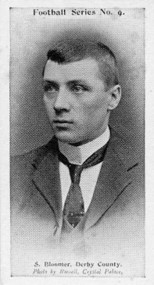
In addition, he is credited with accelerating the development of Derby County’s Steve Bloomer into an England international star. Bloomer recalled:
Goodall was a wonderful footballer, a brilliant captain and Nature’s gentleman. He was as the mentor who taught me the importance of complete ball control and of thinking a moment ahead of an opponent.
Bloomer would later become associated with Everton’s reputation as the School of Science, praising the club after their 1928 league championship season:
We owe a great deal to Everton. No matter where they play, and no matter whether they are well or badly placed in the table in the League table, they always manage to serve football of the highest scientific order. Everton always worship at the shrine of craft and science, and never do they forget the standard of play they set out to achieve.
After spells at New Brighton Tower and Glossop, John was appointed Watford’s first player-manager and guided the club to immediate success in the Southern League Division Two in 1904 without defeat and Southern League Division One in 1905. His final outing for Watford was in September 1907 at age 44 years 87 days.
John Goodall – Everton Appearances

Archie Goodall
Archie’s footballing life began on Merseyside, where he appeared for Stanley, Everton and St Jude’s while employed with the Liverpool Grain Elevator Company in Bootle.
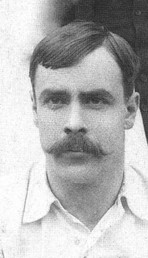
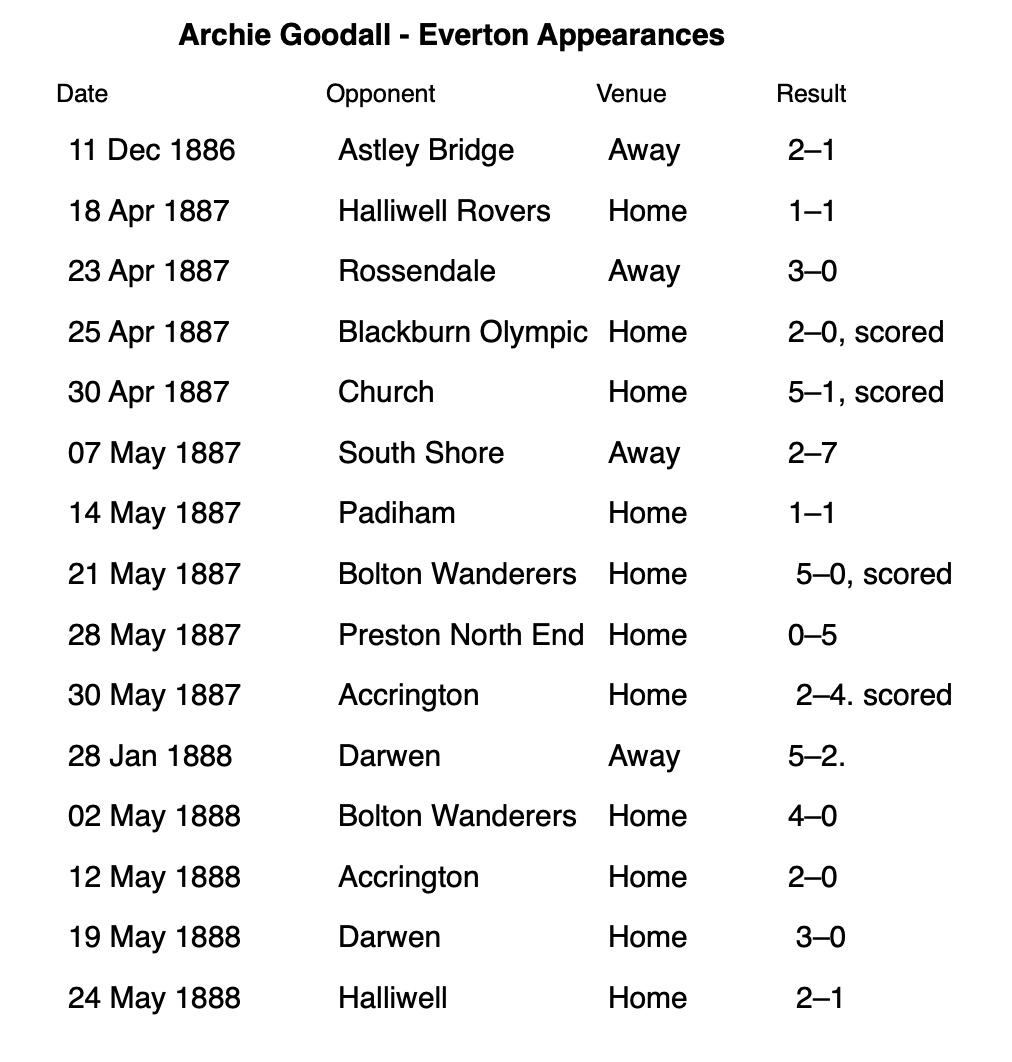
While representing Stanley in a fierce battle at Walton Styles, Everton’s Bobby Jones suffered a broken leg due to Archie’s rough play which resulted in the crowd pouring onto the pitch and chasing Archie along City Road still in his football kit. Nevertheless, he joined Everton in December 1886 and featured in fifteen pre-League friendlies against strong Lancashire opposition.
Archie later joined Bolton Wanderers, Preston North End and Aston Villa before teaming up with his brother at Derby County, where he made more than 400 appearances and scored over fifty goals. Primarily a centre-half, the Derby Telegraph described him as ‘having a cast-iron body set on legs rooted to the earth like oak trees, while opponents were said to be drawn as if by a magnet to the business end of his shoulder.’ He helped Derby County reach three English Cup finals and finish as Football League runners-up.
However, his life was marred by tragedy. In January 1890, his first wife, Mary Anne committed suicide while temporarily insane. Remarkably, just three days after her death, Archie played in an English Cup tie at Anfield, which Everton won 11–2 – the club’s biggest win in a competitive game.
Archie’s temper and stubbornness were legendary making him one of the first hard men of the Victorian era. For example, during his time at Derby County, he assaulted a spectator who accused him of foul play, refused to take part in the extra-time of the 1894 United Counties League Cup final and disrupted the club’s preparations for the 1898 English Cup final by touting tickets outside the Crystal Palace ground. The following year, he was suspended by Derby County amid allegations of turf betting and inattention to training – though he denied any wrongdoing.
In 1899, after Ireland relaxed its residency rule, he made his international debut at age thirty-four and remained a regular at centre-half for five seasons. His goal in a 2–0 win over Wales in March 1903 made him, at thirty-eight years 283 days, the oldest goalscorer in Ireland’s history.
After almost fifteen years at the Baseball Ground, Archie moved to Plymouth Argyle and then onto Glossop, where he took over team management duties and strengthened the playing staff following the club’s re-election to the Second Division. Later, he made a brief return to First Division football as a defender with Wolverhampton Wanderers. His final League appearance was against Everton in December 1905 and, at forty-one years and 153 days, he remains the oldest player ever to feature for the Midlands club.
Archie’s post-football life was as controversial as his playing career. Inspired by a fairground motorcycle loop-the-loop, he created a Vaudeville act called ‘Walking the Hoop,’ in which he performed acrobatic feats inside a giant steel ring. The act made him a star on both sides of the Atlantic. But fame brought misfortune. In 1910, Goodall accidentally struck and killed a seven-year-old boy with his car and his marriage collapsed amid the scandal. By 1927, he was destitute and imprisoned for failing to pay maintenance.
In November 1929, Archie collapsed and died near his home in East Finchley. The Nottingham Evening Post called the sixty-five-year-old ‘one of the most remarkable personalities that football had ever produced.’ It was a fitting epitaph.
Archie Goodall – Everton Appearances
.Richie Gillham with David France
*************************************
ACKNOWLEDGEMENTS
Mike Royden – Proof reading and web layout
Dr David France – Proof Reading
Mark Metcalfe
Bibliography
Smith, B., Blue Correspondent website (1886–88)
Johnson, S. Everton Results website
Hanssen, K. Play Up Liverpool, website
Everton FC Board Minutes (1888), The Everton Collection, Liverpool Record Office
Liverpool Mercury, Liverpool Weekly Courier, Liverpool Daily Post, Findmypast Newspaper Archive (1887–1894).
Brown, P. The Amazing Archie Goodall. FourFourTwo, (April 2014)
Chris Goodwin, England Players – 145. John Goodall, England Football Online,
Watford Football Club, www.watfordgold.org.uk – historical records
The Observer (May 1903)
Northern Ireland Players Roll of Honour online nifootball.blogspot.com
Vintage Footballers Online – John Goodall and Archie Goodall, https://www.vintagefootballers.com/
Simpkin, John, Spartacus-Educational.com John Goodall
The Scots Football Historians Group Online, John Goodall